
Double Top: Overview and Trading Strategies

The double top is one of the most dreaded trading signals for buyers. This ‘M’-shaped chart pattern signals an uptrend’s potential end and a downtrend’s beginning.
Favored by traders looking to lock in profits or open new short positions, the double top is one of the most popular chart patterns.
Quickly spotting double tops can help you find potential entry and exit levels. This enhances the profit potential and minimizes the risks associated with market reversals.
The double top is a bearish reversal pattern shaped like two peaks or an “M.”
The two peaks form at a resistance level. The lowest point between these peaks helps draw the pattern’s ‘neckline’ and set a theoretical price target.
When a double top pattern appears, it might encourage investors to close their buying positions and/or open selling positions to speculate on a price decline.
What is a Double Top?
A double top, also known as a double peak, is a bearish reversal chart pattern shaped like an “M” that occurs at a resistance level.
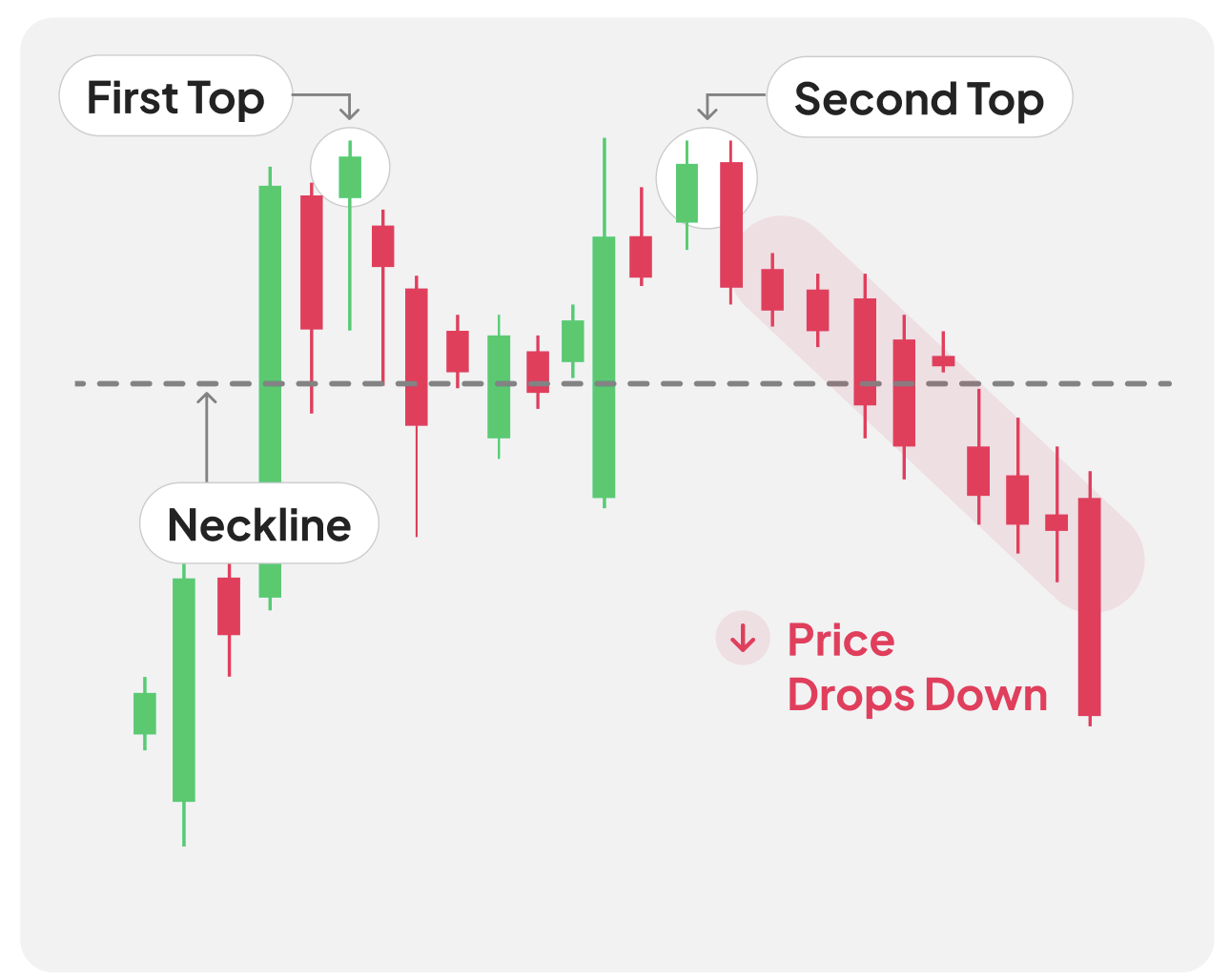
In the course of an upward trend, prices draw a first peak (top) before plummeting. Then, the uptrend resumes, but this new attempt loses steam at the same level as the previous uptrend. Again, prices plunge, forming a second peak (top) similar in height to the first peak.
However, the uptrend is blocked at the resistance level, indicating that the price is now more favorable to sellers than buyers. Prices drop back to a level between the two peaks referred to as the neckline.
Once prices break through the neckline support level, the double top pattern and its bearish signal are validated. The theoretical price target is calculated by adding a distance (representing a price drop), below the neckline, equivalent to the distance between the neckline support level and the resistance level.
The double top pattern and its bearish signal would be invalidated if prices were to cross the resistance level represented by the height of the double top pattern’s two peaks.
If prices bounce off the resistance level a third time, the pattern is called a triple top pattern.
How to Identify a Double Top
| Features | Explanations |
|---|---|
| Prior Uptrend | Before double top patterns take shape, prices trend upward with increasingly higher highs and increasingly lower lows. |
| Two peaks at the same level | The upward trending price fails to cross the resistance level during two consecutive attempts, indicating a struggle to move higher. |
| The neckline | Prices drop back to the neckline between the two peaks, forming a temporary support level (the neckline support level). After the second peak, note that prices break through the neckline support level. This confirms that you have a double top pattern. The neckline is critical to the pattern as it validates the pattern and is used to determine a theoretical price target, by adding a distance (representing a price drop), below the neckline which is equal to the distance between the resistance level and the neckline support level. |
| The time scale | Double top patterns can take place on any time scale. Depending on the trading horizon, the duration between the two peaks can be as much as a few minutes to a few weeks. |
| Volumes | Traders often look for increased trading volume once prices reach the resistance level and then again when prices break through the neckline support level. |
Steps to Identify a Double Top:
1 – Identify a rise in price.
2 – Draw the resistance level after the first peak forms.
3 – Look for a second peak indicating that prices have failed to cross the resistance level.
4 – If that second peak forms and prices fail to cross the resistance level, verify that prices break through the neckline support level, thus validating that you indeed have a double top pattern.
If the price surpasses the resistance level, the double-top pattern is invalidated.
How to Trade a Double Top
In line with chart pattern principles, when prices drop below the neckline support level in a double top pattern, this is a harbinger of a potential price decline. Place a stop-loss order just above the resistance level to limit your losses, and place your take-profit order at a height, below the neckline, equal to the distance between the resistance level and the neckline support level, thereby capturing potential downward movement.
Other more aggressive or more conservative strategies may be available depending on your risk tolerance.
| Trading plan | Conservative | Aggressive |
|---|---|---|
| Position | Sell | Sell |
| Entry Point | After the neckline is broken | At the second failure at resistance |
| Stop loss | Above the resistance | Above the resistance |
| Take profit | At a distance equal to the distance between the resistance and the neckline | At the start of the previous uptrend |
Double Top Example

In this example, the CAC 40 index forms a double top pattern (in black).
Theory suggests taking advantage of it by selling it short at the blue dotted line, placing a stop-loss order at the red dotted line above the resistance level indicated by the continuous red line, and then placing a take-profit order at the end of the “M” at the green dotted line.
What happens after a double top pattern?
Double top patterns are not a sure thing, and their presence alone is insufficient to provide traders with a significant statistical advantage. Therefore, double top patterns should be interpreted more broadly.
Furthermore, the accuracy of double top patterns is often imperfect. In fact, it is common to see a second peak slightly higher or lower than the first due to market noise.
Double top patterns vs. double bottom patterns: What’s the difference?
Double bottom patterns are the exact opposite of double top patterns. In other words, double bottom patterns are bullish reversal patterns that take the shape of a “W” once they reach a support level.
Where the double top pattern sends a seller signal at the end of an uptrend, the double bottom sends a buyer signal at the end of a downtrend.
Double top patterns are rarely perfectly geometric. Therefore, it can take a little time and practice to be able to identify them.
Consider using one of the best trading simulators to teach yourself to trade double top patterns without risk.

Maxime holds two master’s degrees from the SKEMA Business School and FFBC. As founder and editor-in-chief of NewTrading.fr, he writes daily about financial trading.



7 Popular Swing Trading Strategies with Practical Examples


The Most Popular Chart Patterns in 2026