Does Technical Analysis Really Work? Here’s What Research Says


Technical analysis is everywhere—on trading screens, in fund strategies, and across social media charts. But does it actually work?
While millions of traders rely on it daily, many academics still dismiss it as ineffective.
To cut through the noise, we’ve gathered findings from peer-reviewed studies and respected institutional research—laying out what the data says on both sides of the debate. We’ll examine the best arguments for and against technical analysis, followed by a balanced synthesis and some key takeaways.
Let’s dive in.
Arguments for technical analysis
Most day traders lose money not because markets are unbeatable, but because their decisions are reactive, untested, or based on intuition. Technical analysis offers a way to systematize decisions using market-derived data, helping traders move beyond gut feelings and guesswork.
Rather than predict the future, technical analysis helps interpret current price behavior, highlight recurring patterns, and identify potential opportunities or risks. Below are some of the most research-supported reasons professionals incorporate technical tools into their strategies.
#1 – It’s widely used by professional traders

For these professionals, TA is a valuable informational tool that helps justify or correct their existing market hypotheses.
Technical analysis is used particularly heavily at shorter forecasting horizons—up to a few weeks. At this short timeline, fund managers deemed TA even more important than fundamental analysis for decision-making.
#2 – Studies suggest that TA can be profitable

This review concluded that technical rules have consistently generated economic profits in various markets at least through the early 1990s, though it noted potential biases which we’ll discuss in the synthesis below.
#3 – It outperforms in emerging markets
Evidence suggests TA can excel in less efficient or trending markets. For example, a 2018 study of BRICS stock markets used an automated moving-average trading system and found technical strategies beat a buy-and-hold benchmark on average. [3] The study showed notably strong excess returns in Russia and India.
In those BRICS countries, groups of stocks traded with technical analysis rules far surpassed the portfolio’s buy-and-hold returns. The authors also observed that technical signals helped identify dynamic stocks, indicating TA can complement fundamental analysis in emerging markets.
#4 – It shows strong historical performance in FX trading
Technical analysis is highly prevalent in foreign exchange markets, where traders have less company strategy and public policy information to rely on.

#5 – Trends are often slow to change
Certain assets like stocks, currencies, commodities, and bonds tend to keep moving in the same direction for a while—usually between 1 and 12 months—before eventually reversing. Markets often react slowly at first, then swing too far in the opposite direction later.
One study found that using a diversified time-series momentum (trend-following) strategy on 58 futures contracts yielded “substantial abnormal returns.” [5] When you build a mixed portfolio using this trend-following approach across different asset types, you may see strong returns and without many of the traditional market risks.
These strategies also tend to do especially well when markets are very volatile. Looking at who’s trading, we see that speculators usually benefit from this momentum, while hedgers tend to lose out.
#6 – It may work well in bull markets
Research in the hedge fund industry indicates TA can add value where market sentiment is particularly positive. During bull periods, hedge funds that employed technical analysis achieved higher returns, lower risk, and better market-timing than those that did not. [6] (In contrast, their advantage disappeared in low-sentiment markets.)
This suggests technical strategies may thrive when markets are driven by investor sentiment and trending. These also tend to be periods where mispriced assets aren’t quickly arbitraged away.
Arguments against technical analysis
Despite the positive research above, there’s also plenty to the contrary. Critics claim that any success from technical analysis is luck or fleeting. They point to rigorous studies showing no consistent outperformance once biases and real-world factors are accounted for.
Here’s what some of those studies have found.
#1 – Profits vanish in efficient markets
The “efficient market hypothesis” is the most common argument against technical analysis. This theory maintains that public markets already price in all available information. It’s therefore impossible to “beat the market” based on trend analysis.

Substantial returns earned by trend rules in the early 1980s were “no longer available in the subsequent period”.
This aligns with the efficient market hypothesis–once a technical signal becomes known, everybody uses it and it’s no longer profitable. Information is only becoming more available, and analysis easier to perform, so modern markets are getting quicker to react.
#2 – TA is no better than luck

While each market had a few rules that appeared profitable in isolation, those gains evaporated after adjusting for data-snooping bias (where large collections of data with numerous variables are subjected to statistical analysis).
The more market data points you use, the more likely you are to return false positives. And when you can’t discern false positives from real trends, picking correctly is a matter of chance.
#3 – Transaction costs erase gains
While technical analysis strategies often generate attractive returns in simulations, their real-world performance weakens once you factor in transaction costs. This study tested moving average crossovers across BRICS markets, both with and without fees (2% and 5%). The results showed that only a small subset of assets and strategies remained profitable after accounting for costs—most failed to outperform a passive buy-and-hold approach. [9]
In India and Russia, some combinations of moving averages still led to strong net gains. But overall, transaction costs sharply reduced the apparent edge of technical systems. Frequent trading can eat into small advantages, turning paper profits into marginal or even negative real returns.
#4 – Poor predictive power in broad testing
We saw some encouraging studies above that suggested TA can be profitable. But we also have research to the opposite effect.

These widely-used indicators include advance/decline lines, volatility indices, and short-term trading indices. Even when they allowed the effectiveness of indicators to vary by business cycle or sentiment regime, the indicators still failed to show consistent predictive power.
Such exhaustive research suggests that most popular technical signals do not provide an investable forecasting edge.
#5 – Underwhelming results in high-frequency data
When technical rules are tested under the most granular conditions, results are underwhelming.

Only by optimizing parameters after the fact could one find profitable patterns in hindsight. And even then, gains appeared in gold but none in silver. This implies that without cherry-picking scenarios, technical analysis failed to beat the market in a high-frequency setting, again suggesting that it lacks intrinsic predictive power.
Synthesis and balanced takeaways
Technical analysis plays a central role in how many traders operate. It doesn’t guarantee results, but it offers a structured way to read the market through price, volume, and volatility—often more relevant than fundamentals for short-term decisions. This is why technical signals remain a staple of active trading.
Even those who don’t identify as technical traders still rely on price action. Whether it’s recognizing a breakout, reacting to failed support, or staying flat in sideways conditions, most short-term decisions are shaped by principles that trace back to technical analysis.
The research is mixed. Some strategies show potential in specific market conditions. Others lose their edge when applied to new data or tested outside ideal scenarios. Once trading costs are included, performance often drops further. The takeaway isn’t that technical analysis doesn’t work—it’s that it needs context, discipline, and proper validation to be effective.
Traders who use it successfully treat it as one input among several. They use it to time trades, manage risk, and stay consistent. But lasting results come from testing, refinement, and knowing when not to rely on it.
These are the key takeaways from the research—and from how technical analysis is used in practice:
1. Context matters
Technical analysis shows real promise under certain conditions. It may add value in markets that exhibit momentum or are prone to behavioral biases–for example, during bullish, sentiment-driven periods or in relatively less efficient emerging markets. [13]
However, its edge can narrow in markets that are illiquid or very choppy. Indeed, without clear momentum, many traditional TA patterns lose reliability. That said, low-volatility doesn’t always mean directionless—some slow-grinding trends persist under the radar, and seasoned traders often adapt TA tools to spot and ride them.
Rather than a stand-alone strategy, technical analysis tends to work best as a short-term timing tool or a complement to broader context and fundamentals.
2. Beware of data snooping and adaptation
A recurring caution in research is that many positive TA results might be due to excessive data mining or temporary anomalies. The more data you examine, and the more variables you test, the more likely you are to eventually find (false) positives.
Despite numerous studies suggesting some rules can be profitable, most face issues like data-snooping biases. This means investors should be wary of blindly trusting backtested technical patterns – they could be flukes that won’t persist out of sample.
3. The market adapts quickly
For some, the strong results from technical analysis in past decades can be chalked up to information asymmetry and now-defunct systems. Today, most information is widely available, and the markets are quick to adjust.
Once a method becomes widely known or tested across different samples, its edge tends to shrink. That said, practitioners who continuously test and monitor their strategies may be able to spot these shifts early—before performance breaks down. But without that kind of ongoing validation, it’s easy to keep relying on a system long after its edge has faded.
4. Don’t underestimate costs
Another recurring theme in many studies is that once you factor in real-world frictions—like slippage, spreads, data fees, and taxes—the potential profit from TA can shrink significantly. While explicit trading fees have dropped in recent years, strategy performance still needs to account for the full cost of execution. Your models must therefore bake in these factors to provide meaningful value.
So… does technical analysis actually work?
Let’s move past “it depends” and try to offer a clear perspective.
Technical analysis can be useful. Not always, not everywhere, and not on its own—but when used with a structured approach, it can improve how traders interpret price, time trades, and manage risk.
The research shows this clearly. In certain conditions, like trending markets, sentiment-driven periods, or less efficient environments—technical signals often highlight real opportunities. Tools like momentum, support and resistance, and moving average crossovers can offer valuable insight into how other market participants are behaving.
At the same time, most technical strategies fail when they’re used in isolation. The edge often fades once tested out of sample, applied across time, or adjusted for transaction costs. And too often, traders fall into the trap of data mining or treating charts like a prediction engine. That’s where things break down.
In practice, the traders who succeed with technical analysis use it for what it is: a framework for observing price behavior and making more informed decisions. They test their rules, adapt them over time, and combine them with risk management and real-world context.
This isn’t a call to abandon TA—or to blindly trust it. It’s a call to use it deliberately. Study what works, ignore what doesn’t, and treat every signal as a hypothesis to be tested, not a promise to act on.
That’s where technical analysis fits. Not as a shortcut, but as a useful part of a trader’s toolkit when applied with discipline.
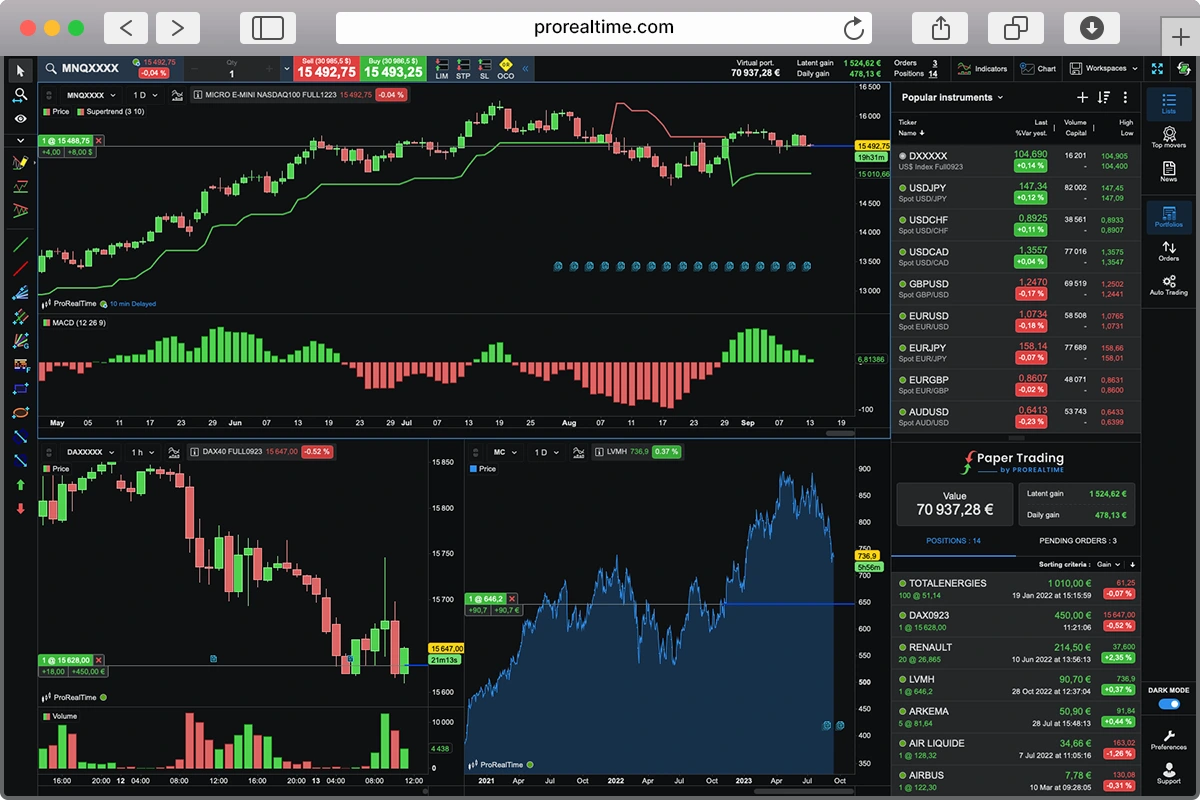
Paper trading lets you test your whole strategy in real market conditions, without risking any money. Fire up a simulator and see what your technical analysis rule produce over a few days or weeks, before committing real cash.
Article sources

Othmane has been swing trading for years and builds on experience in investment banking. He writes regularly about trading and market analysis, and has passed Level I of the CFA Program along with earning a double Master’s degree in Financial Analysis.


7 Popular Swing Trading Strategies with Practical Examples


The Most Popular Chart Patterns in 2026