Best Alternatives to XTB in 2026


You’re researching XTB alternatives. Maybe you hit the €100,000 monthly trading cap and commissions kicked in. Maybe you need features or access to financial instruments, XTB doesn’t offer. Or perhaps you’re just shopping around before committing serious capital.
Whatever brought you here, you’re asking the right question: Is there a better broker for how you actually trade?
XTB is solid at what it does. User-friendly, zero commissions on stocks and ETFs (until that volume threshold). Clean interface. Works great for straightforward buy-and-hold investing and trading stocks. But it’s built for a specific trader profile. If you need API access, platform flexibility, or exposure to global markets, you’ll hit walls fast.
This guide breaks down the best alternatives to XTB for traders. Brokers with different fee structures, broader market access, advanced tools, and features that might actually match your trading style. We’re not here to trash XTB or push you toward expensive platforms you don’t need.
Just honest comparisons. Real trade-offs. And a framework to pick the broker that fits.



How to Choose an Alternative to XTB?
XTB is great when you’re just getting started, but once you trade a bit more seriously, the limits show up fast. If you’re shopping for a better fit, here’s what actually matters.
Market access
XTB covers the basics, but your options shrink quickly once you want more international markets or more than a handful of real stocks and ETFs. A good alternative should let you go wider without making you jump through hoops.
Tools you can grow into
XTB keeps things simple, which is a plus in the beginning. But if you ever want deeper charting, cleaner execution, or the option to plug in third-party platforms, you’ll need a broker that gives you room to upgrade your setup.
Pricing that makes sense long term
The €100,000 commission-free limit is fine for light investors, but it gets old fast once your volume goes up. A solid alternative should offer clear, predictable pricing without thresholds, penalties, or surprises.
Support and transfers
If you’re moving existing positions, look at transfer fees and how long the process takes. And while customer support isn’t something you think about until you need it, having a responsive team can save you real headaches once you’re trading bigger.
1 – ProRealTime & IBKR

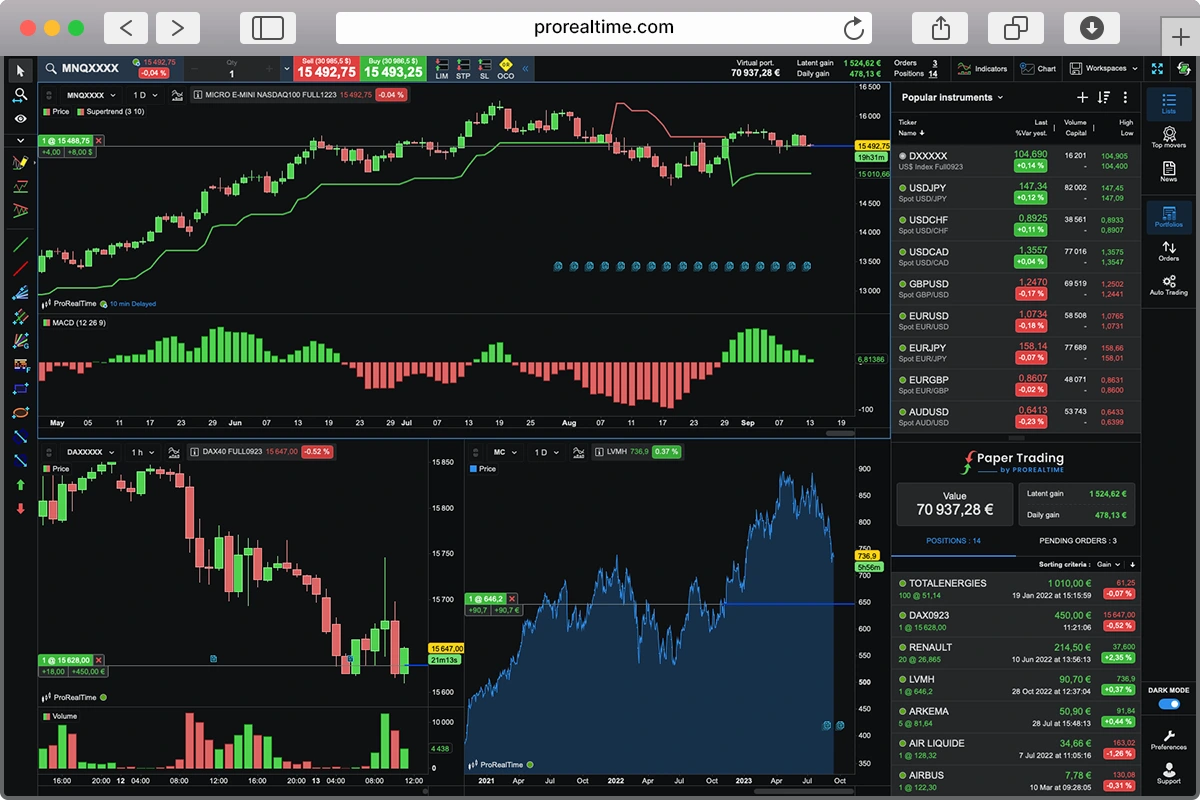
If XTB feels a bit too “starter pack” for where your trading is heading, ProRealTime is the opposite. It’s built for traders who actually care about precision, clean charts, exact order placement, and tools that don’t lock you into a basic interface. You’re not dealing with monthly trading caps or sudden commissions kicking in. You get a setup that scales with you instead of holding you back.
Where XTB keeps things simple, ProRealTime leans into customization. You can trade straight from your charts, automate parts of your workflow, and backtest strategies without duct-taping five tools together. And because execution happens through Interactive Brokers, you unlock global markets and competitive fees without sacrificing charting quality. It’s basically a “plug into IBKR, trade like a pro” experience.
For anyone who’s hit XTB’s limits, whether that’s market access, order types, or technical tools, ProRealTime is the closest thing to upgrading your entire trading desk. It gives you the control, flexibility, and market reach XTB simply does not offer. If you’re serious about active trading, this is the first alternative worth testing.
ProRealTime web version gives you a 100 percent free simulator with real market data, so you can test your routines without touching your capital.
And if you want to see what the full platform can do, the advanced desktop version comes with a two-week free trial. That window is more than enough to check whether the charting workflow, order placement, and overall feel match what you’re looking for in an XTB alternative. It’s a simple way to get a real taste of a pro-level setup before making any commitment.
2 – Interactive Brokers

Interactive Brokers stands out for something XTB cannot match: massive market access. You can trade on more than 150 global exchanges and buy real assets on real markets, including stocks, ETFs, options, futures, and bonds. There is no counterparty risk and no CFD workaround. You own what you buy, and you benefit from competitive fees and professional-grade execution.
IBKR is also flexible. If you do not want to use its native platform, you can connect it to ProRealTime or other trading tools and build the workflow that suits you. Updates like the GlobalTrader app and reduced commissions on some products have made IBKR easier for newer traders to use.
The trade-off is higher complexity. But if you are outgrowing XTB’s limited market access or you want real asset ownership with deeper tools and transparent pricing, IBKR is one of the strongest alternatives available.
One other practical advantage is how flexible your setup becomes. IBKR handles execution and market access, and you can choose the platform you prefer on top of it. You can use ProRealTime, TradingView, or TWS, and switch between them whenever your workflow changes. You’re not locked into a single interface the way you are with XTB.
IBKR also adapts to different experience levels. You can start with the simple GlobalTrader app for basic investing, then move to ProRealTime or TWS when you need more control. You upgrade your tools without having to switch brokers.
This modular structure lets you build a trading environment that fits you. IBKR provides the market access and execution reliability, and you plug in the charting and trading tools that match how you work.
3 – Saxo
Saxo Bank is a fully regulated Danish investment bank known for its professional-grade platforms, SaxoTraderGO and SaxoTraderPRO. It’s designed for active traders who want strong market access, detailed research, and tools that feel a step above the usual retail platforms.
You get access to more than 23,500 instruments across 50 global exchanges, covering stocks, ETFs, forex, commodities, options, and futures. If you’re outgrowing the limited product range of platforms like XTB, Saxo provides the kind of depth that supports more advanced strategies.
The platform lineup is one of Saxo’s biggest selling points. SaxoTraderGO is smooth, modern, and works well across devices, while SaxoTraderPRO supports multi-screen setups and advanced order tools for serious traders. Research, news, and risk management features are built directly into the workspace, so you’re not juggling third-party apps to manage your day.
Saxo’s account tiers make a big difference in how much you pay. Classic accounts come with higher commissions and a custody fee for holding stocks and ETFs. As your balance grows, Platinum and VIP tiers unlock lower trading costs, better interest on uninvested cash, and priority support. This setup clearly benefits larger portfolios, which is why active or well-capitalized traders tend to get more out of Saxo than smaller accounts.
Saxo also gives you more flexibility in how you build your trading setup. You can use advanced order types, subscribe to real-time market data, and add third-party tools when you need more charting or analytics. SaxoTraderGO and PRO are already powerful platforms, but being able to extend your workspace makes the experience feel more professional and broader than what XTB offers.
4 – Degiro
If you are comparing alternatives to XTB and your focus is long-term investing rather than active trading, DEGIRO is one of the easiest upgrades. It offers low-cost access to a wide range of global stocks, ETFs, bonds, and funds, without the trading caps or commission surprises that XTB introduces past certain volumes. Everything is built for investors who want simple execution and broad market coverage without paying premium fees.
Where DEGIRO stands out is in cost efficiency. Trading commissions are low, there is no custody fee for most assets, and the platform makes it straightforward to build diversified portfolios. The interface is cleaner than many traditional brokers, and because the product range is larger than XTB’s stock-and-CFD mix, you get more flexibility without needing advanced tools.
DEGIRO is not designed for active traders or people who rely heavily on charting and technical analysis, but that is also why it works so well for investors. You get transparency, low fees, and access to the markets most long-term portfolios depend on. If XTB’s CFD-first setup feels too trading-oriented for your goals, DEGIRO is a simple and reliable alternative.
DEGIRO shines when you want a low-friction way to build a diversified portfolio. You get broad market access without needing advanced tools, and the cost structure stays friendly as long as your strategy is simple. It is an easy platform to maintain and fits investors who want to focus on their holdings rather than their broker.
FAQ
1. Which broker gives the same stock and ETF access as XTB with fewer restrictions?
Interactive Brokers and DEGIRO are the most common upgrades. IBKR gives you broad access to US, EU and global exchanges without XTB’s €100,000 commission-free limit. DEGIRO is one of the cheapest options for stocks and ETFs and has no monthly threshold at all.
2. Can I transfer my assets from XTB to another broker?
Yes. Stocks and ETFs can be transferred, but XTB charges €25 per ISIN. For Spanish-listed stocks the fee is 0.10% of the position value per ISIN, with a minimum of €100. These costs are taken from your trading account. CFDs cannot be transferred anywhere and must be closed. Brokers like IBKR and DEGIRO accept incoming transfers, but the per-ISIN cost can add up fast if you hold many positions.
3. How limiting is XTB’s €100,000 monthly commission-free cap?
The cap becomes restrictive if you buy regularly or manage a larger portfolio. Anything above €100k per month becomes a paid trade. IBKR has no volume cap and often lowers costs as activity increases. DEGIRO uses simple low commissions regardless of size. If you hit the threshold even occasionally, alternatives scale more smoothly.
4. What are the trade-offs when switching to a broker with broader global market access?
You gain access to more exchanges and more products, but the platforms are more detailed. Expect things like FX conversions when trading in different currencies, optional real-time market data, and more advanced order types. It takes a bit more learning, but you get genuine multi-market access that XTB does not offer.
5. Which alternative is best for long-term investing?
DEGIRO is the simplest and cheapest for long-term portfolios thanks to low fees and wide ETF access. IBKR is the next step if you want global diversification, multi-currency accounts, or more control over how you place trades. Most long-term investors leaving XTB choose one of these two.

Maxime holds two master’s degrees from the SKEMA Business School and FFBC. As founder and editor-in-chief of NewTrading.fr, he writes daily about financial trading.