Best Alternatives to Webull in 2026


Exploring your options beyond Webull? You’re not alone. Maybe you’ve outgrown what the platform offers, or you’re looking for features it simply wasn’t designed to provide—like forex trading, mutual funds, or access to international exchanges.
Webull does a lot of things well: commission-free trades, solid charting tools, and paper trading to test strategies risk-free. It’s a great starting point for many traders. But as your needs evolve, you might find yourself wanting more—better customer support when issues arise, faster fund access, more diverse asset classes, or advanced tools that professional traders rely on.
The good news? There are plenty of strong alternatives built for different trading styles and goals. Whether you need global market exposure, streamlined options workflows, institutional-grade research, or automated trading capabilities, we’ve matched the best platforms to what you’re actually looking for.
What are the Alternatives to Webull?


#1 – Interactive Brokers (IBKR)
Interactive Brokers (IBKR) is the “all markets, one login” broker built for serious traders who still want a clean, modern experience. You get access to stocks, options, futures, forex, bonds, and funds across global exchanges, all tied together by powerful tools: the pro-grade Trader Workstation (TWS), a simple and sleek Client Portal, and a solid mobile app.

Execution is a core strength, and the toolkit runs deep with screeners, options analytics, risk and margin calculators, paper trading, and portfolio performance tracking. If you like to tinker, there are APIs for automation and direct data/export workflows. Also, if you just want to trade, presets and watchlists make it fast. Indeed, IBKR is a genuine upgrade path from Webull when you want more markets, more order control, and more ways to transition from “active” to “professional”.
| Pros | Cons |
|---|---|
| Trade almost everything, almost everywhere | Steep learning curve |
| Pro-grade platforms & execution | Live data often costs extra |
| Lower margin rates versus peers | Pricing can be intricate with tiered commissions plus exchange and regulatory fees, which can be confusing |
| Builder-friendly with APIs, paper trading, and fractional shares for precise position sizing | Plan availability varies by geography |
| No account minimums and strong risk controls |
Why Choose IBKR Over Webull?
Traders pick IBKR over Webull when they want to level up from a US-centric slick stock app to a true multi-asset, global trading desk. IBKR lets you trade stocks, options, futures, forex, bonds, and funds across dozens of markets in one account, with deeper order types, smart routing, and professional risk tools.
You also get richer research, robust screeners, paper trading, APIs for automation, multi-currency cash management, and portfolio analytics that scale as you grow. While Webull is great for getting started, IBKR is what you choose when you need broader products, better execution control, and a platform you won’t outgrow.
#2 – ProRealTime
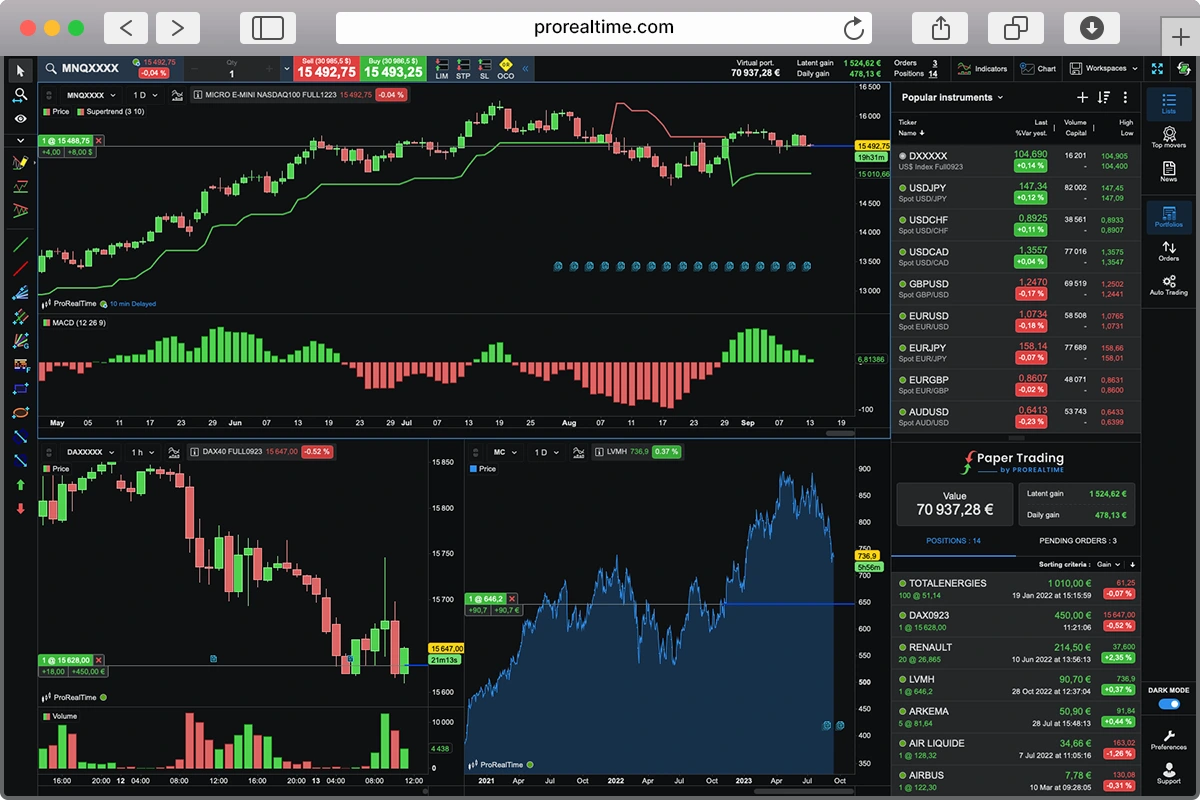
Think of ProRealTime as the turbocharged garage for your trading ideas. The charts are buttery-smooth, ProScreener hunts down setups in seconds, and you can build strategies the easy way with point-and-click UX or the geeky way via coding with ProBuilder & ProBacktest.

Flip the switch, and ProOrder runs your rules on their servers, no laptop babysitting, 24/7. You also get deep intraday history, tick-by-tick replays, and rock-solid alerts. Hook up ProRealTime to brokers like IBKR or IG and trade straight from the platform. If Webull is great for clicking and trading manually, ProRealTime is where you design, test, and automate a repeatable edge.
| Pros | Cons |
|---|---|
| Elite charting with ProScreener market scans and rich technical analysis tools | Not a broker itself. Execution depends on partner brokers, so availability, fees, and products vary by region |
| ProBacktest for strategy simulation and reports | Real-time data often costs extra and premium desktop tiers are paid |
| True server-side auto trading via ProOrder, systems run even when your computer is off | Advanced automation can require coding in ProBuilder. There’s a learning curve for complex systems |
| Deep historical data with tick-by-tick view and market replay for practice | Fewer native “social” features than community-centric charting sites |
| Multiple access modes: Web, Desktop, plus mobile |
Why Choose ProRealTime Over Webull?
ProRealTime beats Webull when you want to design, test, and automate your edge, not just click around charts. ProRealTime’s platform bakes in ProBackTest so you can vet ideas properly, and flips those rules into live trades with ProOrder, that is, true server-side auto-trading that keeps running even when you are sleeping.
By contrast, Webull is best for manual trading and paper trading practice. If you want backtesting or automation, you’re typically reaching for external tools and APIs rather than something built in. What can also be said is that ProRealTime links to major brokers for broad market access and direct from the chart execution, so you get professional-grade workflows without leaving the platform.
#3 – Saxo Bank
Saxo Bank’s platform is a polished, multi-asset workspace with SaxoTraderGO for the web/mobile and SaxoTrader PRO for the desktop. These platforms cover stocks, ETFs, options, futures, forex, bonds and more across global markets with modern charts, deep order types, and robust risk tools like margin breakdowns, alerts, and “cancel-all” controls.

You can trade from any device, sync layouts, and use option chains with Greeks and vols, while tiered pricing lets costs improve as your activity grows, making Saxo a strong Webull alternative when you have one login for global access plus pro-grade controls without losing ease of use.
| Pros | Cons |
|---|---|
| True multi-asset & global access in one platform suite | Exchange/Level 2 data often requires paid subscriptions |
| Robust risk controls in GO, such as margin breakdown, margin alerts, stop, stop-limit and cancel-all orders | Custody fees may apply to stocks, ETFs and bonds unless you opt into securities lending |
| Advanced desktop tools in PRO like multi-screen support, algo orders, and fast trade tickets | Tiered pricing can be complex and varies by country. You must check the pre-trade ticket for exact costs |
| Lower fees & no inactivity fee after 2024 pricing revamp. Clear rate cards across asset classes | High funding to unlock VIP perks |
| No minimum funding to open an account. You can also upgrade tiers as activity or balance grows | Manual orders, such as phone, chat or email, incur a fee in some cases |
Why Saxo Bank Over Webull?
Choose Saxo Bank if you want “one, login, all markets” with pro controls that Webull just doesn’t offer. The Saxo Trader GO & PRO suite gives you global access to stocks, ETFs, options, futures, forex, and bonds, deeper order types and options analytics, robust margin and risk dashboards, a multi-screen desktop for active trading, and built-in research and screeners, all wrapped in tiered pricing that can improve as your activity grows.
If Webull feels like a fast trading app, Saxo feels like a full trading desk you can grow into, with broader products, more venues, and far finer control over risk and execution.
#4 – TradingView
Meet TradingView, your one-tab trading HQ. You get lightning-fast web charts, multi-panel layouts, and a library of built-in and community indicators, plus smart screeners for stocks, crypto, and FX.

Want to tinker? Write strategies in Pine Script, backtest right on the chart, and flip on server-side alerts so setups ping you, not the other way around.
The platform is also a social hub. You can follow creators, share ideas, and borrow chart layouts that actually work. Hook up supported brokers to trade from the chart, keep watchlists synced across web, desktop or mobile, practice with paper trading, and use webhooks for light automation. In short, it’s a clean, beginner-friendly workspace you can grow into without hitting a ceiling.
| Pros | Cons |
|---|---|
| Gorgeous, fast web charts with multi-layouts, drawing tools, screeners, and server-side alerts that fire even when you’re offline | Real-time exchange data usually requires separate paid data subscriptions on top of your plan |
| Pine Script lets you build custom indicators & strategies and run backtests right on the platform | Free and entry plans have limits and show ads |
| Paper trading sum for risk-free practice, wired into the same charts and tools | Trading is routed through supported brokers. Exact order types, products, and availability vary by broker and region |
| Connect dozens of brokers and place trades from the chart for stocks, futures, forex, and more | Deep customization and Pine Script can have a learning curve if you’re new to coding. |
| Massive social community to learn from and share setups | |
| Works everywhere on the web, desktop and mobile with synced layouts and watchlists |
Why Choose TradingView Over Webull?
Traders choose TradingView over Webull when they want world-class charts, endless customization, and a platform that grows with them. TradingView’s web charts are faster and more flexible. You can build or import custom indicators in Pine Script, backtest right on the chart, and set server-side alerts so you never miss a setup.
Plus, its huge community makes learning and idea discovery easy. Because TradingView connects to multiple brokers, you can keep the same watchlists, layouts, and strategies even if you change where you execute. It becomes your home base for analysis, education, and strategy development while Webull stays a solid execution app for simple US trading.
Final Thoughts
Webull is a solid launchpad, but if you want fewer headaches and more runway, build a toolkit that fits how you trade. Choose:
- IBKR for “all markets, one login” and pro-level execution
- Saxo Bank for polished multi-asset trading with strong risk controls
- ProRealTime, when you’re ready to design, backtest and automate strategies
- TradingView for world-class charts, Pine Script, and a huge community.
Match the tool to the job, double-check pricing and data by region, and practice on paper before you size up, so your platform upgrade actually shows up in your results.

Cedric is a seasoned investment management strategist with over a decade of experience, currently working at TTUTC. He holds dual prestigious designations as a Chartered Market Technician (CMT) and Chartered Financial Analyst (CFA).