Top 5 Best alternatives to Trade Republic in 2026


Looking for a Trade Republic alternative? You’re not the only one.
Most people start with Trade Republic. Set up a savings plan, automate monthly ETF buys, and forget about it. Simple. Cheap. Clean.
But then you start checking charts more often. Maybe sell an ETF. Maybe buy a few stocks. Suddenly, you’re not just investing — you’re actively trading and managing a portfolio.
And that’s when Trade Republic starts to feel limiting.
The Web Terminal, live since July 2026, softens the desktop gap, but order transparency stays limited and proper CSV reports are still missing. And when something breaks? Good luck reaching support.
This guide helps you pick a platform that matches how you invest and trade today.
How We Choose The Best Alternatives to Trade Republic?
We focused on three core criteria:
- Order execution
When markets spike, delays cost money. You want a broker or a trading platform that holds up under pressure, with strong infrastructure, direct exchange access, and fast, reliable execution. No unexplained lags. No wondering where your order went. Just tools that work when it matters. - Transparency
You shouldn’t need to dig just to figure out what you’re paying. And if you do, everything should be there: clear pricing, clean reports, and strong regulatory oversight. We also looked for brokers with a longstanding reputation, because trust builds over time. - Trading Features
Some platforms feel great early on but hit a wall as your strategy evolves. Whether you’re managing two ETFs or 20 positions, the right alternative should stay intuitive and give you access smarter tools as you grow.
Comparison summary




*XTB: 75% of accounts lose money when trading CFDs with this provider.
Trading platforms vs brokers
Most people think of their trading app as a single tool — but it’s really two things bundled together: a platform to analyze the markets and a broker to actually place your trades.
Trading platforms like ProRealTime and TradingView focus purely on the experience: powerful charts, faster data, custom indicators, and smarter analysis tools. They don’t hold your money or execute your trades directly. Instead, they let you plug into the broker of your choice, so you’re never locked into one provider.
Brokers like Interactive Brokers, XTB, and DEGIRO, on the other hand, handle your actual trades. They manage your assets, settle your orders, and set the fees you pay. Some come with built-in platforms, but those tools often feel limited compared to what ProRealTime or TradingView can do.
That’s why more hands-on investors use a top-tier platform on the front end and choose the broker that fits their strategy behind the scenes.
| Platform | Chart Analysis & Tools | Technical Features | User Experience | Customer Support | Final Rating |
|---|---|---|---|---|---|
| ProRealTime | 95% | 95% | 85% | 90% | 91.25% |
| Interactive Brokers | 90% | 95% | 85% | 80% | 87.50% |
| TradingView | 95% | 85% | 90% | 80% | 87.50% |
| XTB | 85% | 88% | 90% | 78% | 85.25% |
| DEGIRO | 70% | 72% | 82% | 75% | 74.75% |
1 – ProRealTime

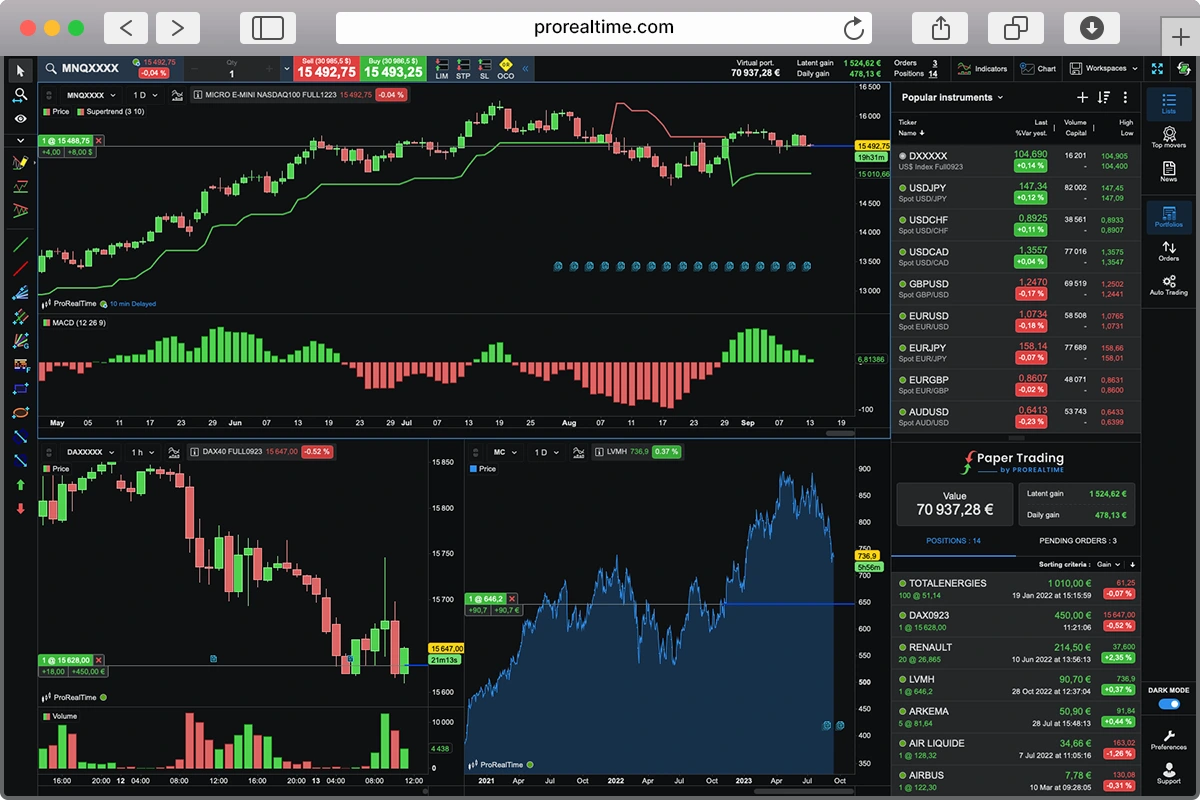
ProRealTime is a serious upgrade for anyone who’s outgrown Trade Republic. It gives you a clean, professional-grade interface where you can trade directly from charts, manage your positions more precisely, and place a wide variety of orders like trailing stops, OCOs or Limits.
You can also draw key levels like support and resistance directly on your charts — and actually use them in your trading. Built in France and trusted by over 1 million users for more than 22 years, ProRealTime connects to top brokers like Interactive Brokers, Saxo Bank, and IG Markets, giving you flexibility without lock-in.
2 – Interactive Brokers

Interactive Brokers (IBKR) is the gold standard for global markets. With access to over 150 markets worldwide, IBKR offers advanced trading tools, a deep product lineup (stocks, ETFs, options, futures), and competitive pricing. While it’s long been a favorite among professionals, recent updates—like the lighter GlobalTrader app and commission-free pricing for certain products—make it a solid pick for newer investors too.
What sets IBKR apart is its flexibility. You’re not tied to their native platform. You can connect IBKR to trusted trading solutions like ProRealTime and TradingView, combining IBKR’s unmatched market access with the charting and analysis tools you prefer.
Interactive Brokers was founded 47 years ago by Thomas Peterffy, who remains its chairman today. It conducts business in over 150 markets worldwide, executing nearly 2.5 million trades per day and has $14.7 billion in equity capital.
IBKR is headquartered in Greenwich, Connecticut and has offices in the USA, Canada, the United Kingdom, Ireland, Switzerland, Hungary, India, China, Japan, Singapore, and Australia. IBKR is regulated by the SEC, FINRA, NYSE, FCA and other regulatory agencies around the world.
3 – TradingView
TradingView combines clean charting, smart tools, and an active global community in one of the most widely used platforms out there. You can trade directly from charts by connecting to supported brokers, customize your workspace, and explore strategies shared by other users — all from your browser, desktop app, or phone.
The platform now serves over 100 million users and offers both free and paid plans. Pricing starts around $167.88 per year and can go up to $2,399.40, depending on how much speed, alerts, and power you need. The free plan gives you a solid starting point, but many basic features — like multiple chart layouts or more than a few indicators per chart — sit behind a paywall. That said, for anyone serious about technical analysis, it’s hard to beat.
4 – XTB
XTB hits a sweet spot for active investors who want more control. You get commission-free trading on real stocks and ETFs (up to €100K per month), interest on uninvested cash, and a surprisingly advanced web platform that’s both fast and intuitive.
Founded in 2004, XTB now serves over 2 million users across 12+ countries. The platform — xStation 5 — is entirely browser-based, with real-time charts, market heatmaps, financial screeners, and full transparency on spreads and overnight fees. It’s clean, customizable, and works just as well for long-term investors as it does for those who want to take short-term positions in ETFs, commodities, or currencies.
XTB doesn’t offer fractional shares, and it’s not the go-to for complex order types or automation. But if you want a reliable broker that covers the essentials — and adds a few power tools — it’s a compelling step up from Trade Republic.
5 – Degiro
DEGIRO is a low-cost broker based in the Netherlands, owned by the German-listed flatexDEGIRO Bank AG. It’s built for long-term investors who want wide market access and low fees, without paying for tools they won’t use. You can trade real stocks, ETFs, bonds, and options across 50+ exchanges, with no minimum deposit and simple, flat-rate pricing.
Launched in 2013, DEGIRO now serves over 3 million users across 18 European countries. It doesn’t support forex or CFDs, and the platform is more focused on investing than trading. But if you want a no-frills experience with strong regulation and clear costs — including a list of commission-free ETFs — DEGIRO is a solid option.
Final Thoughts
Trade Republic is a great starting point. But once you move beyond basic savings plans, you’ll likely need something more powerful — or just more transparent.
That’s where these alternatives come in.
- ProRealTime is built for investors who care about more precision and chart control.
- Interactive Brokers offers unmatched market access, and integrates with the most popular trading platforms on top of proposing it’s own tools.
- TradingView blends intuitive design with strong community insights, great for those who like to explore and experiment.
- XTB delivers a surprisingly strong experience for ETF investors who want more than just passive tracking.
- DEGIRO strips things down to the essentials: global access, ultra-low fees, and no fluff.
There’s no one-size-fits-all. But if Trade Republic is starting to feel like training wheels, there’s a good chance one of these platforms can take you to the next level.

Othmane has been swing trading for years and builds on experience in investment banking. He writes regularly about trading and market analysis, and has passed Level I of the CFA Program along with earning a double Master’s degree in Financial Analysis.