
The Art of Short Selling: Profiting from Falling Prices

In the stock market, it is indeed possible to sell what you do not own! With short selling, traders can sell before buying in order to make money if prices fall.
Whether you’re betting on a slight downturn in share prices or the next stock market crash, short selling is another arrow in the quiver. It enables you to take advantage of all aspects of the market, bullish or bearish.
However, while short selling opens up new opportunities for traders, it also carries specific risks. So, before speculating on falling prices, it’s best to understand all the subtleties of this relatively complex mechanism.
Short selling allows you to make money when prices fall. Traders start by selling a stock in the hope of being able to buy it back at a lower price later.
If prices rise, the short seller loses money. Because the upside has no theoretical limit, the theoretical risk of a short sale is also unlimited. Therefore, you must adhere to strict risk management rules.
Indicators such as short interest, days to cover ratio, and put/call ratios can be used to assess short selling pressure on a given asset.
What is Short Selling?
Short selling involves betting that the price of a security will fall in order to make money.
Unlike typical buy-and-sell transactions, short selling involves selling the security before purchasing it. To achieve this, the mechanism involves four steps: borrow the security, sell it, buy it back, and then return it together with any associated fees and interest.
If the price falls between the time you sell and the time you repurchase, you make money. But if the price goes up, you lose money. Trading performance is, therefore, inversely proportional to the performance of the security you’re shorting.
Please note that regular short selling should not be confused with naked short selling. Naked short selling is a controversial trading practice that is illegal in many countries. It involves shorting shares without borrowing or even owning the shares required for the sale at the time of the transaction.
The verb “short” is sometimes used by traders to designate the action of selling short. A “short” position bets on the downside, while a “long” position bets on the upside.
Example of a Short Sale
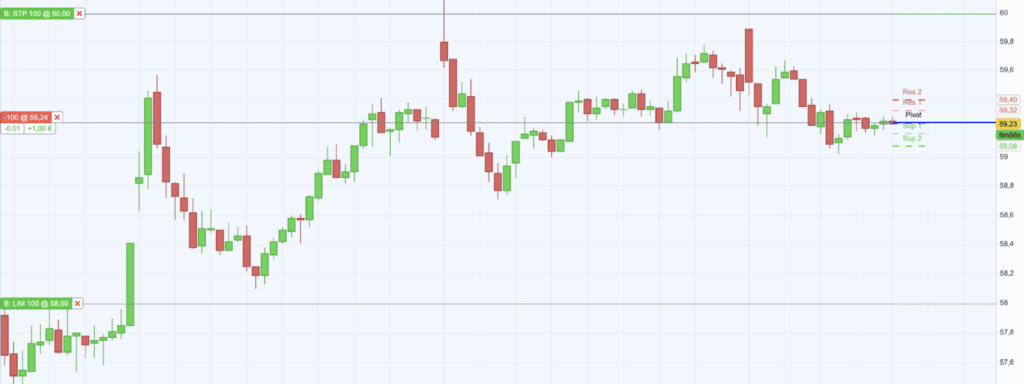
In this example, an investor anticipates that BNP Paribas’ share price will fall and decides to short 100 BNP Paribas shares at $59.24.
If BNP Paribas’ share price falls, the investor makes money. But if the share price rises, they lose money.
Because the investor has sold 100 shares short, every time the share price falls by $1, they earn $100. Conversely, every time the share price rises by $1, they lose $100.
In this example, the investor has placed a stop loss order at $60 to automatically cut their losses if their bearish scenario is invalidated.
So, if prices rise to $60, the investor will automatically buy back their 100 shares and will have lost 100 x ($59.24 – $60), i.e., -$76.
However, the investor has also placed a take profit order at $58 to automatically capture their profits if their bearish scenario is validated.
So, if prices fall to $58, the investor will automatically buy back their 100 shares and will have earned 100 x ($59.24 – $58), i.e., +$124.
| Scenario | Redemption price | Gain or loss |
|---|---|---|
| Stop loss triggered | + $60.00 | + $-76.00 |
| Take profit triggered | + $58.00 | + $124.00 |
How to Sell a Security Short
Traditional short selling involves borrowing shares from a broker and selling them on the market with the intention of buying them back later at a lower price. This method includes the following steps:
- The trader borrows shares from a broker.
- The borrowed shares are sold at the current market price.
- The trader buys back the shares at a lower price if the market moves as anticipated.
- The shares are returned to the broker, along with any applicable fees and interest.
To short a security, first you need to have a securities or derivatives trading account and you need to check your financial intermediary’s short sale list.
The best trading platforms’ websites allow you to short a security in just a few clicks. All a trader has to do is click on sell before clicking on buy. To simplify the trading experience, the entire underlying borrowing and repayment mechanism remains “hidden.”
Short selling is permitted on ordinary securities and derivative trading accounts but not retirement accounts.
The Different Short Selling Mechanisms
Financial derivatives are complex instruments that derive their value from underlying assets. They enable traders to speculate on price movements without directly owning the assets. The most commonly used derivatives for short selling include:
Futures: Contracts to buy or sell an asset at a predetermined price at a specific date in the future. Futures allow traders to speculate on the price direction of various assets such as commodities, indices, and currencies. Short selling through futures involves selling a futures contract anticipating a decline in the asset’s price.
Contracts for Difference (CFDs): CFDs are agreements between a buyer and a seller to exchange the difference in the value of an asset between the opening and closing of the contract. CFDs allow traders to speculate on price movements without owning the underlying asset. They provide leverage, which amplifies both potential gains and losses.
Options: Financial instruments that give the holder the right, but not the obligation, to buy or sell an asset at a specific price within a set time period. Put options are commonly used for short selling as they increase in value when the price of the underlying asset falls. Options can be more complex due to their pricing models and time-sensitive nature.
The inner workings of derivatives are somewhat complex. Nonetheless, with derivatives, you can bet that the price of a security will fall using leverage or cash.
Each country has its own regulations governing short selling and derivatives. CFDs, for example, are banned in the United States.
When to Sell Short
You can use short selling to exploit several types of downturns of varying degrees of severity.
| Market phase | Basic trend | Scope |
|---|---|---|
| Pullback | Bullish | 0 to 10% |
| Correction | Bullish | 10 to 20% |
| Bear Market | Bearish | 20 à`to 50% |
| Stock Market Crash | Bearish | More than 50% reduction |
Some bear market phases, such as pullbacks and corrections, are merely part of the market cycle’s uptrend and are relatively innocuous. In contrast others, such as bear markets and stock market crashes, are characteristic of an underlying downtrend.
Investors often use three main methods of analysis to determine which financial assets to short and when:
- Fundamental analysis is used to detect overvalued assets whose market value is significantly higher than their real value.
- Technical analysis is used to identify the best selling points and bearish trading signals emitted by technical trend indicators and technical oscillators capable of detecting bullish excess.
- Behavioral analysis is used to study investor behavior and spot excessive optimism and nascent speculative bubbles likely to burst sooner or later.
When considering short selling, it’s helpful to use specific indicators that measure selling pressure and market sentiment.
Here are three of the most popular indicators:
| Indicator | What It Measures | What It Tells You |
|---|---|---|
| Short Interest | Number of shares sold short but not yet repurchased. | High numbers suggest many expect the price to drop, but also potential for a short squeeze if prices rise. |
| Short Ratio | Short Interest divided by average daily trading volume. | High ratio indicates significant selling pressure and potential difficulty for short sellers to cover. |
| Put/Call Ratio | Volume of put options compared to call options. | High ratio shows bearish sentiment but can also signal an upcoming bullish reversal. |
This information is available on financial websites and certain specialized sites. For example, here are the short-sale indicators for Apple shares (NASDAQ).
Famous Examples of Short Selling
When speculative bubbles burst, or lawsuits are filed, the sharp declines that ensue allow short sellers to profit.
| George Soros and the Bank of England | In 1992, George Soros massively shorted the British pound. When the Bank of England was forced to remove the pound from the European exchange rate mechanism, its value plummeted. Georges Soros bought back the pounds at a much lower price than he had sold them and made a profit of around $1 billion. Known as “Black Wednesday,” this sterling crash earned George Soros the nickname “the man who blew up the Bank of England.” |
| Michael Burry and the subprime crisis | Michael Burry, founder of Scion Capital, became famous for anticipating the collapse of the US real estate market. In 2005, they began shorting subprime mortgage-backed securities. When the real estate bubble burst in 2007-2008, Michaël Burry pulled off one of the greatest coups in the history of the financial markets. This extraordinary story is told in the book and film “The Big Short.” |
| David Einhorn and Lehman Brothers | David Einhorn, President of Greenlight Capital, shorted Lehman Brothers shares before the 2008 financial crisis. He then publicly expressed his concerns about Lehman Brothers’ solvency. Shortly afterward, Lehman Brothers went bankrupt, vindicating Einhorn’s short selling strategy. |
| Jim Chanos and Enron | Jim Chanos, founder of Kynikos Associates, is known for having shorted Enron shares before the company went bankrupt in 2001. Chanos had identified accounting problems and questionable business practices at Enron. When these irregularities were revealed, the value of Enron shares plummeted dramatically, and Chanos made a substantial profit. |
| Andrew Left and Valeant Pharmaceuticals | In 2015, Andrew Left accused Valeant Pharmaceuticals of accounting fraud and poor business practices. Following publication of their report, Valeant’s shares fell significantly. Short sellers who followed Citron Research’s recommendation and analysis made significant gains. |
How Much does Short Selling cost?
Short selling is not free. To short a security, a trader must pay the usual trading fees, as well as interest for the period during which the security is borrowed.
Interactive Brokers provides free access to a short selling cost simulator for every stock.
The advantages of short selling
Short selling opens up a larger sphere of activity for traders. Rather than being limited to betting on rising markets through buy-and-sell transactions, traders can also bet on falling prices.
In addition to trading in bear markets, short selling can be used to exploit specific market situations, such as stock market corrections and crashes.
And since downward movements occur quicker than upward movements, short sellers can earn money faster. As the saying goes, stocks take the stairs up and the elevator down!
What’s more, short selling can also be used to implement more complex investment strategies, such as arbitrage and hedging.
The disadvantages of short selling
Unlike buy-sell transactions, where the risk of capital loss is limited (since the price of a financial asset cannot fall below zero), the theoretical risk of loss from a short sale is unlimited (since prices can theoretically soar to infinity and beyond).
In the event of a price surge, short sellers may get a margin call and suffer heavy losses. In the worst-case scenario, especially in the event of a price gap, short sellers may fall into debt.
Finally, short sellers may also experience a short squeeze, a market phenomenon in which they are caught off-guard when prices rise. They are forced to sell their positions to cut losses, creating a positive feedback loop and fueling the price surge even further.
Is short selling legal?
Yes, short selling is perfectly legal.
Naked short selling, on the other hand, involves selling an item without first owning or borrowing it. It is illegal in most countries.
But beware: Under certain market conditions, short selling may be suspended, especially in the event of a financial crisis, or to protect a vulnerable company.
Here are a few examples of temporary bans on short selling:
- During the 2008 financial crisis, the U.S. Securities and Exchange Commission (SEC) temporarily banned shorting certain stocks to prevent widespread panic.
- In 2020, during the COVID-19 pandemic, countries such as the UK, France, Germany, and Italy introduced temporary bans on short selling certain stocks.
By reversing the chronological order of buying and selling, traders can exploit downward market movements by selling certain securities short. Nevertheless, since short selling is not very intuitive, it’s wise to start out by practicing shorting the market on one of the best trading simulators.
FAQ
Is short selling good for the economy?
According to their critics, short sellers are the cause of stock market crashes and corporate bankruptcies. Short selling actually acts more as an indicator than a trigger, although there definitely are some instances of abuse and market manipulation, but those are strongly sanctioned by market authorities.
Which stocks can I short?
Brokers usually provide the list of stocks that can be shorted and the associated borrowing costs. Here’s the full list of stocks available for short selling from Interactive Brokers.

Maxime holds two master’s degrees from the SKEMA Business School and FFBC. As founder and editor-in-chief of NewTrading.fr, he writes daily about financial trading.



7 Popular Swing Trading Strategies with Practical Examples


The Most Popular Chart Patterns in 2026