
Nike at a 12-year low: what does it do to the Dow Jones?

Down 3.12%. That was Nike on 25 August, on a day when the Dow Jones, which counts the stock among its thirty components, gained 0.30%. On 17 August the shares had closed at their lowest level since 2014.
Nike closed at $39.09 on 17 August, a level last seen in August 2014. The stock is down 38.6% since the start of the year.
Nike is the thirtieth and last stock in the Dow Jones. S&P Dow Jones Indices removed Verizon from the index last June over a weight it called “immaterial”, even though the index methodology contains no removal rule at all.
Three dates shape the week for markets: PCE inflation on Wednesday at 2:30 pm CEST, Nvidia earnings that same evening, and Kevin Warsh speaking at Jackson Hole on Friday.
Nike trades at a twelve-year low
Nike shares fell back to their twelve-year low on 25 August. The stock gapped down at the open, at $39.51 against a previous-day low of $40.68, then slid to $39.03 during the session. It finished at $39.48, down 3.12%. [1]
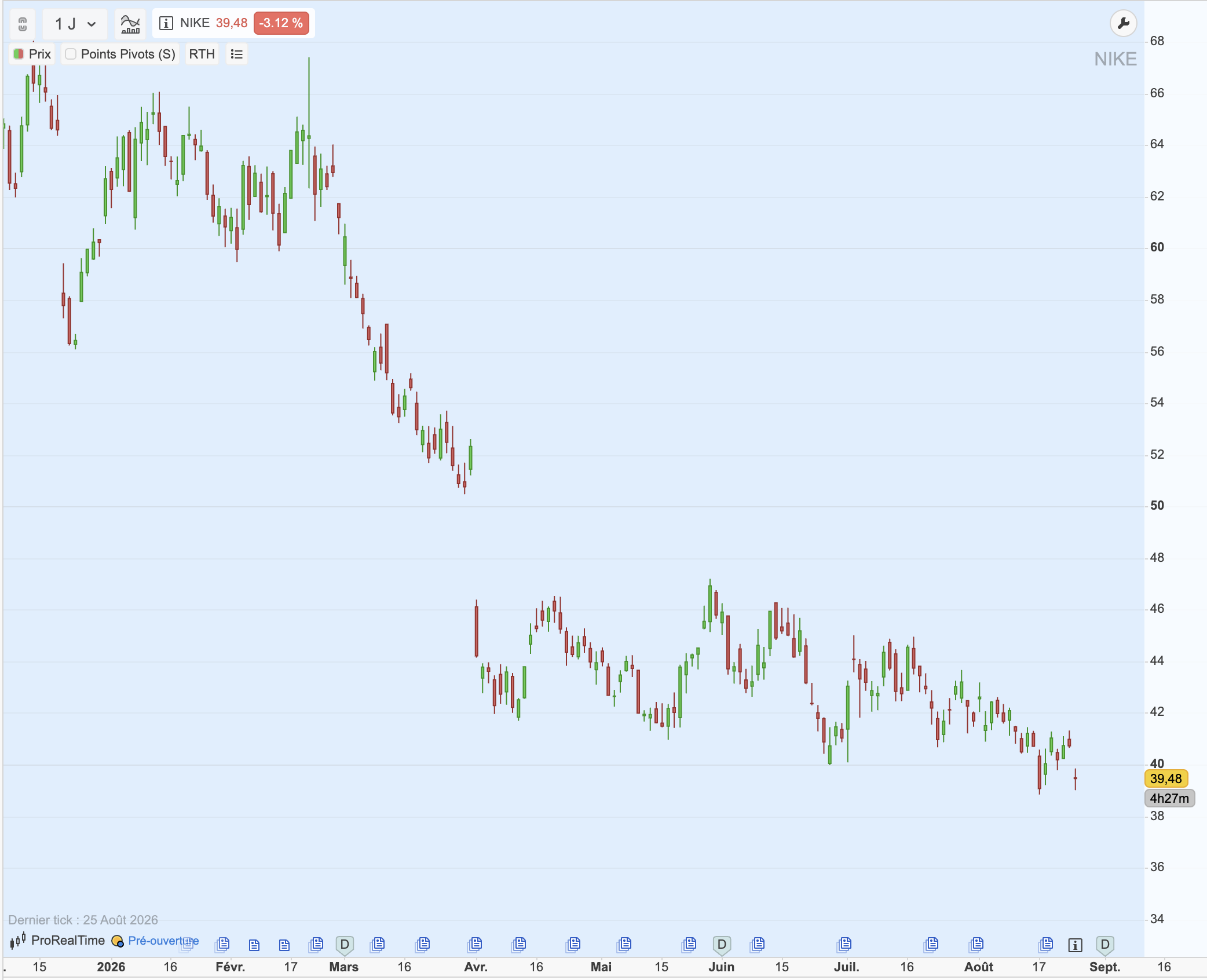
On 17 August it had ended at $39.09, down 4.03%. It had not closed at that level since August 2014.
RBC Capital Markets kept its neutral rating and its $45 target on 25 August. Piral Dadhania wrote the note after an investor meeting with the chief executive in London, where Nike said it was confident in its strategy. The analyst agrees the right calls are being made, but warns that execution is taking longer than hoped. [2]
That slowness is what weighs on the market. Reuters already put the 17 August drop down to investor impatience with the pace of the turnaround. [3]
In the year to 31 May 2026, Nike turned over $46.4 billion. The total came in flat as reported and down 2% at constant currency. The group blames the decline on Greater China and the EMEA region. [4]
Nike Direct is down 6% on the year, with digital down 12%. Converse falls to $1.2 billion, a 31% drop.
Fourth-quarter gross margin jumps 890 basis points to 49.2%, of which roughly 900 basis points come from expected IEEPA tariff recoveries. Strip that out and the quarter’s profitability stops improving.
Dick’s Sporting Goods, which sells Nike products in its own stores and in Foot Locker’s, cut its full-year guidance on 25 August. The retailer describes an athletic footwear market that has turned “increasingly promotional”. [5]
Is Nike heading out of the index?
Nike is the cheapest component in the Dow Jones. The stock trades below $40, while Goldman Sachs, the most expensive in the index, is above $1,050.
The Dow Jones is weighted by share price, not by company size. A $40 stock therefore carries a fraction of the weight of a $1,000 stock, for the same percentage move.
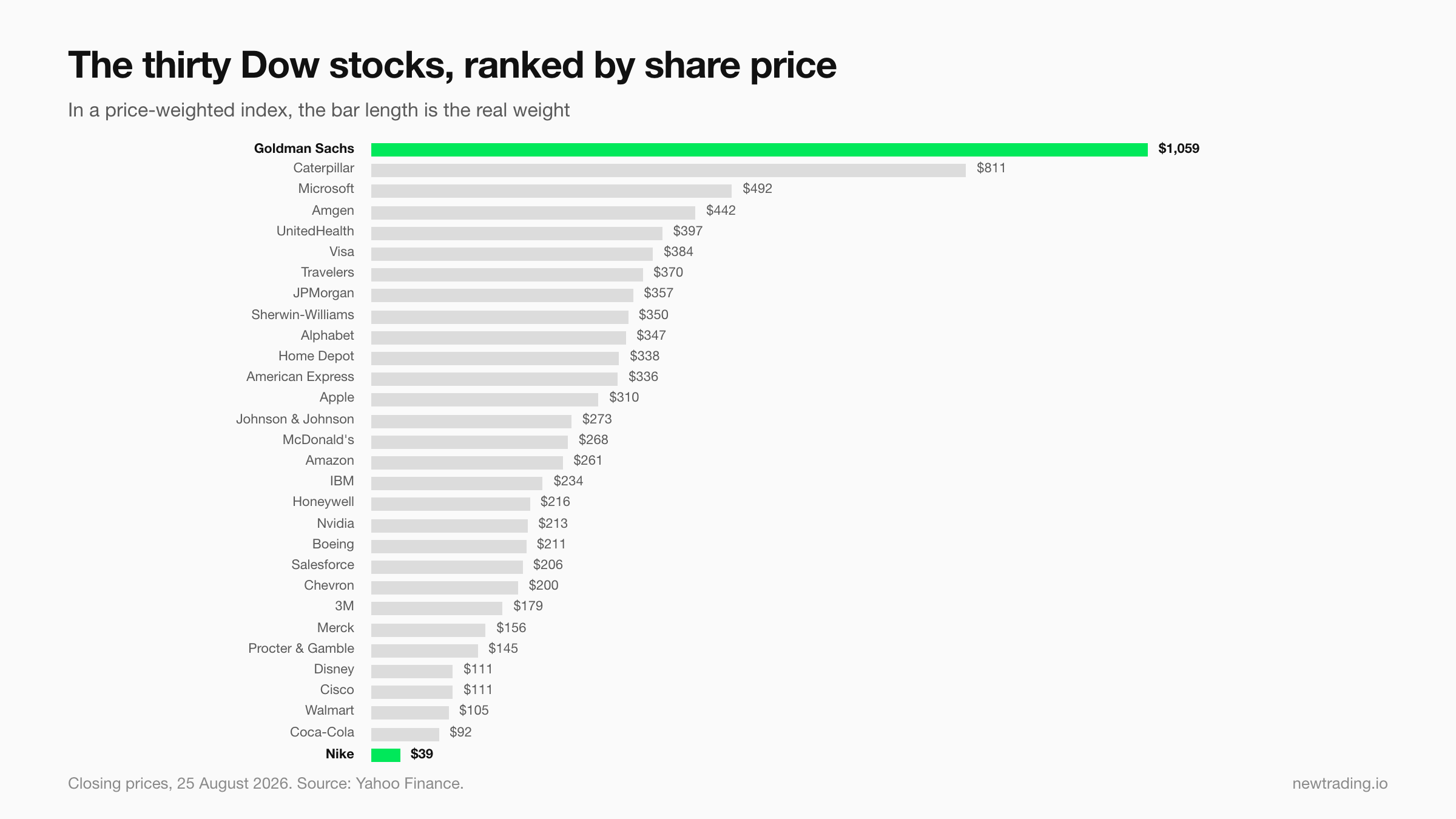
In June 2026, S&P Dow Jones Indices removed Verizon from the index in favour of Alphabet for exactly that reason. The release states that Verizon accounted for only “half a percentage point” of the index “due to its lower share price”, and adds that “persistently low-priced stocks have an immaterial impact on the index” [6] .
No rule forces Nike out, though. The Dow Jones Averages methodology has no section on removals, no threshold and no exclusion criteria. [7]
The document does mention a ten-to-one ratio between the highest and lowest share price in the index, which the committee says it monitors. That sentence sits in the paragraph about adding a new stock, not about removing an existing one.
Five people decide: three from S&P Dow Jones Indices and two from the Wall Street Journal. Their deliberations are confidential, and the committee reserves the right to depart from its own methodology.
There is no timetable either. There is “no annual or semi-annual reconstitution”. Changes come “at any time” and are announced “one to five days” before they take effect.
That makes the Dow an outlier among major indices, where composition is usually reviewed on a calendar published in advance and against quantitative criteria. In the Dow Jones, a change can land with five days’ notice, with no published criterion to see it coming.
Any replacement would come from the S&P 500, excluding transport and utilities, headquartered and incorporated in the United States.
Goldman Sachs, NVIDIA or Walmart, the real weight of each component
Moves in Dow Jones components do not all hit the index equally. A stock’s weight depends on its price, because the index tracks the dollars each stock gains or loses. An expensive stock therefore weighs more than a cheap one.
Nike is the smallest stock in the Dow Jones. On 25 August, while the shares gapped down at the open, the index started the session higher. By the close, Nike was down 3.12% and the Dow up 0.30%.
Goldman Sachs made the difference that day, up 2.18%. The most expensive stock in the index gained around $20 while the cheapest lost a little over $1.
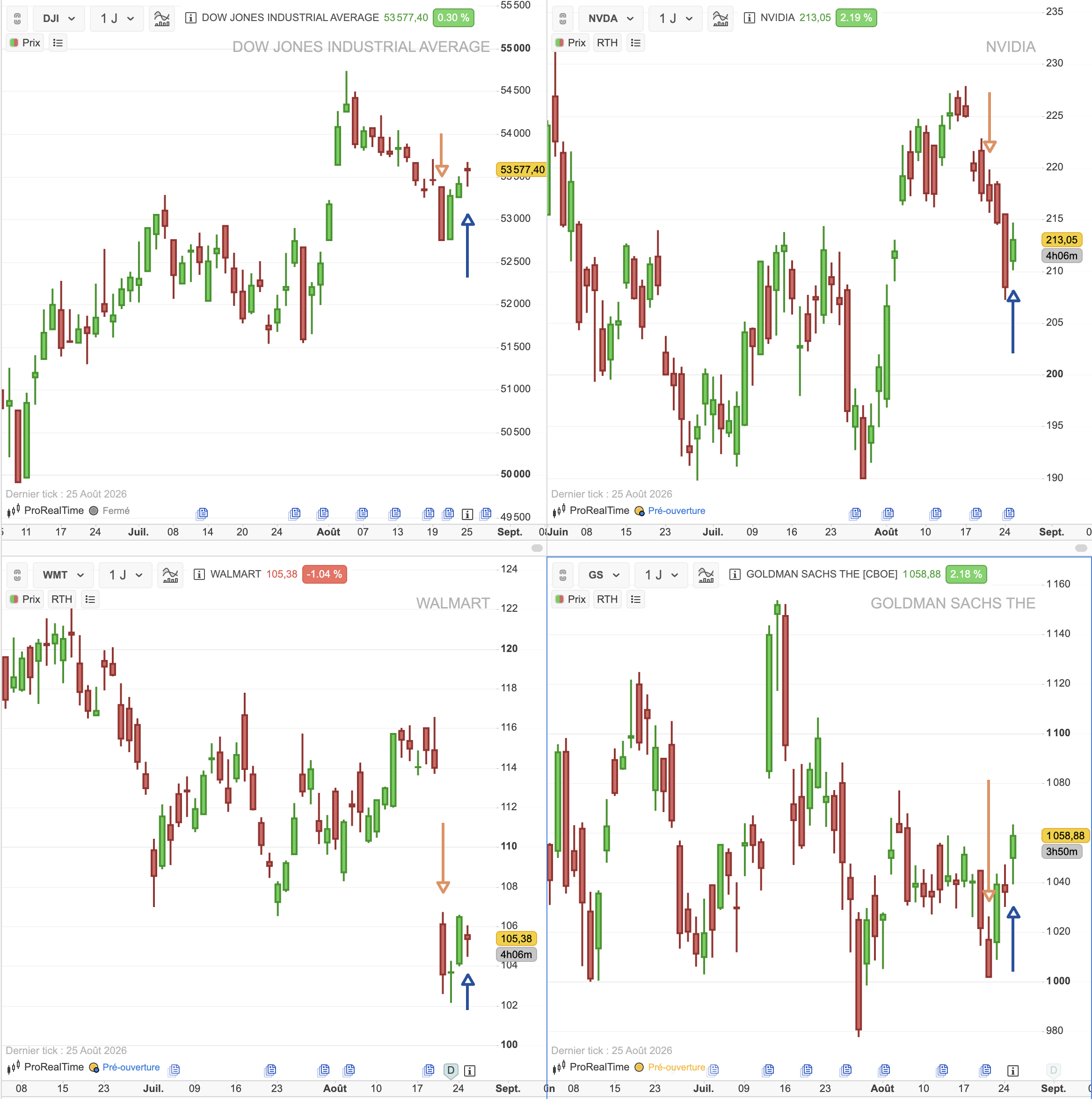
Take 20 August as a second example, marked by the orange arrow. The Dow lost 1.32%, its worst session of the month. Twenty-four of its thirty components closed in the red.
Walmart traded at $114. Its 9.15% fall, the steepest in the index that day, cost it around $10.
Goldman Sachs traded at $1,021. Its 1.93% decline, almost five times smaller in percentage terms, cost it around $20.
Goldman Sachs therefore weighed almost twice as heavily on the index as Walmart, on a far smaller drop.
NVIDIA also fell that day and added to the Dow Jones decline, but less so, because one of the largest market caps in the world ranks only nineteenth in the Dow. Over the next two days the index recovered in step with Goldman Sachs, while NVIDIA kept falling.
Component prices are not the only thing that moves the index.
Dow Jones moves: the factors to watch
Three events could move the Dow Jones. July PCE prices come out on 26 August at 2:30 pm CEST, with consensus around 3.6% year on year. Nvidia reports after the US close, with revenue expected near $92 billion. Kevin Warsh gives his first speech as Fed chair on Friday at the Jackson Hole symposium.
Each of these dates touches a variable the market watches constantly. Inflation for PCE, the rate path for Jackson Hole, and AI infrastructure demand for Nvidia.
Monetary policy reaches equities through a channel that has been measured for a long time. Bernanke and Kuttner put numbers on it in the Journal of Finance. Between 1989 and 2002, an unexpected 25 basis point cut in the policy rate came with a rise of about 1% in the major indices. The authors attribute most of that reaction to the risk premium demanded on equities. [8]
Our weekly Dow Jones trading plans track these variables. The 17 August plan noted that the rise in US yields had decoupled from Fed expectations. The 24 August plan came back to the doubling of Treasury buybacks and called it an effort that went nowhere.
Nike and the Dow Jones: what to take away
Nike loses 3.12% on 25 August, the Dow Jones gains 0.30%. In a price-weighted index, components do not carry the same impact. Nike closes out the ranking at $39, far behind Goldman Sachs at $1,059.
If Nike kept falling, it would drop below the threshold S&P cited to remove Verizon in June. For now, no change has been announced.
Beyond the moves in each component, several events could hit the Dow Jones this week, from PCE inflation to NVIDIA earnings and Kevin Warsh’s Friday speech at Jackson Hole.
One more date is worth noting, the September Fed meeting. The dates are in our FOMC meeting calendar, and our guide on how to trade central bank decisions explains what moves around these announcements.
Article sources

Maxime holds two master’s degrees from the SKEMA Business School and FFBC. As founder and editor-in-chief of NewTrading.fr, he writes daily about financial trading.