How to Trade Central Bank Decisions


When a central bank announces its decision, the market doesn’t think, it reacts. Within seconds, a currency pair can travel what it normally covers in a full day: stops get hit, spreads widen, and the price shoots one way before turning back.
This isn’t a hypothetical: in January 2015, a single decision by the Swiss National Bank sent the franc up nearly 30% in minutes, wiping out several brokers.
This article won’t explain what a policy rate is. It shows what happens on your screen when the announcement lands, which instruments move, and how to manage risk around these events.
NewTrading is an educational publication: you won’t find signals or personalised advice here, only the mechanics and the principles traders use to avoid getting caught out.
Why does a central bank decision shake the markets?
A central bank sets the price of money. When it raises rates, borrowing gets more expensive, the currency’s yield rises, and capital flows toward it. When it cuts them, the reverse happens.
So much for the theory.
In practice, what moves the price isn’t the decision itself. It’s the gap between the decision and what the market had already priced in. If everyone expects a quarter-point hike and it lands, the news is already baked into the price: almost nothing happens. But that same hike, when nobody sees it coming, can trigger an earthquake. You’re not trading the announcement, you’re trading the surprise.
Take the following textbook case:
The Bank of Japan catches everyone off guard
The entire market expected the Bank of Japan to leave everything untouched until its governor stepped down a few months later. The consensus was unanimous and positions had piled up on the same side. That day, it widened its cap on long-term yields anyway, from 0.25% to 0.50%.
On paper, a simple technical adjustment. In reality, Japanese bond yields jumped, the yen posted its biggest one-day gain since March 1995, and the Nikkei dropped. The decision was no earthquake in itself, but nobody saw it coming.
Another key factor: the tone, hawkish or dovish matters as much as the number itself.
For example, a central bank can hold rates steady but strike a hawkish tone, opening the door to possible hikes later. The market may then react as if the increase had already happened.
And sometimes, a few words are enough to calm the tension:
Six words from Draghi push European yields back down
Summer 2012, the eurozone is wobbling: the rates Italy and Spain have to pay to borrow are climbing toward unsustainable levels, and the market is openly betting on the single currency breaking apart. On 26 July, at a conference in London, Mario Draghi, then president of the ECB, says the institution will do “whatever it takes” to preserve the euro and “believe me, it will be enough”.
No policy rate changes that day, yet Italian and Spanish yields start falling immediately and the pressure on the euro eases. The programme that followed was never even used: the promise was enough. The market didn’t react to an ECB decision, only to its president’s words.
What happens at the announcement (the critical minute)
The announcement lands at a time known to the second. The market knows it and gets ready. Here’s the sequence that shows up most often. The direction, though, is never set in advance: the first spike can go up or down, and the false start doesn’t happen every time.
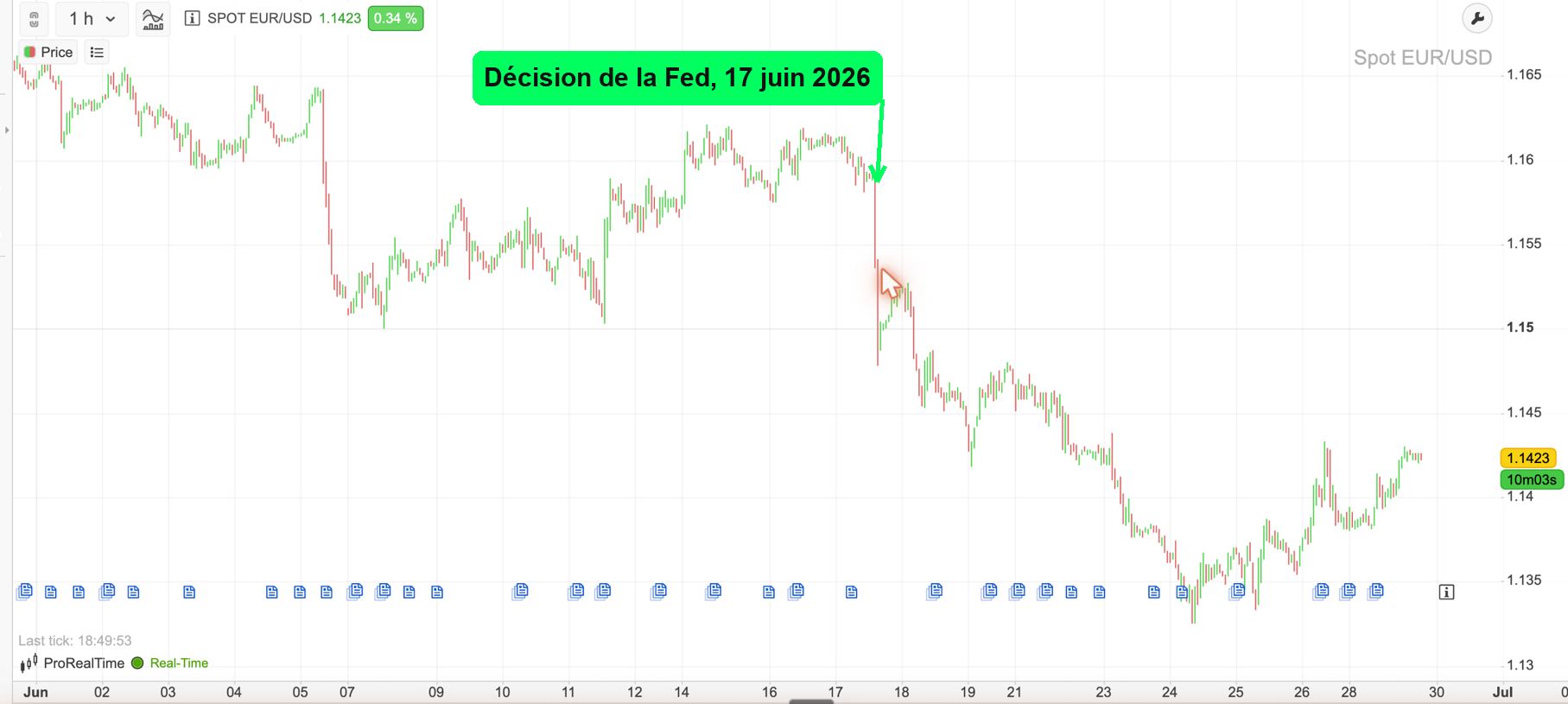
Open this chart on ProRealTime →
The trap
The first move after the announcement is often a decoy: it triggers stops on one side before the real move takes off the other way. Algorithms read the statement in milliseconds. A human clicking on the first candle almost always arrives late.
Which instruments react, and why?
A central bank decision doesn’t hit the whole market the same way. Four asset classes react more than the rest.
| Instrument | Reaction | Why |
|---|---|---|
| Forex (the relevant currency pair) | Strong | The rate is the currency’s yield. EUR/USD for the Fed and the ECB, USD/JPY for the Bank of Japan, GBP/USD for the Bank of England, EUR/CHF for the SNB. |
| Indices (DAX, CAC 40, S&P 500, etc.) | Strong | Higher rates weigh on stocks: pricier credit, compressed valuations. |
| Gold | Medium to strong | Gold pays no interest. When real rates rise, it loses appeal; when they fall, it regains its shine. |
| Bonds (sovereign yields) | Strong | The market most directly tied to rates. It often sets the tone, with stocks just reacting in its wake. |
The useful reflex: know which pair is tied to which central bank. An SNB decision shakes the Swiss franc, not the yen. The SNB also has a long history of intervening directly in its currency, which makes the market especially jumpy around its announcements.
How to position yourself (risk first, not prediction)
Going into an announcement, the goal isn’t to guess which way the market will break, it’s to manage your risk. You have to survive the volatility to stay in the game. There’s no magic formula, but some mistakes, well known to seasoned traders, can be avoided.
Don’t trade during the announcement
Entering the second the release hits means playing against algorithms that decode the information faster than you can. Worse: at the peak, spreads widen and execution slips. Your order can fill at a price far from the one on screen. Most serious traders touch nothing during the hottest window.
Wait for the confirmed breakout
A calmer approach is to let the first shock pass, then act on a confirmed breakout once the direction has settled. You give up a little of the move, but you dodge most of the noise.
Size your position for scheduled volatility
The volatility of an announcement is known in advance. A position sized for a calm market turns dangerous against a scheduled event. Cutting your position size before the announcement date means accepting a bit less upside, rather than risking your whole account on a single move.
Gap and overnight risk
Some decisions land while your market is closed. The Bank of Japan, for instance, announces in the morning, Tokyo time. If you hold a position open from Europe, you risk a gap by the time you wake up. On a central bank event, an unwatched position is an uncontrolled position.
Other gaps can strike in the middle of the day, with far more brutal consequences.
Switzerland shows what tail risk really means
Since 2011, the Swiss National Bank had defended a floor of 1.20 on EUR/CHF, stopping the franc from strengthening too far. As long as it held that line, trading the pair looked risk-free: near-zero volatility, steady gains. A few days earlier, the SNB had reaffirmed its commitment to defend the floor.
On 15 January 2015, without any warning, it abandoned it. Within minutes, the franc soared nearly 30%, EUR/CHF fell below parity, spreads blew out, and liquidity vanished. Some of the best-known brokers went bankrupt or had to be rescued overnight.
A stop-loss would have changed nothing: a stop is an order, not a guarantee. That day, there was nobody on the other side to fill it.
Rate hike, hawkish tone
Currency ▲▲
The bank acts and promises to go further. The cleanest move.
Rate hike, dovish tone
Currency ▼
It hikes but signals a pause. The market is disappointed: the hike can push the currency down.
No change, hawkish tone
Currency ▲
No move, but the door left open to hikes. The tone alone is enough to lift it.
Rate cut, dovish tone
Currency ▼▼
It cuts and confirms it. Selling pressure sets in.
The same decision can push a currency in two opposite directions depending on the tone. That’s why the number alone isn’t enough to read the market.
How a methodical trader prepares
The calendar of the five central banks to watch
Five central banks draw most of the attention from European traders. Each has its own NewTrading tracker, updated after every meeting, with the current rate, the schedule of upcoming decisions, and the exact time of the announcement.
| Bank | Region | Tracker | Markets affected |
|---|---|---|---|
| Fed (Federal Reserve) | United States | FOMC calendar | Dollar, S&P 500, gold, the entire global market |
| ECB | Eurozone | ECB interest rate | Euro, DAX, CAC 40, European bonds |
| Bank of Japan | Japan | Japan interest rate | Yen, USD/JPY, Japanese bond market |
| Bank of England | United Kingdom | Bank of England interest rate | Pound sterling, GBP/USD, FTSE |
| SNB | Switzerland | SNB interest rate | Swiss franc, EUR/CHF |
To follow a specific bank, open its tracker: you’ll find the next date, the announcement time, and the current rate, without digging through official statements.
Common mistakes to avoid
- Trading the number without accounting for market expectations. A rate hike can push a currency up or down depending on what was priced in. The number alone can mislead.
- Ignoring the press conference. The announcement move only tells part of the story. The president’s speech matters just as much to understanding where the market goes.
- Chasing the first move. That first spike is often a decoy. By entering on the first candle, you arrive right as the algorithms cash in their gains, just before the reversal.
- Forgetting slippage. The price on screen isn’t the fill price when volatility explodes.
- Holding too large a position. A position sized for a calm market becomes a risky bet during this kind of event.
Frequently asked questions
Can you trade during a Fed announcement?
Technically yes, the market stays open. In practice, it’s the riskiest window of the day: wide spreads, slippage, false starts. Many traders prefer to wait for the first shock to fade before acting.
Which pair moves most on an ECB decision?
EUR/USD, because it pits the world’s two most closely watched central banks against each other. Euro pairs against the pound or the franc react too, but EUR/USD stays the barometer.
How long does volatility last after the announcement?
The spike plays out in the first few seconds, but the turbulence can last one to two hours, especially during and after the press conference. The market takes time to digest the tone as much as the number.
Should you close your positions before a central bank meeting?
It’s a risk-management choice, not a rule. Cutting size or closing a position before a scheduled event spares you a violent move you can’t control. A position left open through an announcement should be a deliberate call.
Where to start?
The next decision is already on the calendar. Open the tracker for the bank that matters to you, note the exact date and time, and approach the event like a trader who’s been warned: the goal isn’t to guess where the rate goes, it’s to stay in control of your risk.
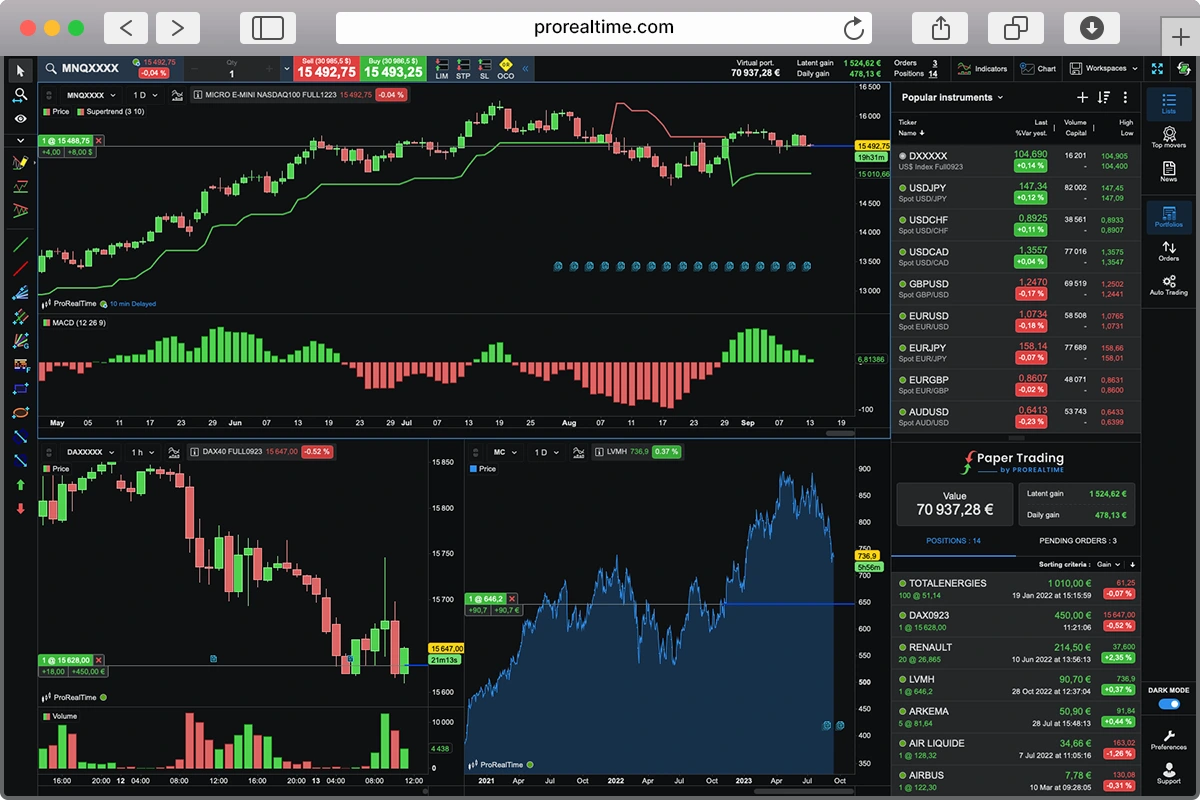
On the day, an open chart and a few alerts are enough to follow the announcement live, on a platform like ProRealTime.

Othmane has been swing trading for years and builds on experience in investment banking. He writes regularly about trading and market analysis, and has passed Level I of the CFA Program along with earning a double Master’s degree in Financial Analysis.
Enjoy free trading practice on
ProRealTime Paper Trading Simulator.