
AI Trading: 7 Actionable Steps to Get Started


Let’s face it: most articles about AI trading are either too basic… or completely overwhelming.
One promises easy money with “autopilot bots.” The other throws you into machine learning theory like you’re prepping for a PhD.
This guide is different.
Whether you’re a technical trader looking to scale your edge, or just curious how AI is changing the game, you’ll learn exactly:
- What AI trading actually is (without the hype)
- Where real traders are using it right now
- Which tools let you start today — with zero coding
- And how to test your first AI-powered idea without blowing up your account
Just a clear path to using AI the way it’s meant to be used: as a tool to trade smarter, faster, and more objectively.
Let’s dive in.
Step 1: Understand what AI trading actually is
You’re analyzing 20 charts, juggling economic headlines, checking your indicators, and trying to stay calm before the market even opens. Now picture having a research assistant who never sleeps, never second-guesses, and can scan thousands of data points in milliseconds. That’s the real promise of AI trading.
At its core, AI trading means using algorithms, often powered by machine learning, to identify patterns, generate signals, or even execute trades based on real-time data. It’s not magic. It’s not a crystal ball. It’s data in, decision out, with more speed and consistency than any human can manage.

This is why hedge funds, quants, and increasingly, retail traders, are leaning in. AI helps them cut through noise, reduce bias, and react faster in volatile markets. Unlike humans, it doesn’t freeze when the market gaps 2% or chase setups out of emotion.
But let’s be clear: AI won’t run your trades on autopilot while you sip cocktails by the pool. It doesn’t guarantee profits, and it won’t replace sound risk management. You don’t need to be a computer scientist to get started, but you still do need a process.
Think of AI less as a black-box trader, and more like a supercharged research assistant. It helps you surface better setups, validate your strategies, and scale your edge. You’re still the portfolio manager, AI just gives you an edge if used properly.
And if you’re tempted to start building trading strategies with ChatGPT, it’s fine for brainstorming or drafting logic. But it’s not built for real-time trading. Tools like TrendSpider’s AI Strategy Lab go several steps further, letting you train predictive models, backtest ideas, and automate signal generation across any market, with no coding required.
Step 2: Explore real-world AI use cases
Imagine this.
You’ve got earnings season around the corner. Everyone’s watching Apple. You don’t have time to read every headline, scan every chart, and guess how the market will react.
But AI? It already scraped the news, read the earnings calls, and flagged a shift in sentiment before most traders even poured their morning coffee.
That’s not sci-fi. That’s how real traders are already using AI, not to predict the future, but to prepare faster and trade smarter.
Here’s where it’s showing up:
- Before earnings drops: AI-powered tools scan news and sentiment to gauge how the crowd might react.

- After macro events: Natural language processing picks up key phrases in headlines and reports and feeds them into reaction models.
- During your chart scans: Instead of flipping through 50 tickers, AI flags setups like breakouts, Wedge pattern, or Crossover for you.

- When testing ideas: AI can stress-test your strategy across different markets, timeframes, or conditions — instantly.

- And in the research you don’t have time for: ESG data, Twitter buzz, satellite imagery? AI helps make sense of it all.

Let’s be clear: none of this replaces your judgment. But it does what machines do best, sift, spot, and surface what matters.
And the tools to try it?
TrendSpider puts a lot of this within reach.
Their AI Strategy Lab lets you train your own trading models without writing a single line of code. You can experiment with different strategies, tweak the parameters, and see how your ideas would have performed historically.

Then there’s the Market Scanner, which is like having a tireless assistant that combs through the markets looking for setups that match your exact conditions, even across multiple timeframes. No more staring at charts all day waiting for your signal to appear.

But TrendSpider doesn’t stop there.
The Variance Explorer is a fantastic reality check; it tests your idea in different markets to see if it’s truly robust or just a one-hit wonder.

And then there’s Sidekick, still in beta, which acts like your personal AI analyst. It learns your trading style and serves up trade ideas tailored to you, almost like having a mentor who knows exactly what you’re looking for.


For new traders, these tools are a game-changer, they bridge the gap between curiosity and execution, letting you explore and apply AI in ways that feel approachable, practical, and just plain exciting.
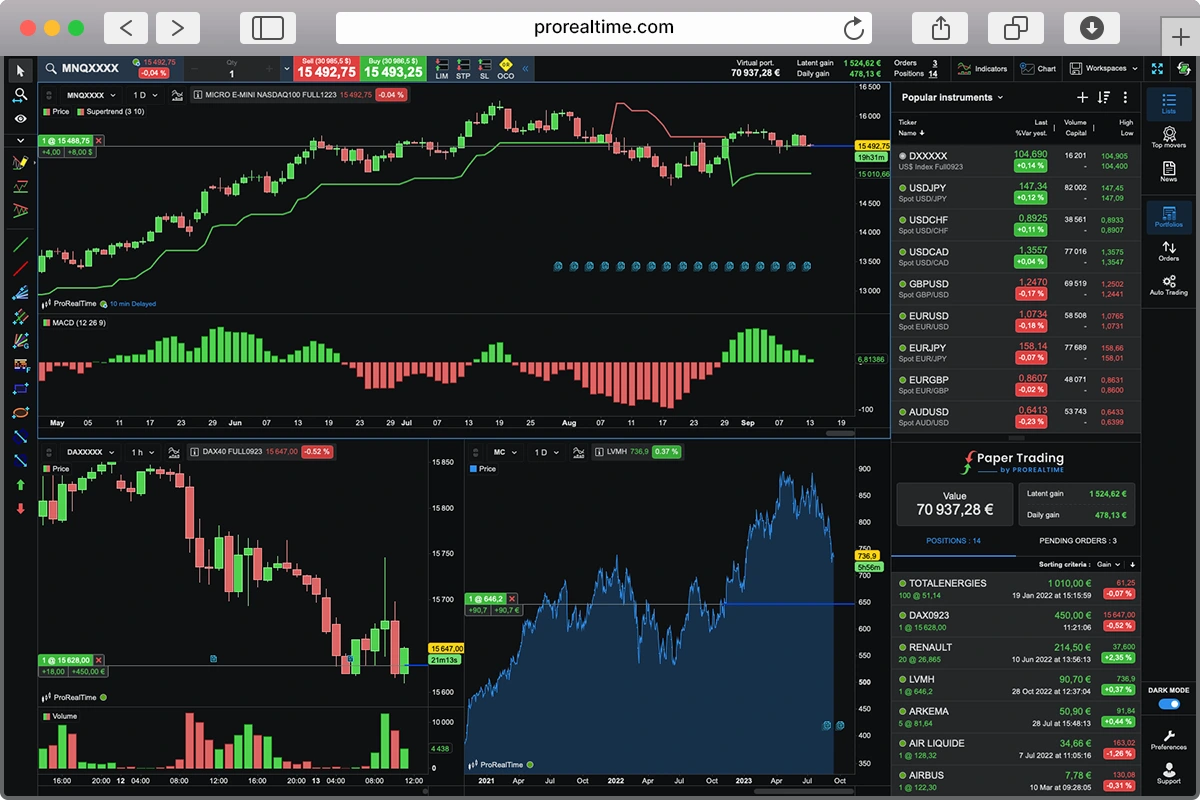
ProRealTime takes a slightly different approach to AI in trading, focusing on making chart analysis faster and more intuitive.
Their ProRealTrend tool automatically draws support, resistance, and trendlines for you, something that can take new traders a lot of time (and sometimes a few headaches) to get right. This means you can spend less energy wondering if your lines are in the “right” place and more time thinking about how you want to trade them. For beginners, it’s like having an experienced chartist sitting over your shoulder, quietly doing the grunt work so you can focus on the bigger picture.

Even better, ProRealTime doesn’t just stop at drawing the patterns, it lets you scan for them across different timeframes. So if you’re looking for a breakout setup, you can instantly see where it’s forming on the daily chart, the 4-hour, and the 1-hour, without having to flick through charts manually.

This is a huge time-saver, and it helps you stay on top of opportunities you might otherwise miss. It’s these kinds of practical AI features that make ProRealTime a great choice for traders who want to blend automation with their own analysis, especially if you’re still building your chart-reading skills.
Bottom line?
You don’t need to build the next ChatGPT of finance.
But if you’re still scanning 100 charts by hand or guessing how the market feels before a big release, AI can give you an edge, starting today.
Step 3: What an AI trading system looks like (in plain English)
At its core, an AI trading system is just a smart, structured process for turning information into trades, no complicated code or PhD-level math required to understand the basics.
It starts with the data layer, which is all about collecting and cleaning up your inputs: market prices, news headlines, alternative data like sentiment or weather reports, anything that might influence the markets.
Then comes the model layer, where you decide how the system will make decisions. This could be something as advanced as deep learning, as simple as a few logic rules, or somewhere in between, like decision trees. Think of it as the brain of your trading bot.
Once the model has an opinion on what should happen next, the execution layer steps in to turn those decisions into actual buy or sell orders and track how they perform in the real world.
Two more pieces tie everything together: feature engineering, which is just a fancy way of saying you transform raw data into meaningful signals (like turning a list of prices into moving averages), and model evaluation, where you test your strategy using backtesting, walk-forward testing, and validation to make sure it’s not just lucky on old data.

In other words, an AI trading system is like building a well-trained athlete. It needs good nutrition (data), a game plan (model), solid execution (orders), and constant practice (evaluation) to perform at its best.
Step 4: Choose your path forward
Option A: Use ready-made AI platforms (recommended starting point)
If you’re just getting started with AI in trading, this is hands down the smartest (and least overwhelming) route to take.
Ready-made platforms like TrendSpider give you the power of AI without forcing you to code or wrestle with data pipelines. You can build and test strategies using built-in AI assistants, tweak the settings to match your style, and see how they would have performed in the past, all in a clean, visual interface.
These platforms also let you scan the markets for setups that fit your exact conditions, so you’re not wasting hours clicking through charts looking for that “perfect” trade.
On top of that, you can automate alerts or even execution using tools like SignalStack, which means you don’t have to be glued to the screen 24/7. Want to make sure your strategy works across different timeframes before committing?
Tools like Variance Explorer help you spot potential weaknesses so you can adjust before money is on the line. For most traders, especially if you’re new, this approach strikes the perfect balance: you get the power and precision of AI without drowning in the technical side, letting you focus on learning, refining your strategy, and actually trading.
These tools give you the power of machine learning without needing to be a quant.
Option B (Optional): Build your own AI trading bot
If you’re the kind of trader who loves to get under the hood and tinker with the engine, this is where things get really fun.
Building your own AI trading bot isn’t just about coding, it’s about creating a trading partner that thinks the way you do. You’ll be working with tools like Python, scikit-learn, and Backtrader to design, train, and test your strategy.
Data is your fuel, and you can pull it from sources like Alpaca, Yahoo Finance, or Quandl. Once your model is trained and battle-tested, you can connect it to an API and let it place trades for you automatically.
Indeed, it’s a more technical route, but for those willing to dive in, it can be incredibly rewarding.
High effort, high flexibility, but not required to benefit from AI today.
Step 5: Test your first AI-powered strategy
The key here is to keep it simple and focus on getting something functional, not perfect. Start with a tried-and-true idea like combining RSI with a moving average crossover, something easy to understand but still effective.
In TrendSpider, you can write the logic out in plain English using the AI Coding Assistant or build it visually in the Strategy Lab without touching a line of code. Once it’s set up, you can scan the market for setups that match your rules, saving you a ton of time and letting you focus on decision-making instead of chart-hunting.
To boost your confidence in the signals, use Multi-Timeframe Analysis to see if your idea lines up across different chart views, like the daily and the 4-hour. When you’re ready, you can paper trade to test your strategy in real conditions or connect through SignalStack to go live.
The most important part?
Keep a record of your assumptions, results, and key takeaways after each run. That’s where the real edge comes from, not just running a strategy, but learning and adapting it over time.
Learn more about backtesting here
Step 6: Avoid beginner traps
Common ways traders misuse AI:
| Trap | What It Means | How to Avoid It |
|---|---|---|
| Overfitting to backtest results | Designing a strategy that works perfectly on historical data but fails in live markets. | Keep your rules simple, use walk-forward testing, and test on out-of-sample (unseen) data. |
| Confusing correlation with causation | Mistaking patterns that occur together as having a cause-and-effect relationship. | Always ask why a signal works and look for logical market reasons behind it. |
| Ignoring execution risks like slippage and latency | Forgetting that delays or price changes between signal and execution can hurt performance. | Factor in realistic slippage and latency when backtesting and paper trading. |
| Using too many inputs; noise over signal | Adding too many indicators or data points, which can create false signals. | Focus on a small set of proven, complementary inputs and test their impact individually. |
| Going live before validating on unseen data | Trading real money without confirming performance in new, untouched market conditions. | Always validate strategies on fresh data and run paper trades before committing capital. |
Bonus: Automation ≠ compliance exemption. Know your platform’s limits.
Step 7: Build a tight feedback loop
One of the biggest mistakes new traders make is jumping from one strategy to the next without giving any of them enough time to mature. Instead, pick one strategy, commit to it, and work on improving it step by step.
Use the tools you already have. TrendSpider’s Strategy Library is a goldmine for inspiration, and their University offers clear, bite-sized lessons to help you get the most out of the platform. You can also learn a lot from community-shared strategies; even if you don’t copy them outright, they can spark ideas you might not have considered. Keep a research document where you track every tweak, every idea, and every result. This becomes your personal playbook for continuous improvement.
Once you’ve built a solid foundation and you’re confident in your process, then—and only then—consider going deeper into the technical side of AI trading.
If the bug bites you, platforms like:
- Coursera’s AI for Trading
- Fast.ai’s tabular ML course
- Aurélien Géron’s Hands-On Machine Learning
are great next steps.
But remember, you don’t need to master machine learning to be profitable. The real edge comes from refining what you already do well, tracking your progress, and making smart, informed adjustments along the way.
Learn as you go, not before you start.
Final Thoughts
You don’t need a PhD or a Python script to start using AI in your trading.
You just need a process, and the right tools to help you follow it with discipline.
Platforms like TrendSpider and ProRealTime now give regular traders access to serious firepower: AI-powered scanners, automatic pattern detection, backtesting engines, and even automated execution. No code required.
These tools won’t magically make decisions for you, but they will help you test faster, trade more objectively, and scale what already works.
And this space is evolving fast. AI is becoming more explainable, more adaptive, and more accessible through low-code platforms. The edge now goes to traders who experiment, test, and stay curious, not the ones chasing shortcuts or hype.
If you think like a builder, test like a scientist, and learn like a beginner, you’ll go further than any plug-and-play promise ever could.
The best way to get started… is to start.

Cedric is a seasoned investment management strategist with over a decade of experience, currently working at TTUTC. He holds dual prestigious designations as a Chartered Market Technician (CMT) and Chartered Financial Analyst (CFA).
Start Trading on a Demo Account
with ProRealTime Paper Trading Simulator.
