8 Best Day Trading Platforms in Europe (2026)


If you’re day trading from Europe, you’ve seen the issues: platforms that push CFDs by default, charge extra for basic features, or lag the moment markets get interesting.
We tested many platforms over the years. This guide is built from that experience, comparing charting tools, fees, regulation, and what actually matters for active traders in Europe.
Here are the eight platforms we recommend. No tool does the work for you, but these are the ones worth taking a look.
 Why trust us
Our reviews are built on real-world experience. We work closely with experienced traders who’ve spent dozens of hours testing these platforms to ensure each recommendation is reliable and practical. Visiting the tools we mention through the links on our website may generate a commission that helps support our mission to make trustworthy financial knowledge free and accessible for everyone—at no extra cost to you. Thank you for supporting us!
- Tested by traders, not marketers
- 30+ hours of testing
- Designed to help beginners






How Did We Pick the Best Day Trading Platforms in Europe?
We looked at three key factors:
Reputation
We checked how long each platform has been operating, whether it’s regulated in Europe, and what users are actually saying. That includes review scores on Trustpilot and app stores, public complaints, and real feedback from Reddit and X. We also prioritized platforms that offer more than just CFDs—since CFD trading is banned or restricted in many countries, we focused on brokers that support direct access to stocks, ETFs, or other regulated instruments.
Charting & Analysis
We tested each platform for chart responsiveness, data refresh speed, and ease of use. We looked for features like drawing tools, custom indicators, multi-chart layouts, and fast order placement directly from the chart—without jumping through hoops.
Data Quality & Platform stability
We evaluated real-time performance during volatile hours. That means checking for price delays, chart freezes, and execution lag complaints when volume spikes. Platforms had to stay responsive and accurate when it matters most.
| Criteria | ProRealTime | IBKR (TWS) | TradingView | cTrader | IG | XTB | MetaTrader 4/5 | Pepperstone |
|---|---|---|---|---|---|---|---|---|
| Reputation | 95% | 95% | 95% | 90% | 90% | 90% | 80% | 85% |
| Charting tools | 95% | 90% | 95% | 90% | 85% | 80% | 70% | 75% |
| Data quality | 90% | 90% | 90% | 85% | 85% | 80% | 80% | 85% |
| Fees | Free / €24/mo | From $0.005/share | Free / €12.95/mo | Free (broker) | From 0.6 pips | Zero stocks/ETFs | Free (broker) | From 0.0 pips |
| Full review | PRT review | IBKR review | TV review | cTrader review | IG review | – | MT review | – |
| NewTrading score | 92% | 89% | 88% | 85% | 83% | 82% | 81% | 80% |
#1 ProRealTime
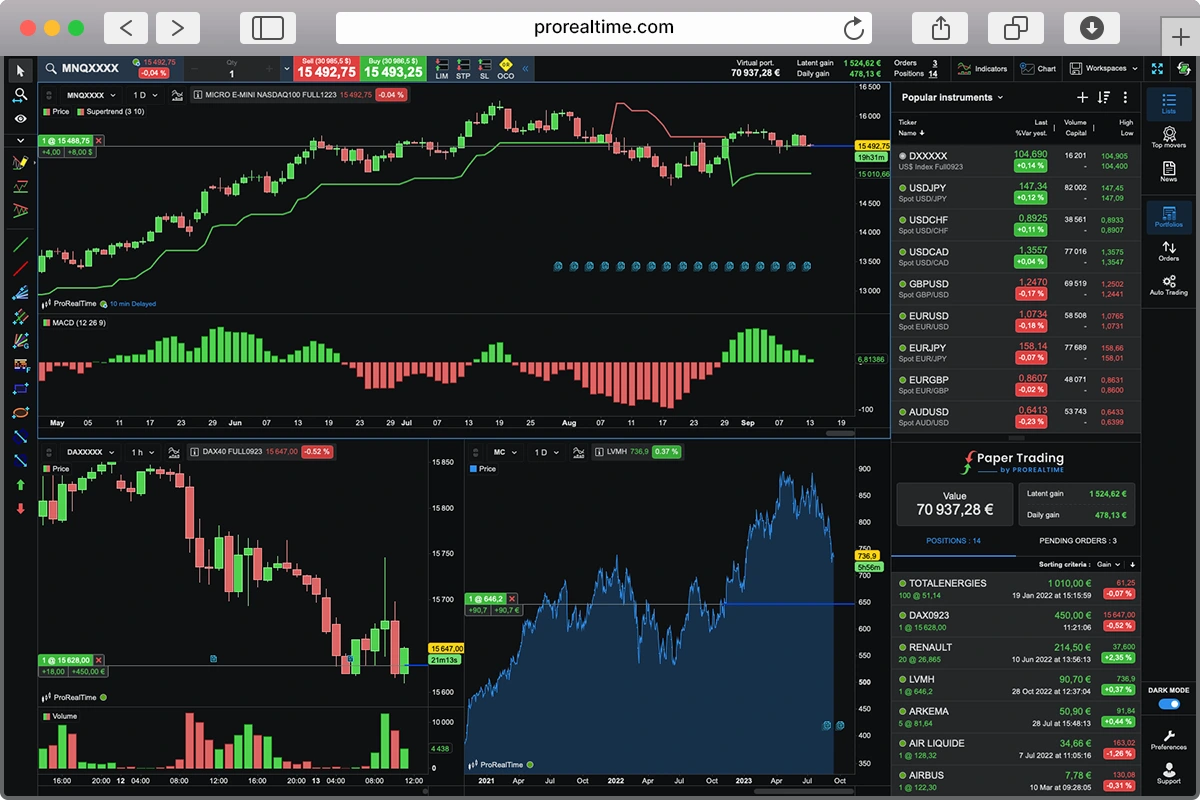
ProRealTime is a professional trading platform developed by French software company IT-Finance, trusted by over a million users since 2001. It offers advanced charting, robust technical analysis tools, strategy backtesting, and direct market access (DMA) through established partners like Interactive Brokers, IG Markets, and Saxo.
You can place trades directly from charts and test your setups in a free demo environment before risking real capital. The platform supports a wide range of trading styles—from fast intraday scalping to rule-based systems—making it suitable for traders who want structure and flexibility without switching platforms.
If something goes wrong, ProRealTime offers real customer support by phone—no chatbots, no waiting on a ticket reply. For European traders who want precision tools and reliable service, it’s one of the strongest platforms available.
The Web and Mobile version is free and covers most day trading needs. The Complete plan (€24/month) unlocks unlimited indicators, market scanning, and backtesting. Trading commissions are set by your connected broker: Interactive Brokers or Saxo.
#2 TraderWorkStation (Interactive Brokers)

Interactive Brokers is one of the most established brokerage firms in the world, serving traders and institutions since 1978. Known for its global reach and deep product access, it offers a powerful desktop platform—Trader Workstation (TWS)—designed for precision trading across stocks, options, futures, and more.
TWS supports advanced order types, real-time market depth, customizable hotkeys, and multi-asset charting down to sub-minute timeframes. It’s ideal for traders who want full control over execution and layout, with the flexibility to adapt the platform to their strategy.
With nearly five decades of experience, strong international regulation, and robust capital backing, Interactive Brokers remains one of the most trusted choices for day traders across Europe.
IBKR offers two pricing tiers. IBKR Lite provides commission-free trading on US stocks and ETFs. IBKR Pro starts from $0.005 per share, with rates that drop at higher volume. No platform fee, no minimum deposit, and you earn up to 3.14% on uninvested cash.
#3 TradingView
TradingView is one of the most widely used trading platforms in Europe, known for its sleek interface, advanced charting capabilities, and seamless broker integrations. It’s particularly popular among active retail traders, swing traders, and technical analysts who want speed, clarity, and flexibility without compromising on depth.
You can use TradingView for free, but most serious users eventually upgrade to paid plans like Pro, Pro+, or Premium to unlock more chart layouts, indicators, and price alerts. The platform also give you access to real-time data subscription and lets you connect to many brokers for trading.
Its browser-based design means there’s no installation required, and it works smoothly across devices.TradingView also supports Pine Script, allowing users to create and share custom indicators and backtests.
For European traders who want modern tools, access to global and local markets, and a clean interface with minimal setup, TradingView is one of the most versatile platforms available.
TradingView has a free tier with basic features. Paid plans start at €12.95/month (Essential) and go up to €199.95/month (Ultimate), unlocking more charts per tab, indicators, and alerts. Trading fees depend on which broker you connect.
#4 cTrader
cTrader is a trading platform developed by Spotware, designed specifically for active forex and CFD traders who need fast execution and precise order management. It’s available through a growing number of EU-regulated brokers including Pepperstone, IC Markets, and FxPro.
The platform stands out with its clean, modern interface, Level II pricing, and advanced order types including stop-limit and market range orders. cTrader Algo lets you build, backtest, and run automated strategies in C#, and cTrader Copy provides built-in copy trading without third-party plugins.
For day traders who spend hours watching charts, cTrader’s detachable chart windows and quick-trade buttons make a real difference in speed. The mobile and web versions are fully functional, not stripped-down versions of the desktop app.
cTrader is free to use. All trading costs (spreads, commissions, swaps) are set by the broker you trade through. Most cTrader brokers offer raw spread accounts starting from 0.0 pips with a per-lot commission.
#5 IG
IG has been around since 1974, making it one of the oldest and most established trading providers in Europe. Regulated by the FCA, BaFin, and other EU authorities, it offers spread betting, CFD trading, and share dealing from a single account.
IG’s own platform is solid for day trading, with real-time charts, customizable watchlists, and one-click dealing. But what makes it stand out is its integration with both ProRealTime and TradingView, so you can use your preferred charting tools while executing through IG.
For UK-based traders, spread betting through IG is tax-free on profits. The platform also provides DMA (direct market access) on shares for more advanced traders who want exchange-level execution.
Forex spreads start from 0.6 pips on major pairs. Index trading starts from 1 point on the FTSE 100. UK share CFDs carry a 0.1% commission (min £10). No platform fee for active traders.
#6 XTB
XTB is a well-established European broker offering a streamlined trading experience through its proprietary platform, xStation 5. Regulated by the FCA and active in multiple EU markets, it has grown rapidly by offering zero-commission investing on real stocks and ETFs—with added perks like a free stocks & shares ISA and interest on uninvested cash.
The platform supports fractional shares, stop-limit orders, and fast execution within a clean, mobile-friendly interface. It’s especially appealing to UK and EU-based investors looking to manage their ISA allowance efficiently or trade global ETFs without paying platform fees.
xStation 5 is designed with active traders in mind, but it remains accessible enough for beginners. Tools like candlestick charting, flexible order types, and real-time price data are built-in, with no need to unlock features via paid add-ons.
Zero commission on stocks and ETFs up to €100K/month. CFD spreads start from 0.5 pips on major forex pairs. An inactivity fee of €10/month applies after 12 months of no trading.
#7 MetaTrader 4/5

MetaTrader (MT4 and MT5) is a globally recognized trading platform known for fast execution, deep customization, and powerful automation. MT4 is a classic for forex, while MT5 expands into stocks, indices, and futures, depending on the broker.
For European traders, MetaTrader stands out for its broad broker compatibility. Most EU-regulated brokers offer MT4/MT5, letting you combine the same interface with different pricing models and asset access. But it’s the broker that delivers market access and ensures account security, so regulation matters.
The platform is built for speed and control. You can place orders from charts, set hotkeys, and apply trailing stops or pending orders with precision. Templates save your setups, and the built-in strategy tester lets you backtest custom indicators or automated scripts (EAs).
MT5 adds depth-of-market data, 21 timeframes, and more native indicators. While the interface may feel dated compared to modern platforms like TradingView, it remains a favorite for system traders and algo users who value performance over polish.
MetaTrader is free to download and use. All trading fees, including spreads, commissions, and overnight swaps, are set by the broker you trade through.
#8 Pepperstone

Pepperstone is an Australian-founded broker that has expanded rapidly into Europe, now regulated by CySEC, FCA, and BaFin. It doesn’t have its own charting platform. Instead, it gives you access to four: MetaTrader 4, MetaTrader 5, cTrader, and TradingView.
This makes Pepperstone a strong option for traders who already have a preferred platform and just need a reliable, low-cost broker behind it. The Razor account offers raw spreads from 0.0 pips with a $3.50 per lot commission. The Standard account starts from 1.0 pips with no commission.
Execution quality is a core selling point. Pepperstone uses Equinix data centers and reports average execution speeds under 30ms. For day traders who scalp or trade news events, that matters.
No minimum deposit is required. Pepperstone mainly covers forex, indices, commodities, and crypto CFDs. If you need direct stock access, this isn’t the right broker, but for leveraged trading on major markets, the pricing is hard to beat in Europe.
How to Choose a Day Trading Platform in Europe
There is no single “best” platform. The right one depends on what you trade, how often, and what tools you need. Here are the factors that matter most for European day traders.
Execution speed. Day trading means acting on small price moves. Delays of even a few hundred milliseconds can cost you. Look for platforms with direct market access (DMA) or brokers using low-latency infrastructure like Equinix data centers.
Charting and analysis tools. You need real-time charts that stay responsive under load. Look for multiple timeframes, drawing tools, custom indicators, and the ability to place orders directly from charts. Advanced traders should check for depth-of-market (DOM) and volume profile tools.
Fees and pricing structure. Compare spreads, commissions per trade, platform fees, and data feed costs. Some platforms are free but charge through the broker’s spread. Others charge a monthly fee but give you tighter execution. Calculate your total cost based on how many trades you place per day.
Regulation and safety. In Europe, stick with platforms and brokers regulated by the FCA (UK), BaFin (Germany), CySEC (Cyprus), or AMF (France). MiFID II requires segregated client funds, negative balance protection, and standardized leverage limits across the EU.
Asset coverage. Some platforms focus on forex and CFDs. Others give you access to stocks, futures, options, and bonds. Make sure the platform covers the markets you actually trade, not just the ones in the marketing material.
Day Trading Regulations in Europe
Europe has a different regulatory framework than the US. Here are the key rules that affect day traders.
ESMA leverage limits. Since 2018, the European Securities and Markets Authority (ESMA) caps leverage for retail traders: 30:1 on major forex pairs, 20:1 on indices and minor forex, 10:1 on commodities, 5:1 on individual stocks, and 2:1 on crypto. These limits apply across all EU-regulated brokers.
No Pattern Day Trader (PDT) rule. Unlike the US, Europe has no minimum account balance requirement for frequent trading. You can day trade with any account size, as long as your broker allows it. This makes Europe one of the most accessible markets for active traders.
Negative balance protection. All EU-regulated brokers must ensure retail clients cannot lose more than their account balance. This is mandatory under MiFID II and protects traders during extreme market events.
Tax treatment varies by country. In the UK, profits from spread betting are tax-free. In most EU countries, capital gains tax applies to trading profits. Germany taxes at a flat 25% (Abgeltungssteuer). France applies a flat 30% (PFU). Always check your local tax rules, as they can significantly affect your net returns and are subject to change.
Final thoughts
The platforms featured in this article are ones we’ve tested ourselves and found reliable for European day traders. They offer strong tools, solid execution, and features that actually make a difference once you start trading more actively.
That said, there are other platforms worth exploring depending on your style. Saxo offers deep market access, strong research, and integrates with tools like ProRealTime and TradingView if you already use them. Trading 212 is another option for beginners, with commission-free stock investing and a clean interface. And while eToro is more beginner-focused, its copy trading features can be interesting to explore.
No single platform suits everyone, so if something feels clunky or limiting, it’s totally fair to test others. The goal is to find one that fits how you trade.
Frequently Asked Questions
What is the best day trading platform in Europe?
Based on our testing, ProRealTime is the best overall day trading platform in Europe. It offers direct market access, advanced charting with over 100 indicators, and free stock charts. For traders who need broad market access, Interactive Brokers (Trader Workstation) covers 150+ markets. The best choice depends on whether you prioritize charting tools, fees, or asset coverage.
Is day trading legal in Europe?
Yes, day trading is fully legal in Europe. Unlike the US, there is no Pattern Day Trader (PDT) rule, so you can trade as frequently as you want with any account size. European brokers regulated under MiFID II must follow ESMA rules on leverage, risk warnings, and negative balance protection.
What leverage can day traders use in Europe?
ESMA sets maximum leverage limits for retail traders in Europe: 30:1 on major forex pairs, 20:1 on indices and minor forex pairs, 10:1 on commodities, 5:1 on individual stocks, and 2:1 on cryptocurrencies. Professional traders can apply for higher leverage, but must meet specific criteria and give up some retail protections.
Do I need a minimum balance to day trade in Europe?
No. Europe has no minimum balance requirement for day trading, unlike the US where the PDT rule requires $25,000. Many European brokers, including XTB and Pepperstone, have no minimum deposit at all. That said, trading with a very small account limits your position sizing and makes it harder to manage risk properly.
What are the cheapest day trading platforms in Europe?
For commission-free stock trading, XTB (xStation 5) charges zero commissions on stocks and ETFs. For forex and CFDs, Pepperstone’s Razor account offers raw spreads from 0.0 pips with a $3.50 per lot commission. ProRealTime offers free stock charts, but active trading features require a paid plan or a connected broker. Always compare total costs: spreads + commissions + platform fees + data feeds.
Can I day trade forex in Europe?
Yes. Forex is one of the most popular markets for European day traders. Most platforms in this guide support forex trading with leverage up to 30:1 on major pairs (ESMA limit). MetaTrader 4/5 and cTrader are particularly popular for forex due to their fast execution and algo trading features. You will need to trade through an EU-regulated broker.
Is MetaTrader good for day trading?
MetaTrader (MT4 and MT5) is widely used for day trading, especially in forex. It offers fast execution, custom indicators, automated trading through Expert Advisors (EAs), and full chart customization. MT5 adds depth-of-market data and more timeframes. The interface looks dated compared to newer platforms, but for speed and reliability, it remains a strong choice.
What is the PDT rule and does it apply in Europe?
The Pattern Day Trader (PDT) rule is a US regulation that requires traders who make 4 or more day trades within 5 business days to maintain a minimum account balance of $25,000. This rule does not apply in Europe. European traders can day trade freely regardless of their account size, which is one of the advantages of trading from Europe.

Othmane has been swing trading for years and builds on experience in investment banking. He writes regularly about trading and market analysis, and has passed Level I of the CFA Program along with earning a double Master’s degree in Financial Analysis.