IG Review 2026: Is This Broker Worth Your Money?

IG started in 1974 as a way for retail investors to speculate on gold prices without buying physical metal. That was the birth of what we now call CFD trading. Today, IG has grown well beyond CFDs: the broker covers share dealing, spread betting (UK), crypto CFDs, ISAs, and managed portfolios, all from a single account.
In this IG review, we test the platform as European traders, dig into the real costs of trading CFDs on IG, and compare it against the alternatives you are most likely considering.
We cover:
- What IG actually costs to trade (spreads, commissions, overnight financing)
- Regulation: 11 licenses across 8 Tier-1 regulators
- The IG platform, MetaTrader 4, and ProRealTime
- Cryptocurrency CFD trading
- How IG stacks up against Pepperstone, eToro, and CMC Markets
- What 9,000+ Trustpilot reviewers actually say

IG is one of the oldest and most regulated brokers in the world. With 17,000+ markets, 11 regulatory licenses (8 Tier-1), and a FTSE250 listing, it covers forex, indices, shares, and commodities from a single account. The ProRealTime integration adds institutional-grade charting and automated trading. Fees are competitive without being the cheapest, and the regulatory protection (FSCS up to £85,000 for UK clients) is among the strongest available to retail traders.
About IG: IG Group Holdings plc was founded in 1974 and is publicly listed on the London Stock Exchange (FTSE250). The group serves 313,000+ clients worldwide across 17,000+ markets. IG is regulated by 11 authorities including the FCA (UK), ASIC (Australia), FINMA (Switzerland), JFSA (Japan), MAS (Singapore), and BaFin (Germany, via IG Europe GmbH for EU clients). Trustpilot rating: 3.8/5 across 9,000+ reviews.
Our Take on IG
IG is a well-regulated, publicly traded broker with one of the widest market selections in the industry: 17,000+ instruments across forex, indices, shares, commodities, and now crypto. The trading costs are competitive without being the cheapest. Where IG stands out is trust and infrastructure: 11 regulatory licenses, FTSE250 listing, and nearly 50 years of track record.
The weak spots? Overnight financing charges eat into your returns if you hold CFD positions for more than a day. Spreads are competitive but not the lowest (Pepperstone beats IG on raw forex spreads). The platform can feel overwhelming for beginners, which is the most common complaint on Trustpilot. And there is no social or copy trading if that matters to you.
IG also covers cryptocurrency markets via CFDs, letting you speculate on Bitcoin, Ethereum, and other coins with leverage. Like all CFDs, you do not own the underlying asset.
CFD risk warning: 71% of retail client accounts lose money when trading CFDs with IG. CFDs are complex instruments with a high risk of losing money rapidly due to leverage. You should consider whether you understand how CFDs work, and whether you can afford the risk of losing your money.
Bottom line: IG is best for European traders who want a single regulated broker covering CFDs, spread betting (UK), and share dealing under strong regulatory oversight. If your priority is the lowest possible spreads, Pepperstone is cheaper. If you want social trading, eToro is the better pick. But for breadth and trust, IG is hard to fault.
Who Is IG For?
Not every broker fits every trader. IG works particularly well for three profiles.
The multi-asset CFD trader. You want forex, indices, shares, commodities, and crypto from one account. IG covers 17,000+ markets. Most competitors force you to open separate accounts or switch platforms for each asset class. On IG, you go from EUR/USD to the DAX to Apple shares in the same interface, with the same margin account.
The UK spread bettor. Spread betting profits are tax-free in the UK (capital gains tax does not apply). IG is one of the most established spread betting providers, with tight spreads and a platform built for it. The spreads match the CFD account, so you are not paying extra for the tax advantage.
The systematic trader using ProRealTime. IG integrates ProRealTime for advanced charting and automated trading via the ProOrder module. ProRealTime Complete starts at €24/month, but IG may waive the fee for active traders (check with IG for current conditions). For systematic traders, this gives you institutional-grade tools without the institutional price tag.
If IG does not fit your profile, check our best IG alternatives guide. Skip IG if you need 24/7 customer support, if you want the absolute lowest spreads on forex only, or if you trade primarily on MetaTrader (IG limits MT4 to around 90 instruments).
IG: A Quick Overview
| Founded | 1974 (London, UK) |
| Parent company | IG Group Holdings plc (FTSE250) |
| Clients worldwide | 313,000+ |
| Markets available | 17,000+ |
| Forex pairs | 97 |
| Headquarters | London, UK |
| EU entity | IG Europe GmbH (BaFin-regulated) |
| Trustpilot | 3.8/5 (9,000+ reviews) |
IG Group has been publicly listed on the London Stock Exchange since 2000 and is a constituent of the FTSE250 index, with a market cap above £3 billion. It is one of the few retail brokers that has survived multiple financial crises, regulatory overhauls (including the 2018 ESMA leverage restrictions), and the rise of commission-free competitors.
The business model is straightforward: IG makes money from spreads on CFD and spread betting trades, commissions on share dealing, and overnight financing charges. Unlike some newer brokers that rely on payment for order flow, IG’s revenue model is transparent and well understood.
Is IG Legit?
The short version: IG holds 11 regulatory licenses across 8 Tier-1 regulators. That is more than almost any other retail broker, and it matters when you are depositing real money.
Tier-1 regulators (the strictest oversight):
- FCA (United Kingdom) , the main license for UK and international clients
- ASIC (Australia)
- JFSA (Japan)
- MAS (Singapore)
- FINMA (Switzerland)
- CFTC (United States)
- FMA (New Zealand)
- BaFin / MiFID EU (Germany / European Union, via IG Europe GmbH)
What this means for your money:
- Client funds are held in segregated accounts, separate from IG’s corporate money. If IG went bankrupt, your funds would not be mixed with the company’s creditors.
- UK clients are covered by the FSCS compensation scheme up to £85,000. EU clients trading via IG Europe GmbH are protected up to €100,000 by the German investor compensation fund (EdW).
- IG Group is publicly listed on the London Stock Exchange: audited financials, quarterly reporting, and regulatory scrutiny from multiple angles. You can read their annual report yourself.
One thing to keep in mind: 71% of retail client accounts lose money when trading CFDs with IG. This is a mandatory disclosure that all CFD brokers must publish. The percentage varies by broker and period, but most regulated brokers report similar figures. It reflects the nature of leveraged trading, not a specific problem with IG.
What Trustpilot reviewers say
| Rating | Percentage | Reviews |
|---|---|---|
| ⭐⭐⭐⭐⭐ | 56% | ~5,060 |
| ⭐⭐⭐⭐ | 16% | ~1,390 |
| ⭐⭐⭐ | 6% | ~530 |
| ⭐⭐ | 4% | ~330 |
| ⭐ | 18% | ~1,650 |
The pattern is polarized. The positive reviews praise individual support agents by name and describe smooth onboarding. The negative reviews cluster around three themes: slow customer support response times, difficulty closing accounts, and unclear communication about fees. Serious complaints about missing funds or platform manipulation are rare.
Compared to the industry, 3.8/5 is solid. Most CFD brokers sit between 3.0 and 4.0 on Trustpilot. The 56% five-star rate is higher than most competitors.
IG Fees and Pricing
How much does it actually cost to trade on IG? The answer depends on what you trade and how actively.
CFD and spread betting costs
| Instrument | Cost type | Amount |
|---|---|---|
| Forex (standard) | Spread | From 0.6 pips on EUR/USD |
| Forex (DMA) | Spread + commission | Raw spread + commission |
| Indices CFD | Spread | Variable by index |
| Share CFDs | Commission | Variable by exchange |
| Spread betting | Spread | Same as CFD spreads |
| Overnight financing | Daily charge | Based on interbank rate + IG admin fee (varies daily) |
The 0.6 pip minimum on EUR/USD is competitive but not the cheapest. Pepperstone can go as low as 0.1 pips on a Razor account. CMC Markets goes as low as 0.0 pips on the FX Active account. IG sits in the middle.
 Real cost example
Say you trade 1 standard lot of EUR/USD (100,000 units) on the standard account. With a 0.6 pip spread, your round-trip cost is about $6. If you hold the position overnight, you pay a daily financing charge based on the interbank rate plus IG admin fee. Day traders who open and close within the session only pay the spread. Swing traders who hold for days or weeks should check the overnight funding rates on IG’s website before sizing their positions.
For active traders, IG’s DMA (Direct Market Access) pricing gives you raw market spreads plus a commission. High-volume traders (above £300 million monthly) can earn rebates up to 20%.
Share dealing (non-leveraged)
IG also runs a share dealing account where you buy and own actual shares, not CFDs. Commission-free access to 6,000+ shares and 2,000+ ETFs, and the account has no leverage, no overnight financing, and no margin calls. This is a separate product from the CFD account.
Account fees
| Fee | Amount | Trigger |
|---|---|---|
| Inactivity | $18/month | After 24 consecutive months of no trading |
| Minimum deposit | €1 | One of the lowest in the industry |
| Currency conversion | Applies on non-base currency trades | When trading in a different currency |
The inactivity fee is lenient compared to most brokers. eToro charges $10 after 12 months. XTB charges after 12 months too. IG gives you two full years before any charge kicks in.
Deposit and withdrawal
| Method | Deposit | Withdrawal |
|---|---|---|
| Bank transfer | Free, 1-3 business days | Free, 1 business day |
| Debit/credit card | Free, instant | Free, 2-3 business days |
| PayPal | Free, instant | Free, 1 business day |
No deposit fees. No withdrawal fees for UK clients. Account setup takes less than 24 hours with automated ID verification.
Trading Platforms
IG runs three platform options. Each targets a different type of trader.
IG’s web platform
The web-based platform is where most clients trade. It runs in any browser, loads fast, and covers the core well: charting with 33 indicators, one-click trading, price alerts, and Reuters news integration. The layout is customizable, though setting it up takes some manual work.

What sets it apart from generic white-label platforms is the depth of market data. You get level-2 pricing on shares, deal analytics showing your entry point versus the market, and a well-designed economic calendar.

MetaTrader 4
MT4 is available but limited. IG only makes around 90 instruments available on MetaTrader, compared to 17,000+ on the IG platform. If MT4 is your primary platform, this is a real limitation. See our guide to MetaTrader alternatives for other options.
That said, if you use Expert Advisors (EAs) for automated trading and only need forex and major indices, MT4 on IG works fine. The execution quality is the same as the IG platform.
ProRealTime
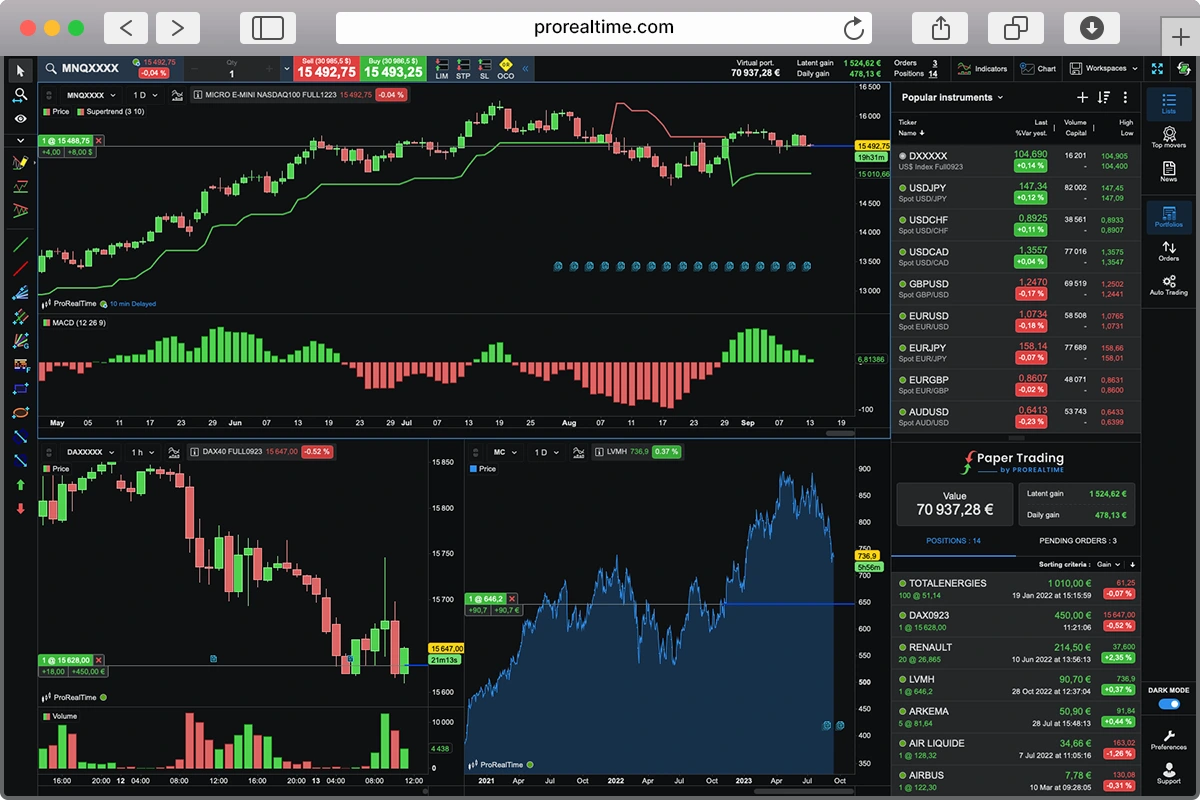
This is where IG shines for advanced traders. ProRealTime is an institutional-grade charting platform with the ProOrder module for automated trading. You get advanced indicators, tick-by-tick data, and a backtesting engine (ProBacktest) that runs strategies against historical data.

ProRealTime Complete starts at €24/month, but IG may waive the fee for active traders (check with IG for conditions). This means potential free access to one of the best charting and backtesting platforms in Europe.
Direct Market Access (DMA)
Most retail brokers act as market makers: you trade against the broker, not on the actual exchange. IG also runs a DMA model where your orders go directly to the exchange order book. You see real bid/ask depth, your order competes with institutional flow, and execution happens at the exchange price.
DMA is available on forex (via Forex Direct) and on shares. The pricing structure is different: instead of a spread markup, you pay a commission on top of raw market spreads. Check IG's DMA page for current rates.
DMA is not for everyone. It is designed for experienced traders who want tighter spreads, better fills on large orders, and the ability to see market depth. If you trade small sizes and do not care about a few tenths of a pip on spreads, the standard account is simpler.
Order types
IG covers the full range: market orders, limit orders, stop orders, trailing stops, and guaranteed stops (for a premium). Guaranteed stops are worth noting because they protect you from slippage during volatile events like central bank announcements or earnings gaps. Most brokers do not have them.
Crypto Trading
IG covers major cryptocurrencies via CFDs: Bitcoin, Ethereum, Litecoin, Bitcoin Cash, Ripple, and others. You trade on price movements with leverage, the same way you trade forex or indices on IG. You do not own the underlying coins.
Crypto CFD spreads are variable and wider than dedicated crypto exchanges, which is typical for CFD brokers. Margin requirements follow ESMA rules.
If you want to actually own and hold crypto, IG is not the right place. A dedicated exchange like Coinbase or Kraken will serve you better. If you just want leveraged exposure to Bitcoin alongside your forex and index positions, IG keeps it all in one account.
Mobile App
The IG mobile app mirrors the web platform closely. Real-time pricing, full order types, charting with 33 indicators, and price alerts all work as expected.


Placing trades takes two taps. The watchlist syncs between desktop and mobile. Push notifications for price alerts work reliably. Where the app falls short is customization: you cannot create complex multi-chart layouts like on desktop. For monitoring positions and quick trades, it is excellent. For deep analysis, stick to desktop or ProRealTime. See our best mobile trading apps comparison for alternatives.
Comparing IG with Competitors
| Feature | IG | ProRealTime | Pepperstone | eToro | CMC Markets |
|---|---|---|---|---|---|
| Forex spread (EUR/USD) | From 0.6 pips | Via broker (IG, IBKR) | From 0.1 pips | Varies (check eToro) | From 0.0 pips (FX Active) |
| Share dealing | €0 (stocks/ETFs) | N/A (platform only) | N/A | $1-2/trade | Varies by market |
| Markets | 17,000+ | Depends on broker | 1,400+ | 7,000+ | 12,000+ |
| Regulation | 11 licenses (8 Tier-1) | N/A (not a broker) | Multiple (incl. FCA, ASIC) | Multiple (incl. FCA, ASIC) | Multiple (incl. FCA, ASIC) |
| Crypto (direct) | CFDs | N/A | CFDs only | Yes (direct + CFDs) | CFDs only |
| Advanced charting | Good | Excellent | Basic | Basic | Good |
| Backtesting | Via ProRealTime | ProBacktest | No | No | No |
| Spread betting | Yes (UK) | Via broker | Yes (UK) | No | Yes (UK) |
| Inactivity fee | $18 (24 months) | N/A | None | $10 (12 months) | £10 (12 months) |
| Trustpilot | 3.8/5 (9,000+) | N/A | 4.3/5 (3,300+) | 4.2/5 (25,000+) | 4.3/5 (3,000+) |
Best for charting and automation: ProRealTime (available through IG) gives you the most powerful charting and backtesting tools. If systematic trading is your focus, the IG + ProRealTime combination is one of the strongest setups available to retail traders in Europe. For futures traders, NinjaTrader and cTrader are worth comparing.
Best for low-cost forex: Pepperstone. The Razor account with 0.1 pip spreads and no inactivity fee beats IG on pure cost. But Pepperstone covers fewer markets overall (1,400+ vs 17,000+).
Best for social trading: eToro. Copy trading and a large community of traders are not something you will find on IG. If learning from other traders matters to you, eToro fills that gap.
Best for multi-asset breadth: IG. With 17,000+ markets, 11 regulatory licenses, and spread betting alongside CFDs and share dealing, no broker on this list matches IG’s overall coverage. For a deeper comparison, see our best IG alternatives guide.
Education and Research
IG Academy is a structured learning program with courses ranging from beginner fundamentals to advanced strategies. The content is free, covers forex, shares, indices, and risk management, and includes interactive exercises.

Beyond the academy, IG publishes daily market analysis, hosts regular webinars with their in-house analysts, and integrates Reuters news directly into the platform. The economic calendar is filterable by impact level and well-designed.


For beginners, the demo account gives you virtual funds and full access to all platform features. It runs on live market data, so the experience matches real trading closely.
The gap: IG discontinued its Community feature, and no new educational courses have been added recently. The existing library is solid, but dedicated trading education platforms go deeper.
Is IG Good for Beginners?
It depends on what you want to do. For buying and holding shares through the share dealing account, IG works fine for beginners. The IG Academy covers the fundamentals, the demo account lets you practice with virtual funds, and the share dealing account has no leverage and no risk of losing more than you put in.
For CFD trading, the answer is different. CFDs are leveraged products. A 5% move against you on a 20:1 leveraged position wipes out your entire margin. The platform itself can feel overwhelming for someone who has never traded before: multiple order types, margin calculations, overnight financing charges, and a Trustpilot review section full of beginners who lost money they did not understand they could lose.
The 71% retail loss rate is not a quirk of IG. It is the reality of leveraged trading. If you are new to trading, start with the demo account or the share dealing account. Build experience before touching CFDs.
Final Words
IG is not the cheapest broker, not the flashiest, and not the one with the most aggressive marketing. What it is: one of the most complete brokers available to European traders. Fifty years in business, listed on the London Stock Exchange, regulated in 11 jurisdictions, and covering 17,000+ markets from a single account.
The fee structure is fair without being the lowest. The platforms are strong, especially with ProRealTime bolted on. Crypto CFDs round out the product range. And the regulatory coverage gives a level of fund protection that newer, smaller brokers simply cannot match.
If you are a European trader who values breadth, trust, and solid execution over rock-bottom prices, IG belongs on your shortlist. Start with a free demo to test the platform before committing real capital.
FAQ
Is IG a legit and trusted broker?
Yes. IG holds 11 regulatory licenses including 8 Tier-1 regulators (FCA, ASIC, FINMA, JFSA, MAS, CFTC, FMA, BaFin/MiFID EU). The parent company, IG Group Holdings plc, is publicly traded on the London Stock Exchange. UK client funds are protected up to £85,000 by the FSCS. EU clients are protected up to €100,000 by the German compensation fund (EdW) via IG Europe GmbH. On Trustpilot, IG has a 3.8/5 rating across 9,000+ reviews.
How much does it cost to trade on IG?
IG charges through spreads on CFDs and spread bets (EUR/USD from 0.6 pips), plus overnight financing if you hold positions past market close. Share dealing on stocks and ETFs is commission-free. The inactivity fee is $18/month, but only kicks in after 24 months of no trading. No deposit or withdrawal fees for UK clients. Minimum deposit: €1.
Is IG good for beginners?
For share dealing and learning via IG Academy, yes. For CFDs, proceed with extreme caution: 71% of retail accounts lose money trading CFDs on IG. Beginners should start with the demo account (virtual funds), or use the share dealing account, not leveraged products.
Can you trade crypto on IG?
IG lets you trade major cryptocurrencies (Bitcoin, Ethereum, Litecoin, and others) via CFDs. You speculate on price movements with leverage but do not own the underlying coins. If you want to buy and hold actual crypto, use a dedicated exchange.
How does IG compare to eToro?
IG has wider market access (17,000+ vs 7,000+), stronger regulation (11 licenses vs multiple), and lower forex spreads (from 0.6 pips vs higher on eToro). eToro has share trading with low commissions ($1-2 per trade depending on country, plus spreads and conversion fees), social/copy trading features, and a lower inactivity fee trigger (12 months vs 24 months). Choose IG for breadth and regulation. Choose eToro for social and copy trading.

Cedric is a seasoned investment management strategist with over a decade of experience, currently working at TTUTC. He holds dual prestigious designations as a Chartered Market Technician (CMT) and Chartered Financial Analyst (CFA).
Start Trading on a Demo Account with
ProRealTime Paper Trading Simulator.