SpaceX Q2 Earnings: Growth Beats Estimates, So Does Spending


$7.8 billion. That’s SpaceX’s revenue for the second quarter, up 92% year on year.
The stock sold off after the close all the same.
By publishing its accounts on 4 August, SpaceX also set the date for a second event hanging over the shares.
Key takeaways
- SpaceX revenue grew 92% to $7.81 billion. All three divisions beat the analyst consensus.
- The stock gave up 7.46% after the close, on capital spending of $18.37 billion, $15.83 billion of it in the AI segment alone.
- On 6 August the first lock-up period expires: employees and early investors can sell up to 911.5 million shares.
A first set of accounts that beats the consensus
SpaceX published its second-quarter accounts on 4 August, after the Wall Street close. It’s the company’s first report since listing on 12 June. [1]
Revenue came in at $7.81 billion, up 92% year on year. Analysts polled by FactSet had expected $6.8 billion. [2]
All three of the company’s business segments did better than forecast.
| Division | Revenue | Year on year | Consensus | Operating result |
|---|---|---|---|---|
| Connectivity (Starlink) | $4,291M | +66% | $3,830M | +$1,656M |
| AI (xAI, X, cloud) | $2,561M | +247% | $2,180M | −$1,257M |
| Space (launches) | $962M | +29% | $835M | −$542M |
The net loss narrowed to $541 million, from $1,008 million a year earlier. The consensus had braced for far worse, at $1.9 billion.
Adjusted EBITDA reached $3.54 billion, close to triple last year’s figure. At the operating level, the group’s loss fell to $143 million from $970 million in the second quarter of 2025.
The group ended the period with $100 billion in cash and a $47.5 billion backlog.
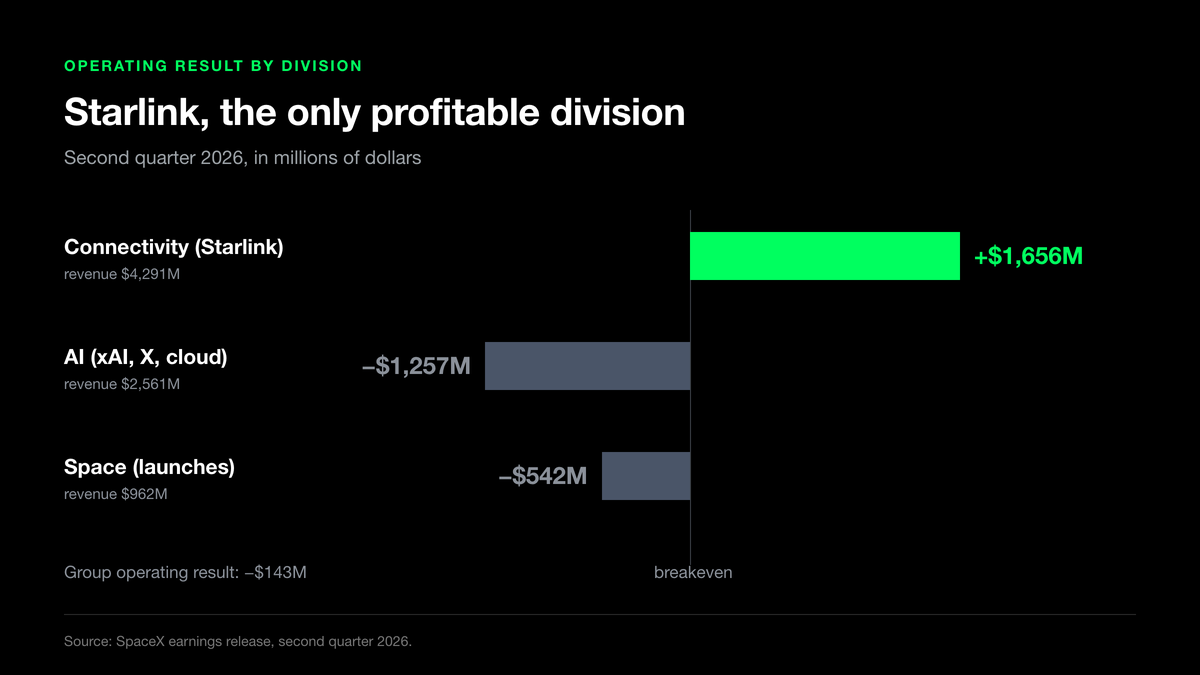
Starlink alone accounts for 55% of group revenue. The division passed 12 million subscribers, twice as many as a year ago, and remains the only one turning an operating profit.
The AI division posted the fastest growth, at 247%. It covers xAI, the social network X, and compute capacity rented out to customers. SpaceX signed $14.1 billion of cloud services contracts during the quarter.
The Space division carried out 78 rocket launches in the first half, putting 1,041 metric tons into orbit. Most of that served to deploy the Starlink constellation, and so to feed another division of the group.
Why the stock fell once the numbers landed
The market is worried about the level of capital spending. It hit $18.37 billion for the quarter, against analyst forecasts of roughly $13 billion. [2]
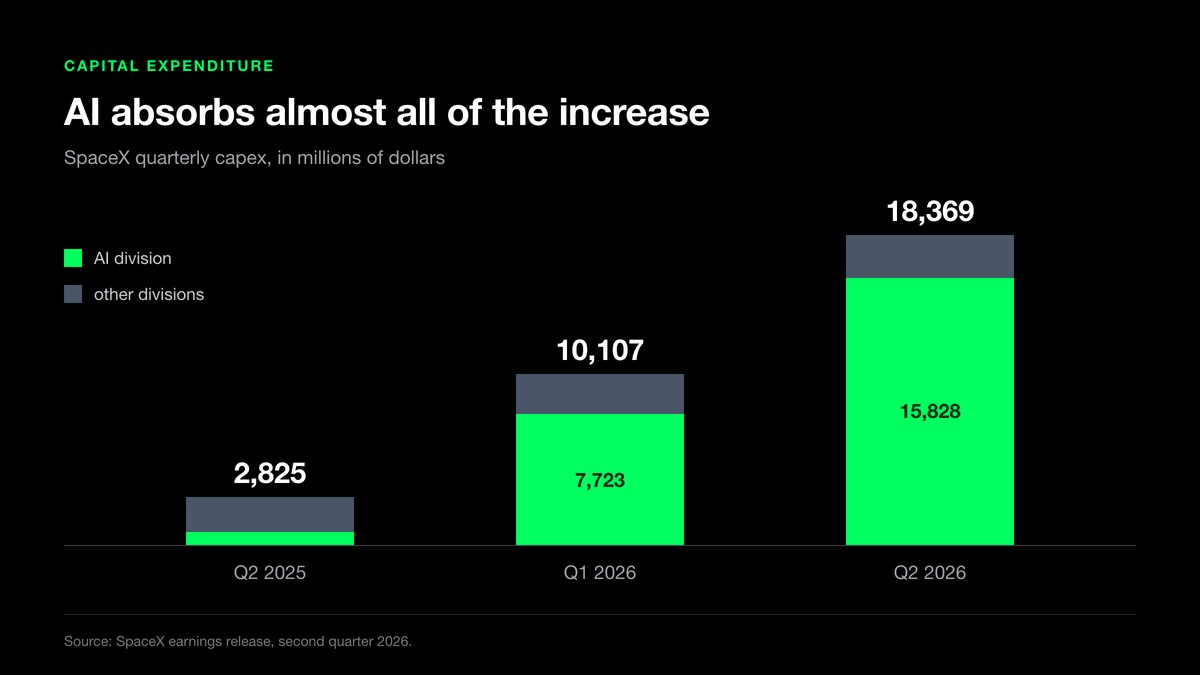
The AI division alone spent $15.83 billion over the quarter, against $749 million in the second quarter of 2025, 21 times more in a year. SpaceX is building data centres and its capacity has gone from 1.0 to 1.4 gigawatts in three months.
The company has an answer to that. Its chief financial officer said a further $6.7 billion of cloud revenue is already under contract, ramping from October. [5]
The stock had in fact closed the 4 August session up 9.43%, at $125.33, its strongest gain since 15 June.
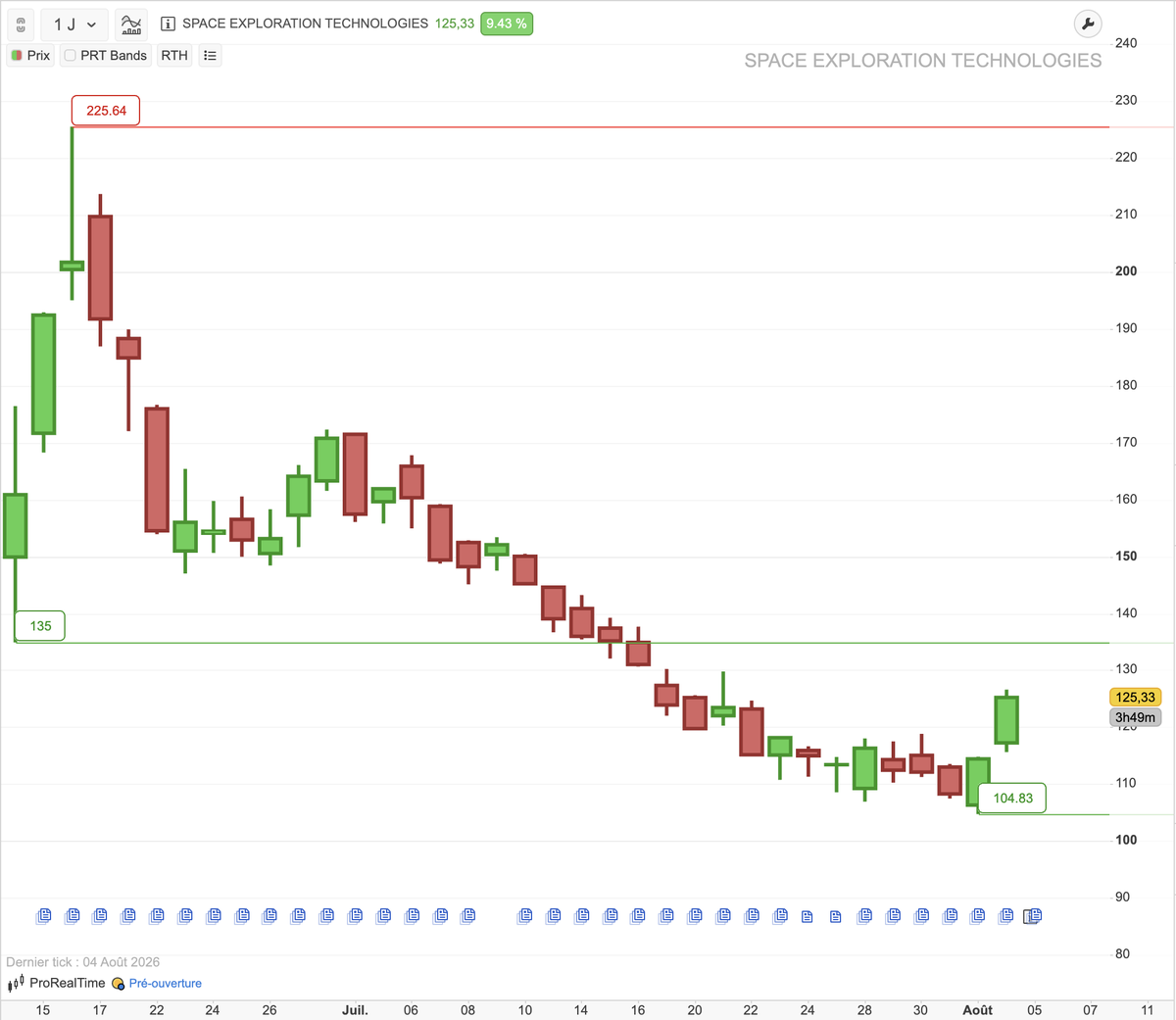
The accounts landed after the close. In after-hours trading, the stock gave up 7.46%, to $115.98. [3]
911 million shares unlock on 6 August
From 6 August, employees and early investors can sell up to 911.5 million shares. That marks the end of a first blocking period, what the market calls the lock-up. [4]
The date is anything but arbitrary. The lock-up terms set the unlock for the second trading day following the first earnings release. The 4 August report therefore fixed 6 August.
The group split its lock-up into tranches, instead of the standard 180 days in one block. The aim is to spread the selling rather than concentrate it in a single session.
The unlock creates no new shares, so it doesn’t dilute existing holders. What it does is increase the number of shares that can be sold, in a company where only a small part of the capital could trade until now.
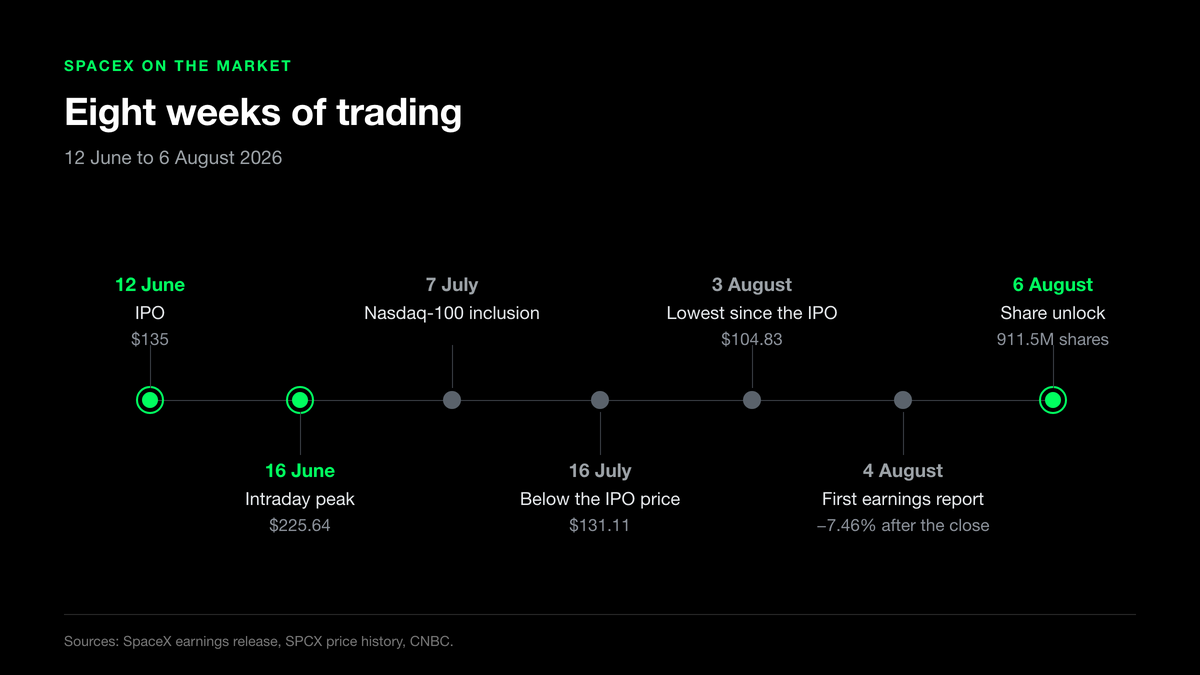
A further tranche of 455.8 million shares could have joined them. It required the stock to close 30% above the IPO price, or $175.50, on five of the ten sessions before the results. The highest close over that window was $123.54, on 21 July. The threshold wasn’t met.
Shares held by Elon Musk and a handful of executives stay locked until mid-2027. [6]
Short sellers piled in as the stock fell. On 21 July, CNBC reported that their positions had reached about a third of the free float. [4] If insiders sell less than the market expects, those sellers will have to buy back to close their positions, which would support the price.
AI turns a corner, Starlink earns less per subscriber
The AI division generated $1,146 million of adjusted EBITDA in the second quarter. It turns positive on that measure, after a $609 million loss in the previous quarter and $276 million a year earlier. [1]
Its operating result stays negative, at a loss of $1,257 million. The gap between the two measures comes from depreciation and share-based compensation, which adjusted EBITDA leaves out. Writing that the AI division makes money would therefore be wrong.
It did cut its operating loss by 49% in a single quarter, while revenue grew 213%.
That turnaround has a price. The division’s capital spending reached $15.83 billion over the quarter, six times its revenue.
Starlink’s average revenue per subscriber stands at $66 a month, against $85 a year earlier, 22% less.
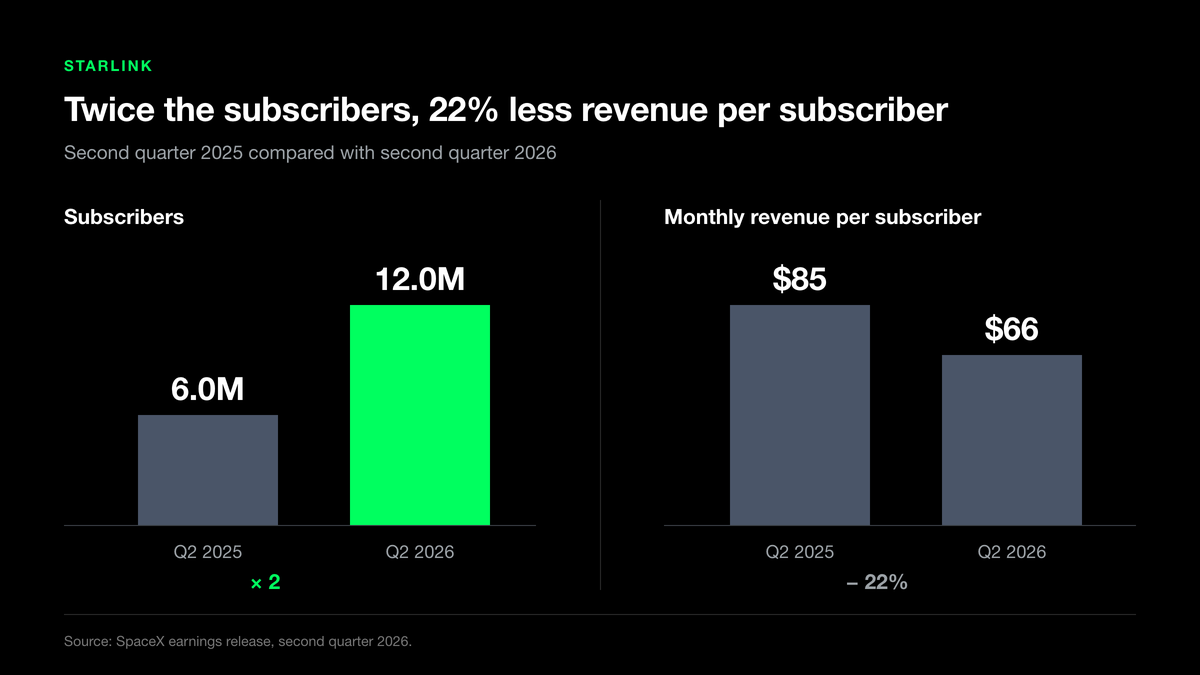
Subscriber numbers doubled over the same period, to 12 million. Divisional revenue is growing, then, while revenue per customer falls.
That revenue per subscriber has held steady for two quarters, at $66. The drop happened earlier, between the second quarter of 2025 and the first quarter of 2026, not in the quarter just reported.
The release gives no explanation for the decline. It does note that growth increasingly comes from businesses and government, whose revenue is up 108% year on year, against 44% for consumers.
Following SPCX from Europe
SPCX is an ordinary share listed on the Nasdaq. It trades like any other US stock, at any broker that gives access to that market.
There is a second exposure, and plenty of people hold it without having chosen it. SpaceX joined the Nasdaq-100 on 7 July, which pulled the stock into every index fund tracking the benchmark, as we covered in our article on its inclusion.
For anyone following the stock, volatility matters. Priced at $135 on 12 June, it reached $225.64 intraday on 16 June, 67% above. On 3 August it touched $104.83, 22% below its IPO price and 54% below its peak.
On a stock like this one, the move happens during the session, and delayed prices cost traders money.
SpaceX results: what to take away
For a first report as a listed company, the accounts are surprisingly good. Revenue is up 92%, the net loss has halved, adjusted EBITDA has almost tripled. All three divisions beat analyst expectations, Starlink passed 12 million subscribers, and the AI division cut its operating loss in half in a single quarter.
The stock still sold off after hours, mainly because of the spending. SpaceX invested $18.37 billion over the quarter, five more than expected, including $15.83 billion for the AI division alone.
The report isn’t the only event to watch. From 6 August, employees and early investors can sell up to 911.5 million shares, locked up since the listing.
Hence a note of caution. In eight weeks of trading, the stock has already put together a session up 19.6%, on 15 June, and another down 16.4%, on 22 June. On the eve of an unlock this size, it doesn’t trade like a buy-and-hold position.
Article sources

Audrey holds a Diploma in Accounting and Financial Studies (DECF) and has over 15 years of professional experience in the banking and accounting sectors.
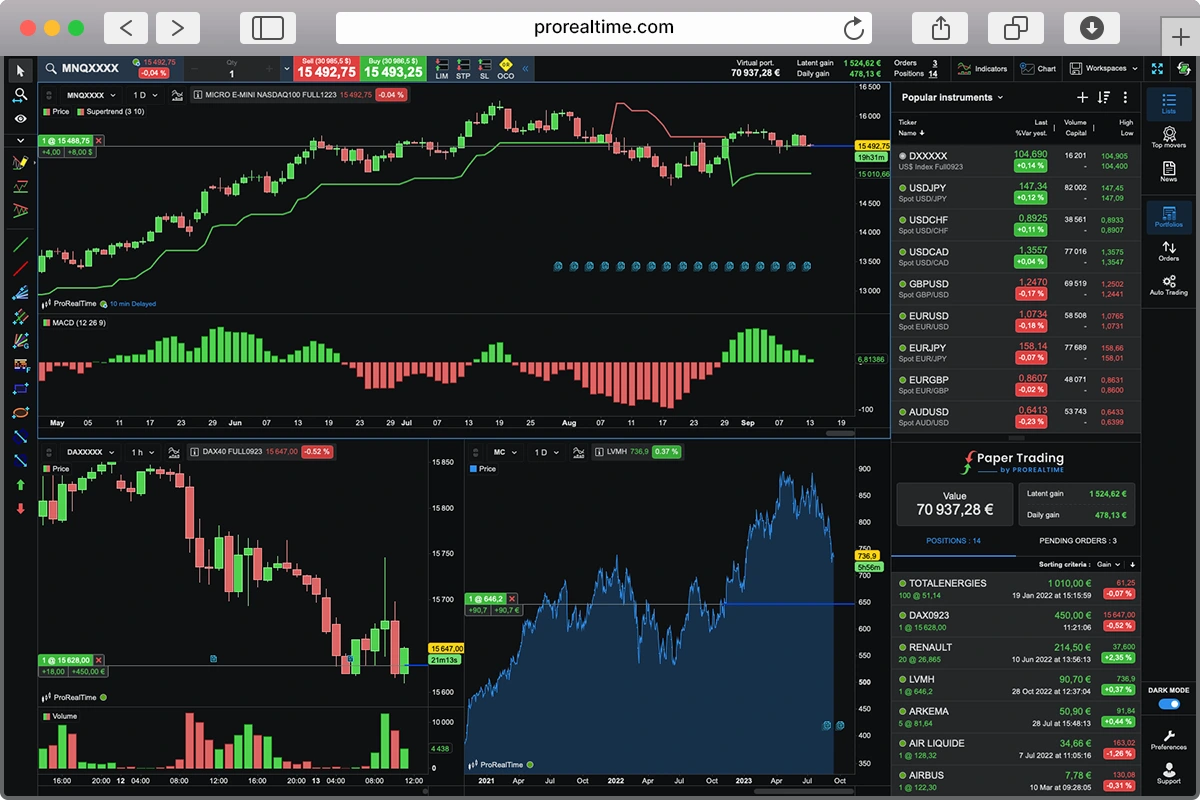
Enjoy free trading practice on
ProRealTime Paper Trading Simulator.