Shein IPO: What Is the Stock Worth Against European Risk?


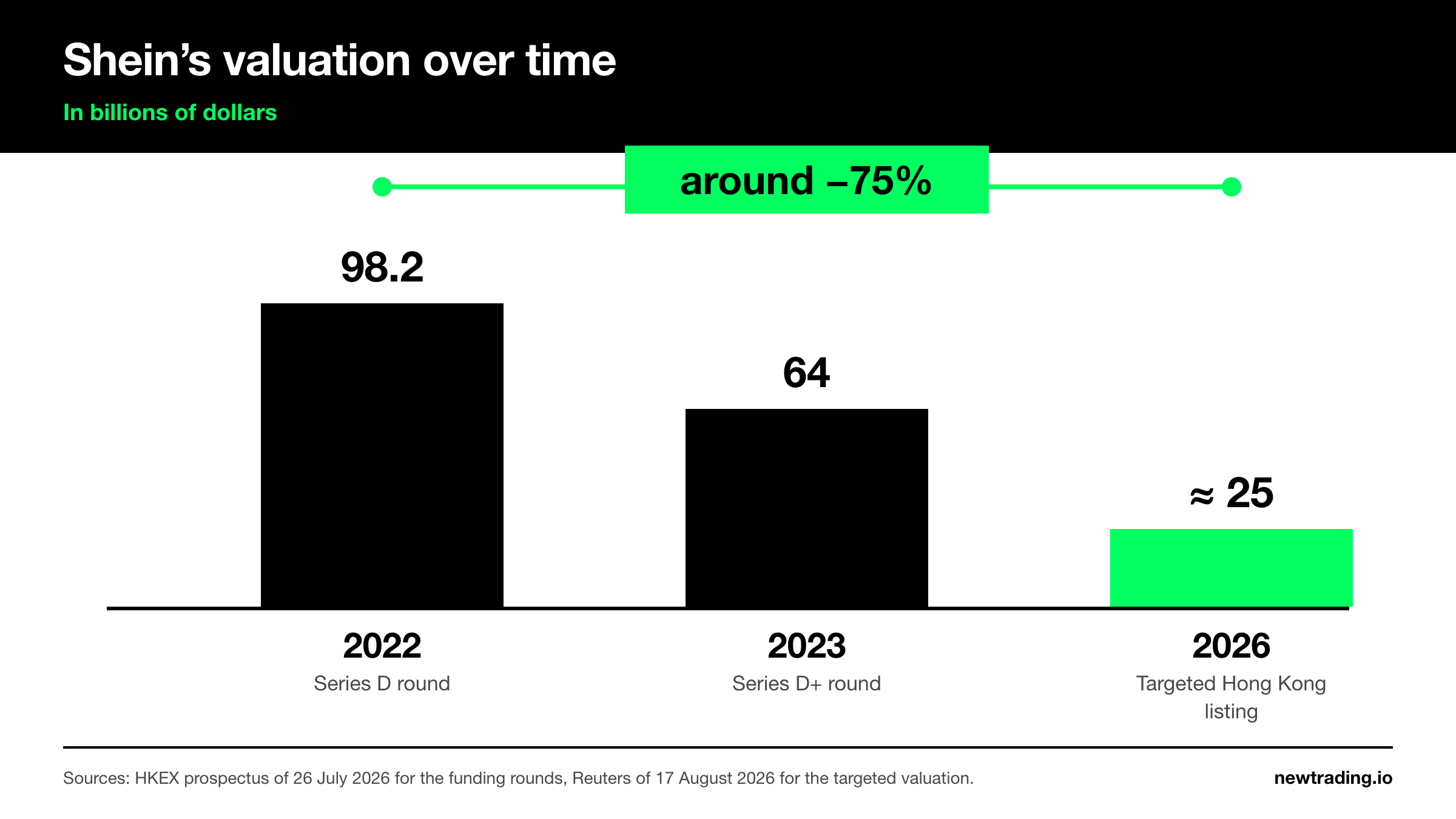
$26.8 billion. That is what Shein is worth at the top of the price range set for its Hong Kong listing, due on 1 September. In 2022, a private funding round valued the company at $98.2 billion.
Key points
- Shein is targeting up to $26.8 billion. Its net profit is down 38.7% and the first quarter of 2026 is in the red.
- Europe is its largest market at 35.4% of revenue. Regulatory deadlines could disrupt its results: customs duties, a French penalty of up to 50% of the sale price, and an advertising ban.
- Subscribing to the offer is not possible from Europe: the public tranche is reserved for Hong Kong residents, and the international tranche is placed with institutional and professional investors. From 1 September, the stock can be traded on the secondary market through a broker that gives access to the Hong Kong exchange.
Shein’s IPO: the prospectus numbers
Shein published its final prospectus on 24 August. The offer covers 279,992,500 class B shares in a range of HK$47.60 to HK$49.50, for a maximum raise of HK$13.86 billion, or $1.77 billion. [1]
Shein posted $41.8 billion in net revenue for 2025, up 8%, with 273 million active customers.
Net profit, though, fell from $3,365m to $2,064m, a drop of 38.7%. And in the first quarter of 2026, Shein swung from a $395m profit a year earlier to a $99m loss.
Two line items are eating into the margin.
- Marketing jumped 48.9% in a year.
- Logistics costs rose from 43.5% to 45.6% of revenue, driven by the marketplace ramp-up.
The fall in profit comes mainly from the change in fair value of the convertible preference shares, down from $2.4 billion in 2024 to $0.3 billion in 2025. The same mechanism is at work in the first quarter of 2026: the $99m loss is mostly explained by a $328m fair-value loss on those same instruments.
| Metric | 2024 | 2025 | Q1 2026 |
|---|---|---|---|
| Net revenue | $38,748m | $41,847m | $9,052m |
| Net profit | $3,365m | $2,064m | -$99m |
| Operating margin | 2.5% | 4.1% | 2.9% |
| Europe’s share | 35.1% | 35.4% | 32.1% |
| US share | 27.0% | 24.1% | 22.5% |
| Marketing spend | $4,159m | $6,191m | not disclosed |
The prospectus flags a change in dividend policy. Shein has never paid one, but the company commits to distributing at least 50% of its profit each year once listed, after significant investments are deducted.
The IPO timetable and Shein’s valuation
Subscriptions in Hong Kong opened on 24 August at 9am and close on the 27th at noon, local time. The price has to be set before noon on 28 August: if Shein and the coordinators have not agreed by then, the offer is cancelled. The final price and the allocations are announced on 31 August, and the first trading day is 1 September.
The shares sold to the market do not carry the same weight as the founders’. A class A share carries ten votes, a class B share only one, except on four reserved matters where each share counts for one vote: amending the articles of association, appointing independent directors, appointing auditors, and voluntary liquidation. After the offering, the four founders keep 59.6% of the capital and 89.9% of the voting rights. Yangtian Xu holds 47% on his own.
Private funding rounds valued Shein at $98.2 billion in 2022, then $64 billion in 2023. The listing targets a little more than a quarter of that peak. Investors from those later rounds negotiated compensation, in cash and additional shares, to absorb the gap.
Europe, the largest market and the risks to plan for
Europe accounted for 35.4% of Shein’s revenue in 2025, or $14.8 billion. The United States slipped from 27.0% to 24.1% in a year. Europe is now Shein’s largest market.
Washington scrapped the customs exemption on small parcels from China on 2 May 2025. Shein’s US revenue fell 3.5% across 2025, then 14.3% in the first quarter of 2026 against the same quarter of 2025. The prospectus says it has since seen signs of purchasing behaviour normalising in the United States.
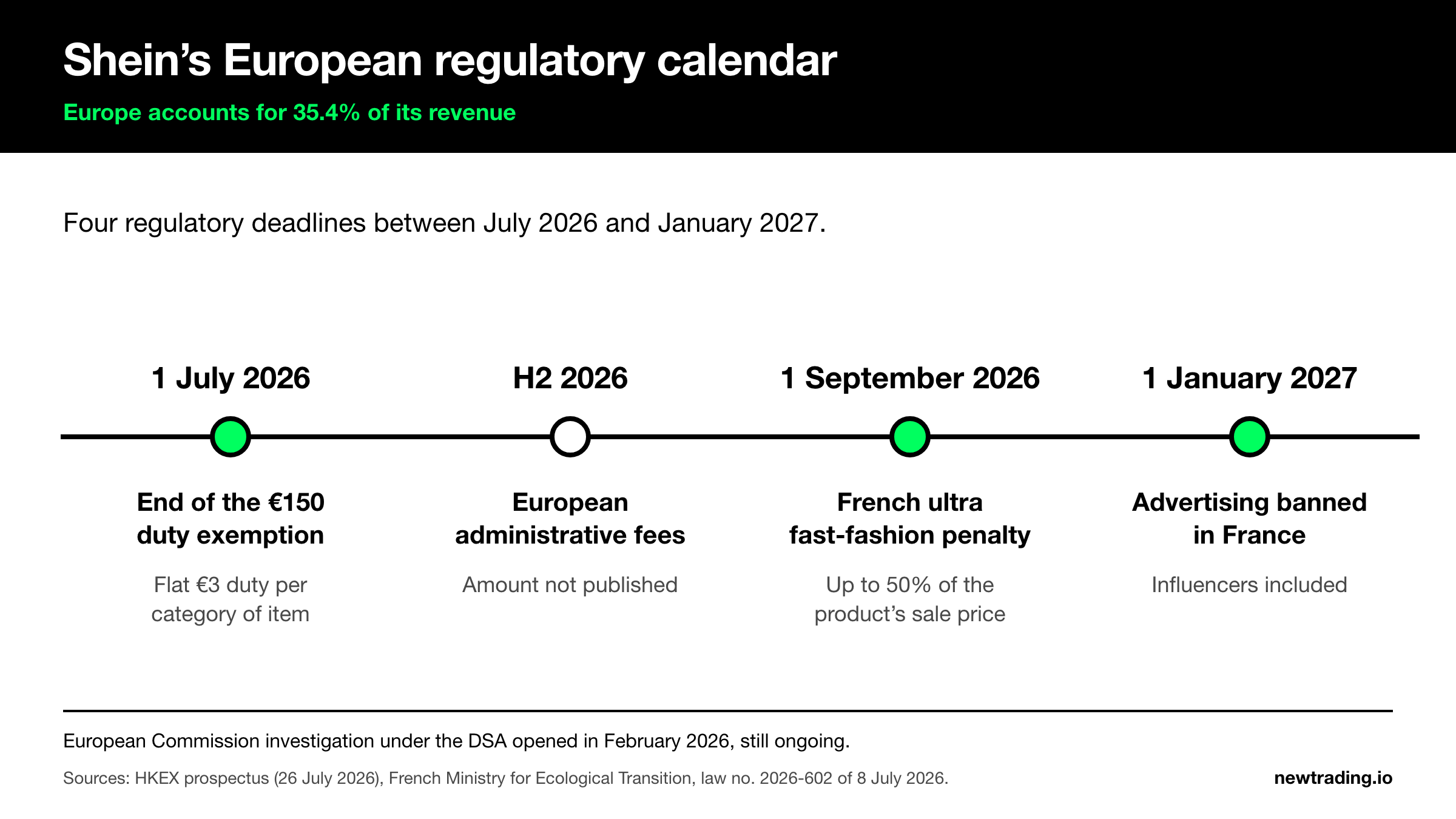
The European Union approved a regulation in February 2026 removing its customs duty exemption on shipments below €150. It took effect on 1 July 2026. A flat €3 duty applies to each category of item in a parcel. European administrative fees are due to be added in the second half of 2026.
Shein is weighing several responses, including raising its prices in Europe to offset part of the extra cost, with a possible short-term hit to volumes. The prospectus concedes that the European impact could match what the company saw in the United States, or exceed it.
In the first quarter of 2026, Europe was still growing: $2,908m, up 2.3% year on year. That is the last quarter reported before the new customs regime took effect.
Shein puts a number on the slowdown itself. The prospectus expects net revenue growth in the first half of 2026 to be “broadly in line” with the first quarter’s, that is 1.1%. The company points to higher customs duties and taxes, possible pressure on prices, weaker regional demand, and higher logistics, freight and raw material costs.
The European Commission classified Shein among the very large online platforms in April 2024, then opened a formal investigation in February 2026 under the Digital Services Act. It covers the systems for blocking illegal products, the risks tied to the service’s design, and the transparency of its recommendation systems.
Law no. 2026-602 of 8 July 2026 creates a penalty applicable from 1 September 2026, which can reach 50% of the product’s sale price. The French Ministry for Ecological Transition names its target plainly: “emblematic non-European platforms” [2] . Shein itself puts that penalty at €20 per item by 2030.
From 1 January 2027, France bans all advertising for ultra fast-fashion brands and products, including promotions by influencers.
Two unknowns remain. The criteria identifying which companies are covered still have to be set by decree. And Shein points out that the text can be challenged before the French Constitutional Council or the European Commission.
How to buy Shein from Europe
Subscribing to the offer is not possible from Europe. The 24 August prospectus reserves the public tranche for Hong Kong residents: those 27,999,300 shares, or 10% of the offer, “will not be offered to any person located outside Hong Kong and/or not resident in Hong Kong”.
The remaining 251,993,200 shares make up the international tranche, which is not a public offer but a placement with institutional and professional investors.
Buying becomes possible on 1 September, on the secondary market, through a broker that gives access to the Hong Kong exchange.
| Broker | Stated cost on Hong Kong |
|---|---|
| Saxo | 0.08% of the order with a HK$15 minimum on Classic [3] |
| Interactive Brokers | 0.08% of the order with a HK$18 minimum on the Fixed tier [4] |
| DEGIRO | €5.00 per order, plus €1.00 in handling fees [5] |
The list of accessible venues varies widely from one broker to another. You can check it in their pricing terms.
Two costs come on top of brokerage commissions.
- Hong Kong levies stamp duty of 0.20% per transaction, split equally between the two parties, so 0.10% falls to the buyer.
- And the stock trades in Hong Kong dollars, which means converting from a euro account.
The session runs through the European night. During European summer time, the Hong Kong exchange opens at 3:30am CEST and closes at 10am, with a lunch break from 6am to 7am. An order placed during the European day will execute in the next session.
Shein IPO: key takeaways
Shein is going public with revenue up 8%, net profit down 38.7% and a first quarter in the red, both declines coming first of all from the accounting value of its preference shares. The target valuation, up to $26.8 billion, is a little more than a quarter of the 2022 peak.
The Hong Kong exchange is coming off its best first half in five years. The venue raised HK$209.9 billion across 85 listings, 92% more than a year earlier according to KPMG [6] . More than 500 filings are waiting their turn. Shein arrives on a buoyant market, with a valuation cut to roughly a quarter of what it was in 2022.
Europe accounts for 35.4% of revenue, and it is where the regulatory deadlines most likely to shake the company’s results are piling up. The US market, hit by the same customs shock a year earlier, fell 14.3% in the first quarter.
Trading Shein or other Hong Kong stocks means opening an account with a broker that gives access to Asian venues. Our comparison of the best trading platforms covers the main options.
Article sources

Audrey holds a Diploma in Accounting and Financial Studies (DECF) and has over 15 years of professional experience in the banking and accounting sectors.
Enjoy free trading practice on
ProRealTime Paper Trading Simulator.