Interactive Brokers MCP: How Far Can AI Go on Your Account?


On 28 July 2026, Interactive Brokers widened its AI integration. You can now plug your account into the AI tool of your choice. ChatGPT, Claude Code, Cursor, and Perplexity all reach your portfolio through the MCP standard.
How far can AI go on a brokerage account? At Interactive Brokers, it stops just before the order. MetaTrader 5, Capital.com, and eToro drew the line somewhere else.
The Interactive Brokers AI integration
Interactive Brokers announced on 28 July 2026 that its clients can connect their account to nearly any AI tool on the market. [1] Until now, only the certified marketplaces for ChatGPT, Claude, and Grok gave you that connection.
The list now covers any tool that supports the Model Context Protocol. The press release names Claude Code, Cursor, Perplexity, and Windsurf. Gemini comes later.
The Model Context Protocol, or MCP, is an open standard that describes how an artificial intelligence application talks to an outside service. Anthropic published it on 25 November 2024. [3] It has since become the common format across the industry.
Milan Galik, the broker’s chief executive, sees support for MCP tools as a “natural extension” of the open API philosophy Interactive Brokers has followed for years.
Once the connection is live, the AI tool reaches the data of the account you authorised and the markets the broker covers, more than 170 of them. The integration runs on five in-house platforms: Client Portal, IBKR Desktop, IBKR GlobalTrader, IBKR Mobile, and Trader Workstation.
What the AI can reach on your account
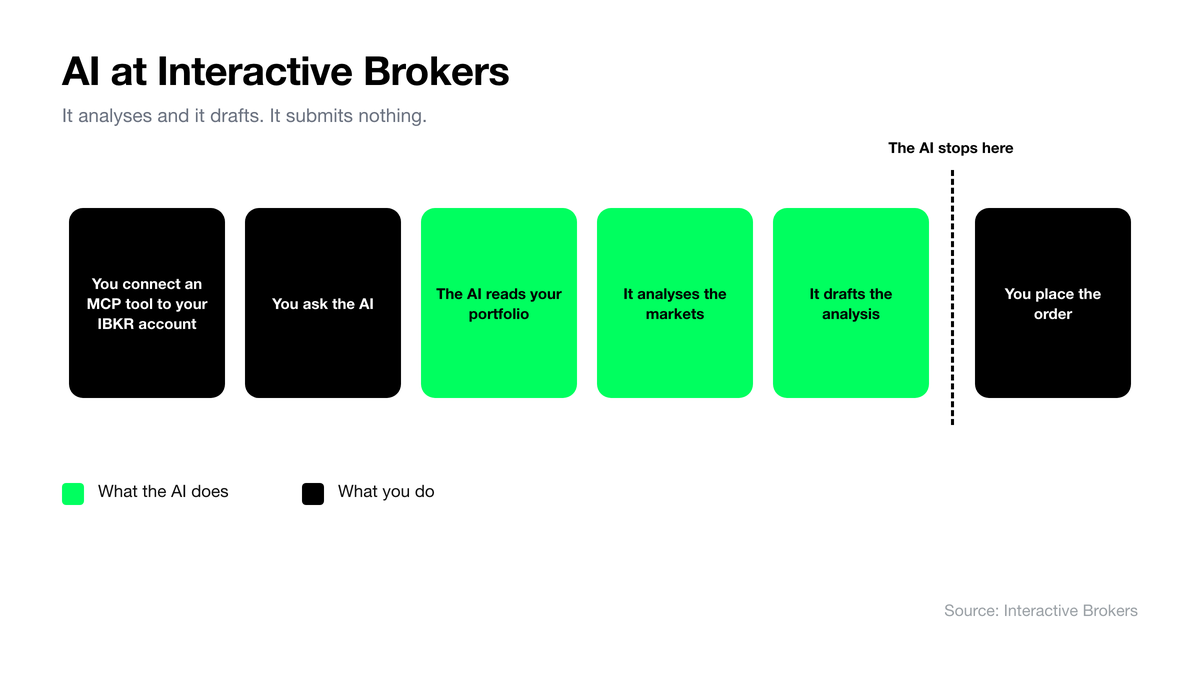
Connecting your Interactive Brokers account to an AI tool takes four steps:
- open the tool’s “add MCP server” or “custom connector” setting;
- paste the IBKR connector address, https://api.ibkr.com/v1/api/mcp-public;
- log in through the secure Interactive Brokers screen;
- authorise access for a single account.
The tool then reads your portfolio and analyses the markets available at the broker. IBKR gives four examples of questions to ask.
- How would the portfolio be affected if interest rates rise, and which holdings are the most sensitive?
- What is the implied volatility of each position, with its 52-week high and low?
- What is the currency impact if the dollar weakens 10% against the largest foreign exposures?
- If the S&P 500 fell 10%, how would the portfolio be affected, and which strategies would help manage that risk?
The questions go beyond portfolio analysis. The broker’s product page adds pure research examples, such as spotting the sectors where robotics and automation overlap.
That same page sets the limits of working with AI [2] : “Instructions never become orders automatically”.
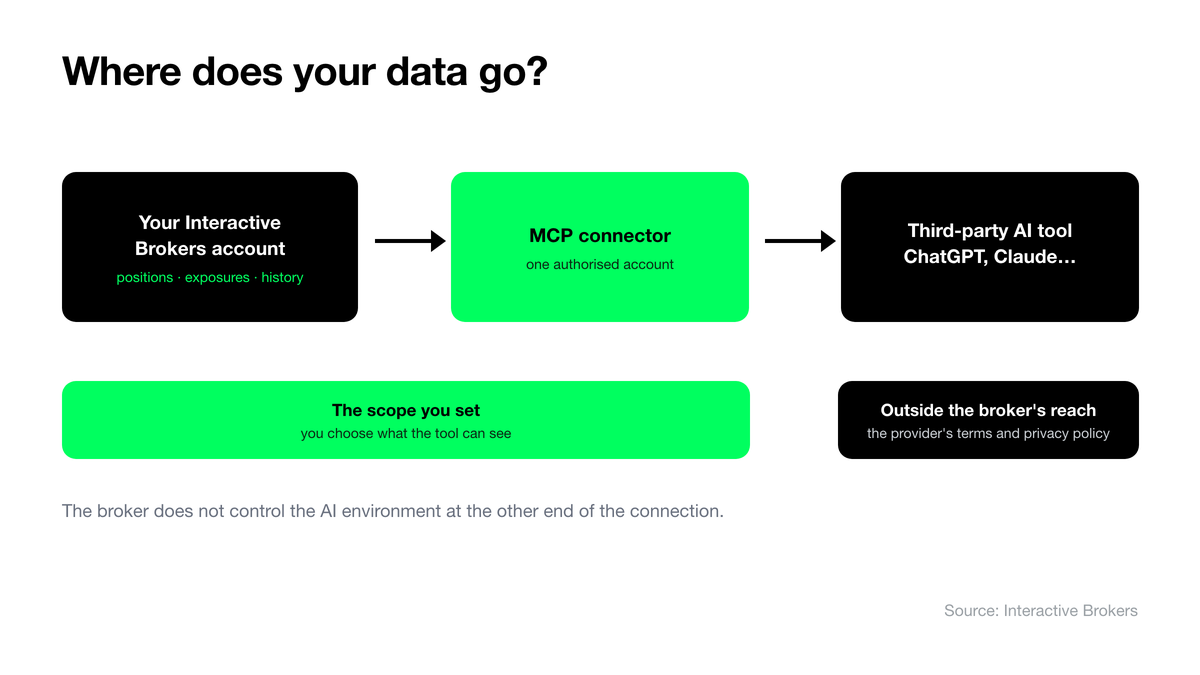
You keep control over:
- the account data the AI can see;
- placing the order.
One thing sits outside the broker’s reach. Its documentation describes what you authorise on its side, and says nothing about what the AI tool does with the data it reads. Positions, exposures, and transaction history travel through a third-party service, with its own terms of use and its own privacy policy.
AI at MetaTrader 5, Capital.com, and eToro
Interactive Brokers is not the only one wiring AI into client accounts.
| Platform | Standard | Can the AI place the order? | Announced availability |
|---|---|---|---|
| Interactive Brokers | MCP open to any tool | No, the client enters the order | Dedicated Europe page, on the group’s Irish entity |
| MetaTrader 5 | MCP native in the platform | Yes, agents carry out the operations | Built in since build 6060 |
| Capital.com | Open MCP, local plugin | Yes, after a two-step confirmation | Eligible clients of the MENA entity |
| eToro | Proprietary ecosystem, no MCP | Yes, agents that trade around the clock | Varies by jurisdiction |
MetaTrader 5 has handled the MCP protocol and agentic AI natively since build 6060, released on 23 July 2026. [4] MetaQuotes describes an integration for trading, analysing markets and strategies, and building and testing Expert Advisors with the help of AI. Connected agents read market information, work inside the trading environment, and carry out the operations they are asked for.
Nothing to configure. Signing in with an MQL5.community account opens the free MQL5 Lite plan and adds the required API key automatically. If you prefer your own keys, you can go through OpenAI, Anthropic, Gemini, DeepSeek, or Ollama. Alongside the built-in assistant, the platform accepts external systems such as OpenAI Codex or Claude Code.
Capital.com opened its MCP server on 8 June 2026. [5] Free and open source, the plugin runs locally on the client’s own machine. It works with Codex, Claude Desktop, and Cursor.
The scope covers live market data, open positions, portfolio exposure, historical prices, and aggregated client sentiment. You can place an order from the assistant, through a mandatory preview and a two-step confirmation. The broker, for its part, disclaims any legal responsibility for the MCP it describes and for how the models behave.
Access is restricted to eligible clients of Capital Com Mena Securities Trading LLC, the entity licensed by the Capital Market Authority. Nothing equivalent exists on the broker’s European site, whose newsroom makes no mention of MCP.
eToro built its AI in house. On 7 July 2026, the platform unveiled Tori, its own AI agent, alongside a redesign of its app. [6] Its press release makes no mention of MCP.
Investors can build or copy agents that trade around the clock on their behalf, each one running inside its own sub-account. eToro is building its own ecosystem around them, with an App Store and a developer portal.
AI and trading: what to take away
Brokers and trading platforms now present AI as a feature in its own right. But they have not dropped the warnings.
Capital.com and eToro both state that their tools give no investment advice. The first disclaims any legal responsibility for how the models behave. MetaQuotes points the user back to their own judgement.
Interactive Brokers goes further and keeps the order out of the AI’s reach. Turning analysis into an order stays manual for now.
AI may well be a real step forward for trading, but it does not erase market risk. Capital.com states that 89% of retail investor accounts lose money trading CFDs, [7] and writes that its tool does nothing to reduce that risk.
The decision to enter or exit a position still belongs to the trader, along with meeting margin calls and absorbing losses. A trader leans first on their knowledge of the markets and on a strategy built carefully and tested in different conditions.
Learning the craft and understanding how markets work is what lets you think critically about what the AI suggests and analyses.
Article sources

Audrey holds a Diploma in Accounting and Financial Studies (DECF) and has over 15 years of professional experience in the banking and accounting sectors.
Enjoy free trading practice on
ProRealTime Paper Trading Simulator.