The Leap: TradingView’s Paper Trading Competition Returns July 20 With $50,000 at Stake

On July 20, TradingView kicks off a new edition of The Leap, its paper trading competition, this time run with the US broker TradeStation. The idea fits in one sentence: $100,000 in virtual money, 26 days to grow it on US futures, and real prizes for the top 250, including $10,000 for the winner. By July 17, more than 4,700 traders had already signed up.
On paper, that’s risk-free trading with very real winnings. Read the fine print, though, and a few conditions deserve your attention before you click “Join The Leap”. Here’s what the rules say, what this competition can teach you, and what it can’t.
The Leap runs from July 20 to August 14, 2026 on US futures, starting with $100,000 in virtual money. Registration stays open until August 9.
The top 250 win real prizes, including $10,000 for first place. You need a paid or trial TradingView subscription to take part.
The ranking rewards absolute gains with no risk penalty: the strategy that wins a competition is roughly the opposite of how you’d manage a real account.
How the competition works
Signing up takes three steps on the official competition page. You connect your TradingView account, join The Leap while registration is open, then paper trade for the duration of the event.
The dates to remember:
- the competition runs from July 20 to August 14, 2026;
- registration stays open until August 9;
- you need to trade on at least 5 days to be ranked.
Every participant starts with $100,000 in virtual money. The ranking comes down to a single criterion: the highest gain at the end of the 26 days. No Sharpe ratio, no penalty for drawdowns. Whoever grows their fictional $100,000 the most wins, no matter how they got there.
As for instruments, this edition sticks to US futures: the S&P 500, Nasdaq-100, and Dow Jones indices in E-mini and micro contracts, gold and crude oil, plus micro Bitcoin, Ether, and EUR/USD contracts. A fitting lineup for co-organiser TradeStation, which specialises in futures.
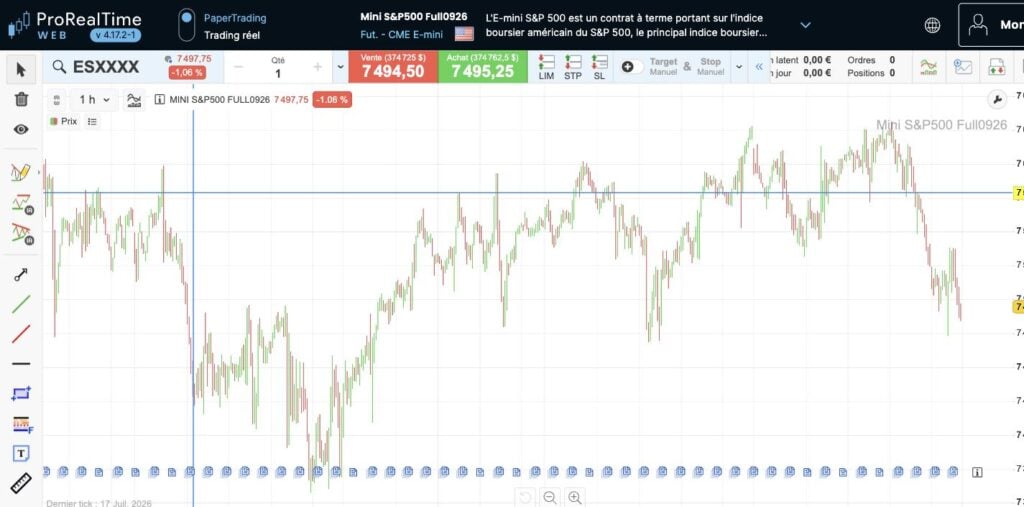
E-mini, micro: what does that mean
If you’re coming from stocks, the instrument list can be disorienting. A futures contract controls a sizeable notional value: every index point gained or lost converts into dollars, multiplied by the contract size. That structural leverage is what makes futures fast, in both directions.
| Contract | Size |
|---|---|
| E-mini S&P 500 (ES) | $50 per index point |
| Micro E-mini S&P 500 (MES) | $5 per index point |
| Gold (GC) | 100 troy ounces |
| Micro gold (MGC) | 10 troy ounces |
A micro weighs one tenth of the standard contract, on indices and gold alike. For the competition, that’s the real decision to make: with micros, the same virtual capital absorbs ten times more mistakes, which means ten times more chances to learn before you run dry.
The prizes at stake
TradingView puts up $50,000 in cash, topped up with 200 subscriptions. The full breakdown:
| Rank | Prize |
|---|---|
| 1st | $10,000 |
| 2nd | $7,000 |
| 3rd | $6,000 |
| 4th | $3,500 |
| 5th | $2,500 |
| 6th to 25th | $550 |
| 26th to 50th | $400 |
| 51st to 250th | 3-month TradingView subscription |
Finishing in the top 250 out of several thousand participants remains an ambitious goal. And the ranking criterion, the highest gain, has a direct consequence on how this competition gets played. More on that below.
The detail that matters: you need a subscription
The competition bills itself as free, and there is no entry fee. But participation is reserved for paid or trial TradingView accounts. With a standard free account, the door stays shut.
Nothing is hidden: the condition sits in plain sight on the registration page. A free trial is enough to take part, so you can still compete without pulling out your card, as long as you haven’t already used up your trial. For everyone else, the first paid tier becomes the price of entry.
You have to see The Leap for what it is: an excellent acquisition tool for TradingView and TradeStation. The platform converts the curious into subscribers, and the broker gets its name in front of futures traders. Fair play, and the consolation prize for the top 250, a 3-month subscription, follows the same logic. If you’re weighing up whether a paid account is worth it beyond the competition, our TradingView free vs paid comparison breaks down what each tier unlocks, and our full TradingView review covers the platform in depth.
A competition doesn’t trade like a real account
This is the most important point in this article, and the one the registration page leaves out.
A ranking based on absolute gains, with no risk penalty, mathematically rewards the most aggressive strategies. Out of several thousand participants, the ones who finish on top almost always combine maximum leverage with a good run of luck over the period. The hundreds of virtual accounts blown up along the way appear nowhere in the results.
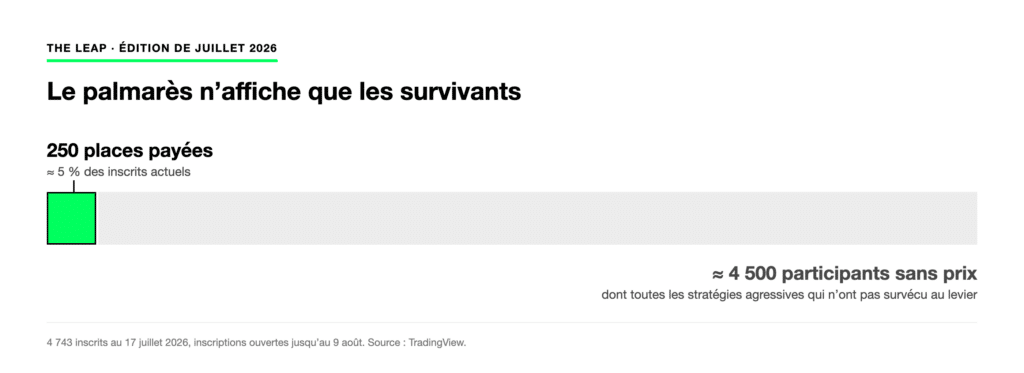
In other words, the optimal strategy for winning The Leap is roughly the opposite of serious risk management. Betting everything on a few highly leveraged positions is a rational approach when the money is fictional and only the top of the leaderboard gets paid. The same approach on a real account ends in a margin call.
That bias doesn’t make the competition useless, far from it. You just have to take it for what it is: a training ground, not a test of your real abilities. Used well, The Leap gets you familiar with the mechanics of futures without risking a euro: how margin works, contract tick values, the difference between an E-mini and a micro, how the order book behaves on US indices. That knowledge transfers to a real account. An 80% gain in 26 days does not.
To understand what simulation reproduces faithfully and what it distorts (execution, slippage, psychology), our paper trading guide covers the ground.
Our verdict
The Leap is a decent way into futures, provided you go in with the right expectations. The prizes are real, the setting is risk-free, and the 5-day minimum trading requirement pushes you towards regular practice. If you have a TradingView trial sitting unused, the July edition is a fair occasion to put it to work before registration closes on August 9.
Just don’t let the leaderboard trap you: aiming for the top 250 demands a trading style that has nothing to do with managing a real account. Use the competition to learn the mechanics, not to validate a strategy.
And if your goal is to train seriously rather than compete, our comparison of the best trading simulators runs through the alternatives, with and without time limits.

Othmane has been swing trading for years and builds on experience in investment banking. He writes regularly about trading and market analysis, and has passed Level I of the CFA Program along with earning a double Master’s degree in Financial Analysis.
Enjoy free trading practice on
ProRealTime Paper Trading Simulator.