SpaceX Joins the Nasdaq-100: You May Already Own It


You may already own a piece of SpaceX without knowing it. Since July 7, Elon Musk’s company has been part of the Nasdaq-100, one of the most tracked indices in the world. To stay faithful to the index, the managers of every fund that follows it had to buy the stock.
If you hold a Nasdaq-100 ETF, you now own a fraction of SpaceX without ever choosing it. Many read this inclusion as a buy signal. Is it one? Far from certain.
Since July 7, SpaceX has been part of the Nasdaq-100, forcing funds that track the index to buy around $4.3 billion of the stock.
If you hold a Nasdaq-100 ETF, you already own a piece of SpaceX, about 1.34% of the basket.
Joining an index is not a buy signal: the stock fell nearly 7% on inclusion day, and the Nasdaq-100 admission effect on prices has all but vanished since the 1990s.
A fast-tracked entry into the index
SpaceX joined the Nasdaq-100 on July 7, before the open. The Nasdaq had announced it on June 26. [1]
The entry is remarkably fast, only fifteen trading sessions after the June 12 IPO, thanks to a rule that took effect on May 1. A newly listed company whose market cap ranks in the index’s top 40 can now join after fifteen sessions, against three months and a 10% float before. [3] SpaceX is the first company to benefit from it.
Any ETF that physically replicates the Nasdaq-100 must hold its components at index weight. Admission to the Nasdaq-100 therefore forces index funds to buy SpaceX. JPMorgan puts this forced buying at around $4.3 billion. [2]
The Nasdaq-100 serves as a benchmark for more than 200 products, with over $800 billion in assets. All of them had to make room for the newcomer.
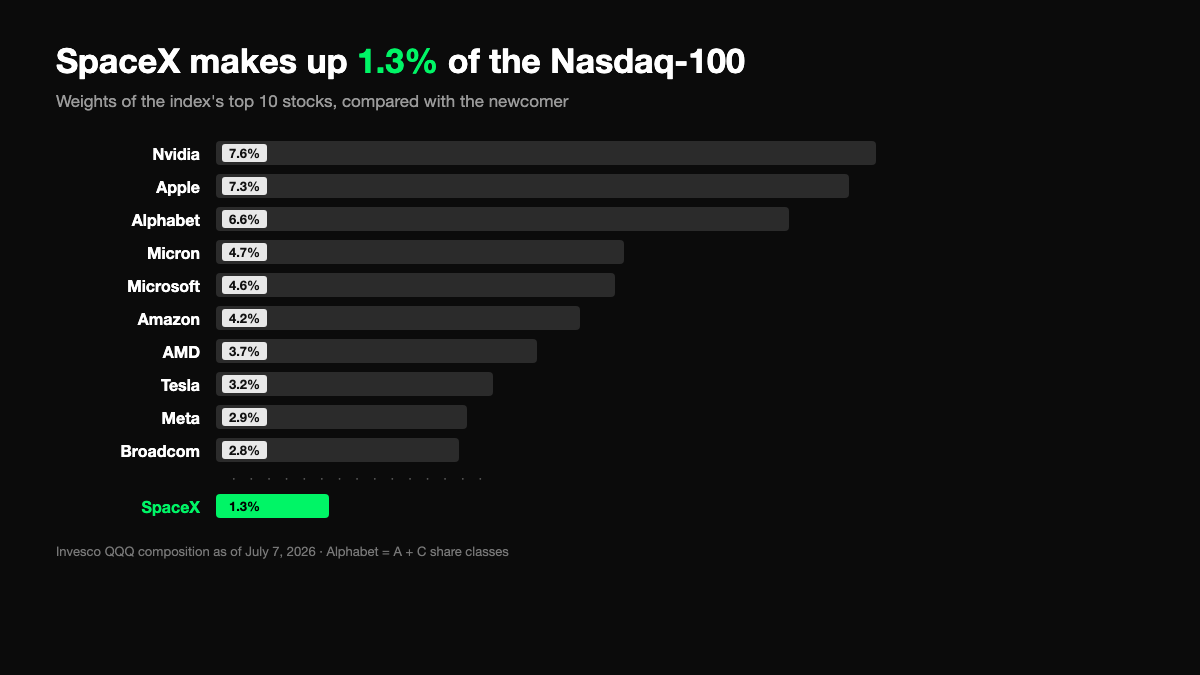
SpaceX still carries little weight in the index. The Nasdaq-100 weights each stock by its float, and the company has put only 4 to 5% of its shares on the market. Its weighting comes out around 1.3%: the iShares Nasdaq-100 UCITS ETF shows it at 1.34%. [4] For comparison, Nvidia and Apple each exceed 7% of the index. [5]
What it changes if you hold a Nasdaq-100 ETF
The direct consequence for you: if you hold a Nasdaq-100 ETF, you now own a piece of SpaceX without having chosen it.
The weight is real but modest. At 1.34% of the index, €10,000 in a Nasdaq-100 ETF represents about €134 of SpaceX. Not much, but it’s automatic: admission puts the stock into the basket of every tracker of the index, including the UCITS funds available in Europe such as the iShares or Amundi Nasdaq-100.
That leaves two ways to target SpaceX from Europe.
- The first is passive: the Nasdaq-100 ETF. You’re not buying SpaceX, but the index it belongs to. Some brokers list it commission-free, such as XTB or IG.
- The second is direct: you trade the SPCX share to target the stock rather than the basket. It trades like any other US stock.
SpaceX stock or Nasdaq-100 ETF: which one to pick?
Faced with a stock this volatile, many prefer an ETF to dilute the risk. The reasoning only partly holds up.
At 1.34%, the ETF gives you almost no exposure to SpaceX. If SpaceX is your goal, the tracker hands you €134 of it for every €10,000 invested: you’re mostly buying the other 99 stocks. Diluting the risk here means drowning SpaceX in the crowd.
And that diversification has limits of its own. The Nasdaq-100 is concentrated: Nvidia and Apple each weigh more than 7%, and the top five make up over 30% of the index. Through the ETF, you dilute the SpaceX risk but end up exposed mostly to tech mega-caps.
Buying the stock outright means betting everything on a single name. And this one stacks up the risk factors: a small float, a rich valuation, and a very recent listing right after a heavily followed IPO and an index inclusion.
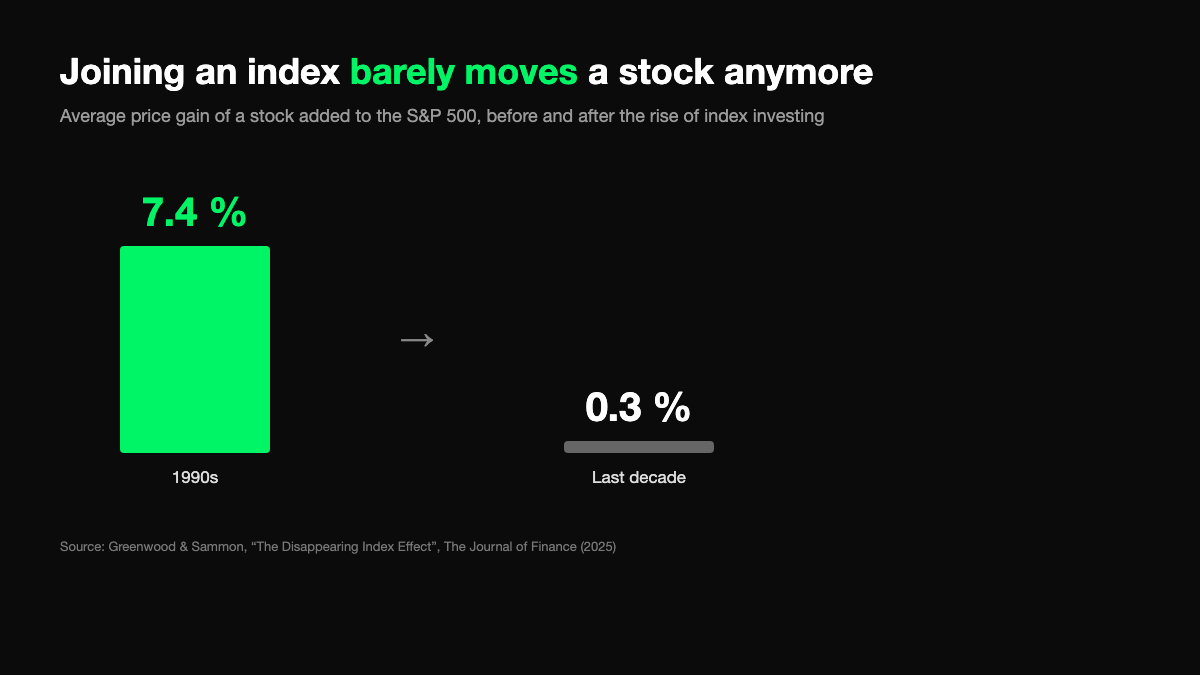
History calls for caution here: a landmark study by Robin Greenwood and Marco Sammon shows that the price “pop” on joining the S&P 500 fell from 7.4% in the 1990s to 0.3% over the last decade. [6] These index changes are now announced in advance and anticipated by the market, so the demand from index funds is already absorbed by the time the entry becomes official. For SpaceX, most of the buying was done before July 7.
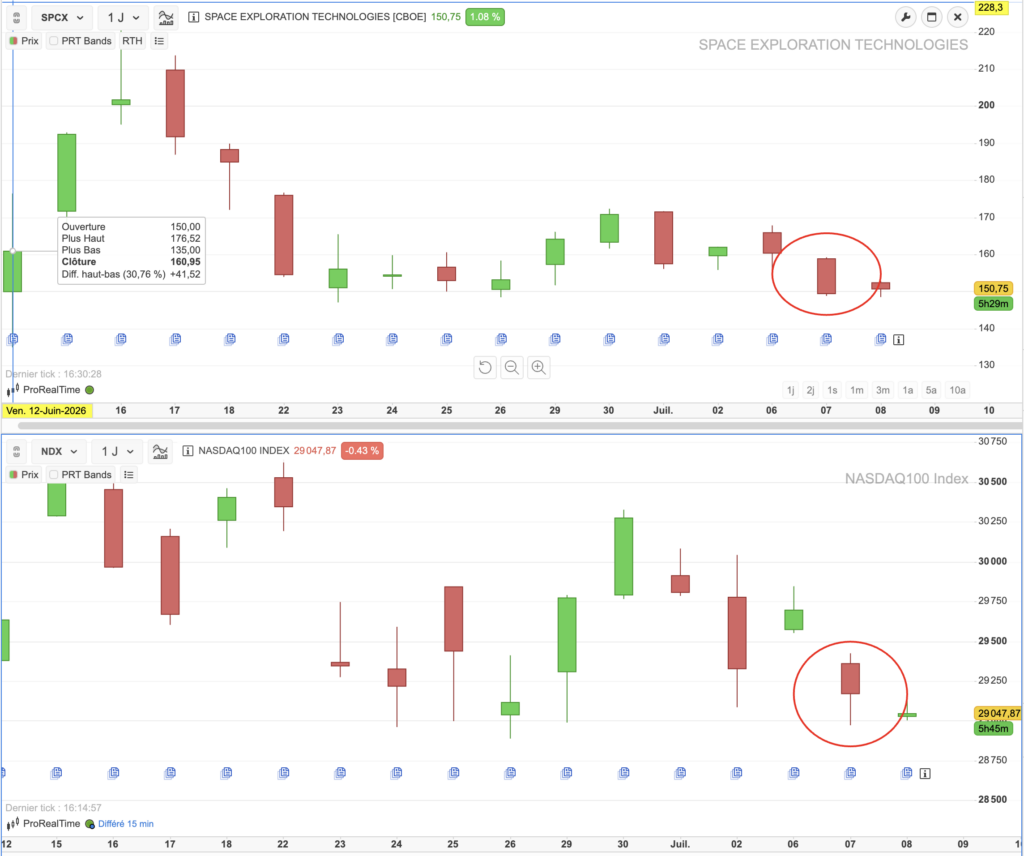
Indeed, despite the $4.3 billion in forced buying, the Space Exploration share lost nearly 7% on July 7, far more than the Nasdaq-100, which also finished in the red that day amid a sell-off in semiconductors. [7]
The real decision point is not “stock or ETF” but your objective. For broad exposure to US tech, the ETF does the job. To target SpaceX specifically, you need the stock, with a modest position and its volatility accepted upfront. In both cases, joining the index is not reason enough to buy.
SpaceX in the Nasdaq-100: key takeaways
Joining an index is not a buy signal. It makes the stock neither stronger nor cheaper: it mechanically files the name into a basket without touching its fundamentals. The July 7 session was a reminder, as the share fell despite billions of dollars in forced buying.
If SpaceX appeals to you for its fundamentals, its growth potential, or its short-term price prospects, you’re free to take a position whenever you judge the moment right. Just don’t give in to FOMO, the fear of missing out, or to overly simplistic correlations.
On the fundamentals, there is now something concrete to work with. The first quarterly results as a listed company, published on 4 August, show revenue up 92% and capital spending well above what analysts expected.
That leaves one practical question: which broker to trade with. Our broker reviews break down fees and the markets covered.
Article sources

Audrey holds a Diploma in Accounting and Financial Studies (DECF) and has over 15 years of professional experience in the banking and accounting sectors.
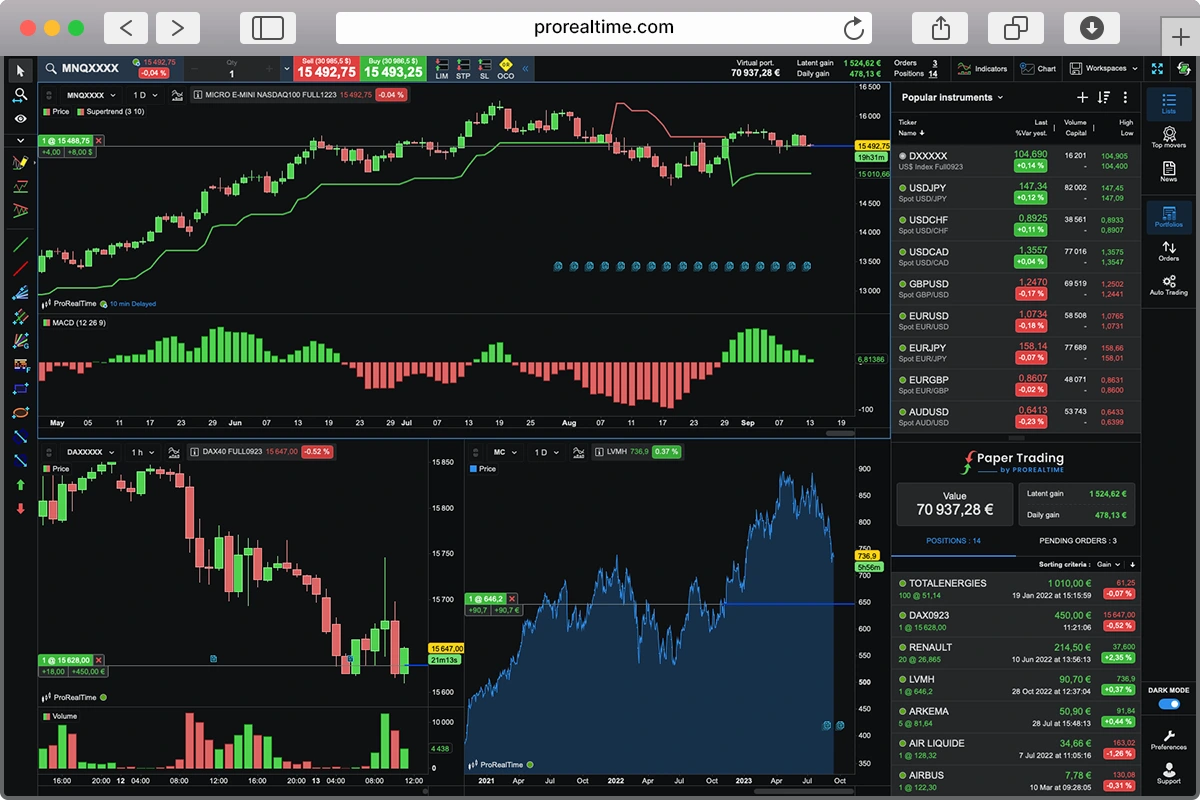
Enjoy free trading practice on
ProRealTime Paper Trading Simulator.