SpaceX IPO: How to Trade the Biggest Listing in History


The biggest stock market listing in history is on its way. SpaceX launched its roadshow on 4 June and is targeting a Nasdaq debut on the 12th, under the ticker SPCX. The headline numbers: $75 billion raised, two and a half times the record Aramco has held since 2019.
How can you get exposure to the deal as a European investor? Three approaches, three rationales, three risk profiles.
SPCX: the numbers behind an outsized listing
SpaceX filed its registration statement S-1 with the SEC on 20 May 2026. [1] The 3 June amendment sets the terms of the deal: 555,555,555 Class A shares, at an expected price of $135.00 each, for a $75 billion raise.
The over-allotment option can lift the total to 638.9 million shares, or $86.25 billion. Net of bank commissions and fees, SpaceX expects $74.4 billion, or $85.7 billion.
The prospectus also spells out where the money goes: expanding the computing infrastructure for AI, upgrades to facilities and launch vehicles, scaling up the satellite constellations, and general corporate purposes.
At that price, the implied valuation lands around $1.75 trillion.
Two records are at stake.
- The raise would reach 2.5 times the record Saudi Aramco has held since 2019, when it collected $29.4 billion including the over-allotment. [2]
- The valuation would also top Aramco’s at listing, around $1.7 trillion.
The announced timetable is tight: roadshow launched on 4 June, pricing on 11 June, first trades expected on 12 June on the Nasdaq, under the ticker SPCX.
One thing to keep in mind: this date is not contractual. The prospectus leaves the share delivery date blank, and the registration only becomes effective once the SEC decides. A delay remains possible up to the last minute.
On the retail offering, chief financial officer Bret Johnsen has flagged a retail share “larger than any IPO in history”, up to 30% of the deal according to Reuters, where conventional listings set aside 5 to 10%. [3] That figure is not in the prospectus: it’s a statement of intent.
| Item | Detail |
|---|---|
| Ticker | SPCX (Nasdaq and Nasdaq Texas) |
| Shares offered | 555,555,555 Class A shares |
| Expected price | $135.00 per share |
| Targeted raise | $75bn (up to $86.25bn with over-allotment) |
| Implied valuation | ≈ $1.75 trillion |
| Announced timetable | pricing on 11 June, listing expected 12 June 2026 |
| Syndicate | 10 bookrunners, led by Goldman Sachs and Morgan Stanley |
IG’s pre-IPO market: betting on SpaceX’s valuation
Let’s clear up the misunderstanding first: on IG’s pre-IPO market, you don’t buy SpaceX shares, nor an allocation at listing, nor a conversion into stock afterwards.
The product is a CFD*, quoted under the ticker .SPACEX. [4]
This CFD tracks SpaceX’s expected market capitalisation in billions of dollars. On 5 June, the market sat at around 2,140. So on that date, IG clients were trading the idea that SpaceX would be worth some $2.14 trillion at the time of the IPO. That’s about 22% above the listing valuation implied by the $135 price.
That gap is the whole point of the product. A trader who thinks the hype will push the market cap even higher goes long. One who senses disappointment goes short.
Two clauses deserve your attention.
- A position still open on the first day of trading is cash-settled, against the official market cap recorded at that session’s close.
- If there’s no listing by 31 December 2027, all open positions are cancelled.
The fact sheet notes in passing that the market cap used includes xAI, now merged with SpaceX.
Market sentiment is one-sided: on 5 June, more than eight in ten IG clients were positioned for a rise.
* “CFDs are complex instruments and come with a high risk of losing money rapidly due to leverage. 69% of retail investor accounts lose money when trading CFDs with this provider. You should consider whether you understand how CFDs work and whether you can afford to take the high risk of losing your money.”
Fees, platforms, products: read our IG review.
Taking part in the IPO with Trade Republic or Saxo
The prospectus provides for a European public tranche in seven countries: Germany, Denmark, France, the Netherlands, Norway, Spain, and Sweden. It still hinges on approval of the European prospectus by Germany’s regulator, BaFin. [10]
Retail investors in those countries should therefore be able to subscribe at the offer price.
Two brokers available to European retail investors confirmed their role at the time of writing: Trade Republic and Saxo.
- Trade Republic is positioning itself as a “distribution partner” for retail investors, in an email to its clients reported by the German financial press. [5]
- Saxo, for its part, has opened subscriptions on a dedicated page for the deal, where a “Participate now” button invites clients to place an order. [8] The broker caps orders at $162 per share: that’s the maximum price you agree to pay, since the final IPO price, expected at $135, is only set on 11 June.
DEGIRO, often cited in the press, says the opposite on its help page: it can’t facilitate participation in a US company’s IPO. [6]
What do you gain by subscribing to the IPO rather than buying shares on 12 June? The offer price, expected at $135 but only set on 11 June, and the certainty of sidestepping any opening-day frenzy.
That said, your allocation isn’t guaranteed: if demand surges, orders can be scaled back or left unfilled, depending on the deal’s allocation rules. And between the close of subscriptions and the first trades, you can’t sell: the shares aren’t listed yet.
Since 6 June 2026, Trade Republic has officially opened IPO subscriptions: shares are allocated at the official offer price, pro rata to the volume subscribed, for €1 in settlement fees per order. The specifics of each deal, such as the deadline, minimum amount, and order cancellation, are worth checking in the app before you commit.
Our Trade Republic review and our Saxo review go through both brokers, from their fees to their product range.
Buying SPCX at listing, the classic route
From the first day of trading, SPCX becomes available at any broker giving access to US stocks, such as Interactive Brokers, Saxo, eToro, XTB, or DEGIRO.
A quick note for the big day. An IPO doesn’t start at the official open of the US session, 3:30 p.m. Central European Time. The Nasdaq first runs a dedicated auction, the IPO Cross, to set the first price. [7] The first trade may only happen an hour or more after the open. A market order placed blind before that first print will execute at whatever level the auction sets.
The registration statement filed with the SEC stresses the volatility risks. SpaceX notes that a high share of retail investors on the register can amplify the stock’s swings after listing, and that the price may reflect that enthusiasm more than actual operating performance.
Buying at the open means paying whatever price collective enthusiasm has set. Nothing forces you to rush: the stock will still trade the following Monday, and the months after.
Tax-wise, SPCX is a US stock. You’ll hold it in an ordinary brokerage account, and any gains fall under the capital gains tax in your country of residence.
To compare stock brokers, our Interactive Brokers review or our DEGIRO review lay out each one’s terms.
How to trade the SpaceX IPO: the recap table
| Pre-IPO market (CFD) | IPO subscription | Buying at listing | |
|---|---|---|---|
| What you hold | A position on the expected market cap | SPCX shares at the offer price | SPCX shares at the market price |
| Available | Right now | Until pricing | From the first trades |
| Entry price | Pre-IPO market level when you open the position | $135 per share | Opening price, unknown in advance |
| Main risk | Leverage and settlement against the real first-day market cap | Allocation not guaranteed, possible pullback after listing | First-day volatility |
| Platforms | IG | Trade Republic, Saxo | Any broker with Nasdaq access |
A valuation that’s hard to pin down
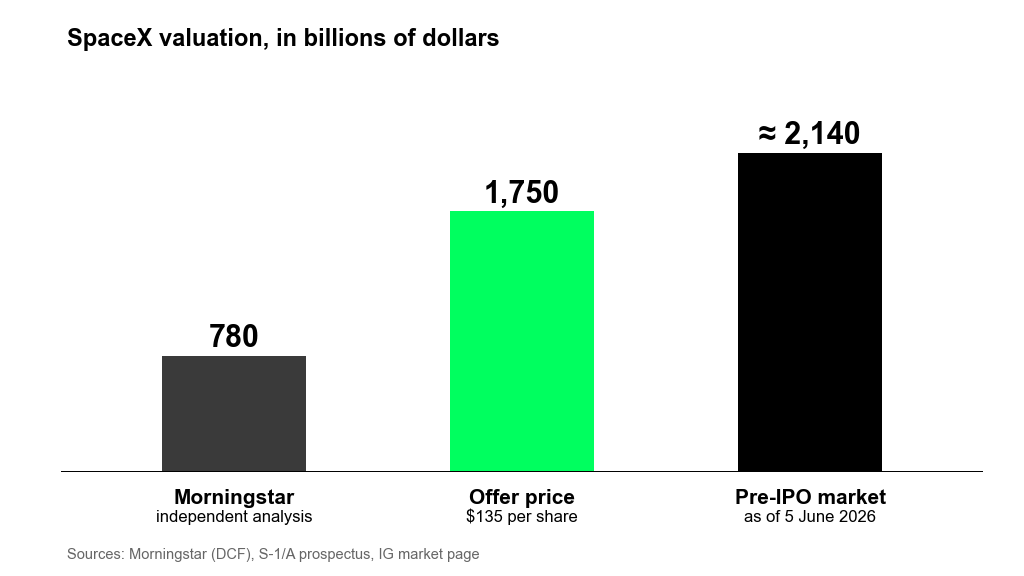
Morningstar values SpaceX at $780 billion, with what it calls “very high” uncertainty. [9] The IPO implies a $1.75 trillion valuation. And IG’s pre-IPO market is betting on $2.14 trillion as of 5 June.
A threefold spread, for the same company.
The accounts in the prospectus feed the scepticism. SpaceX lost $4.9 billion in 2025, after a profitable 2024, and $4.3 billion in the first quarter of 2026 alone.
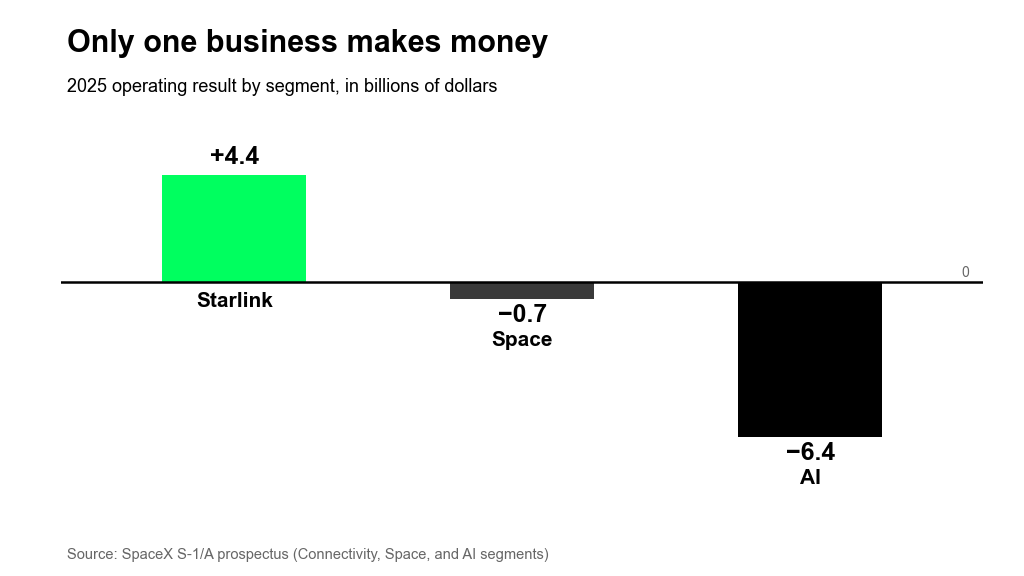
One business makes money: Starlink, with $11.4 billion in revenue, 61% of the total, and $4.4 billion in operating profit, driven by 10.3 million subscribers, a number that doubled in a year. The other segments booked $7 billion in operating losses over the year, $6.4 billion of it from the AI business alone.
The prospectus’s dilution table adds a telling detail. Existing shareholders paid an average of $6.48 for their stock. New entrants will pay $135, twenty times more.
Where the $75 billion goes is also worth a close read: computing infrastructure for AI tops the list, ahead of rockets and satellites. Since the xAI merger, buying SPCX no longer means buying a space company alone. It also means taking a bet on artificial intelligence, the group’s most loss-making segment.
The governance disclosures are also worth weighing. After the deal, Elon Musk is set to keep around 82% of voting rights. In practice, new shareholders will have no real say.
Trading the SpaceX IPO: the takeaways
The biggest listing in history is likely to draw retail orders. And when 86% of grey market positions lean bullish, it’s hard to resist the urge to follow the crowd. That’s the surest way to turn a market event into a bad experience.
Nobody knows what SpaceX is really worth. Morningstar puts it at $780 billion, the IPO implies $1.75 trillion, and IG’s pre-IPO market quotes $2.14 trillion. Across a range that wide, position size matters more than conviction.
Since 4 August there is at least one hard number to anchor on: $7.81 billion of quarterly revenue, up 92% year on year. Our article on the Q2 2026 results breaks down the three divisions.
That leaves your approach to choose, and it comes down to profile, experience, and strategy.
- IG’s pre-IPO speaks to the active trader, comfortable with CFDs.
- Subscribing through Trade Republic or Saxo suits the investor convinced by the case, ready to live with an uncertain allocation.
- Buying on the market stays the simplest option, and the first day is no must: Morningstar points out that share unlocks in the coming months could offer better entry points than the listing itself.
And if the listing of the century becomes the moment you open a first brokerage account, our comparison of the best brokers goes through the brokers mentioned in this article.
Article sources

Audrey holds a Diploma in Accounting and Financial Studies (DECF) and has over 15 years of professional experience in the banking and accounting sectors.
Enjoy free trading practice on
ProRealTime Paper Trading Simulator.