What are The Best alternatives to Saxo Bank in 2026


Saxo is a strong broker on paper. But many users complain about slow support, administrative delays, and a platform that feels heavy once you start trading daily.
If you’re looking for a smoother experience—or tools that better match the way you trade—here are the best alternatives in 2026.
Top 3 Saxo Alternatives


*XTB: 75% of accounts lose money when trading CFDs with this provider.
How to Choose an Alternative to Saxo
To select the best alternative to Saxo, we used 4 criteria.
- The range of tradable assets: Saxo has a wide catalog of financial instruments, but other brokers, such as IBKR or DEGIRO, offer as many, if not more, products and markets than the Danish investment bank.
- The trading platform: Saxo gives you access to several in-house developed interfaces and professional-quality platforms, such as ProRealTime or TradingView. You can find this type of partnership with other players in the sector, like Interactive Brokers.
- Fees: they directly impact your earnings, so it’s essential to select competitive solutions with no hidden fees.
- Customer service: a lack of support, responsiveness, or expertise is detrimental to your investments. We have chosen companies renowned for the quality of their customer service.
1 – ProRealTime & IBKR
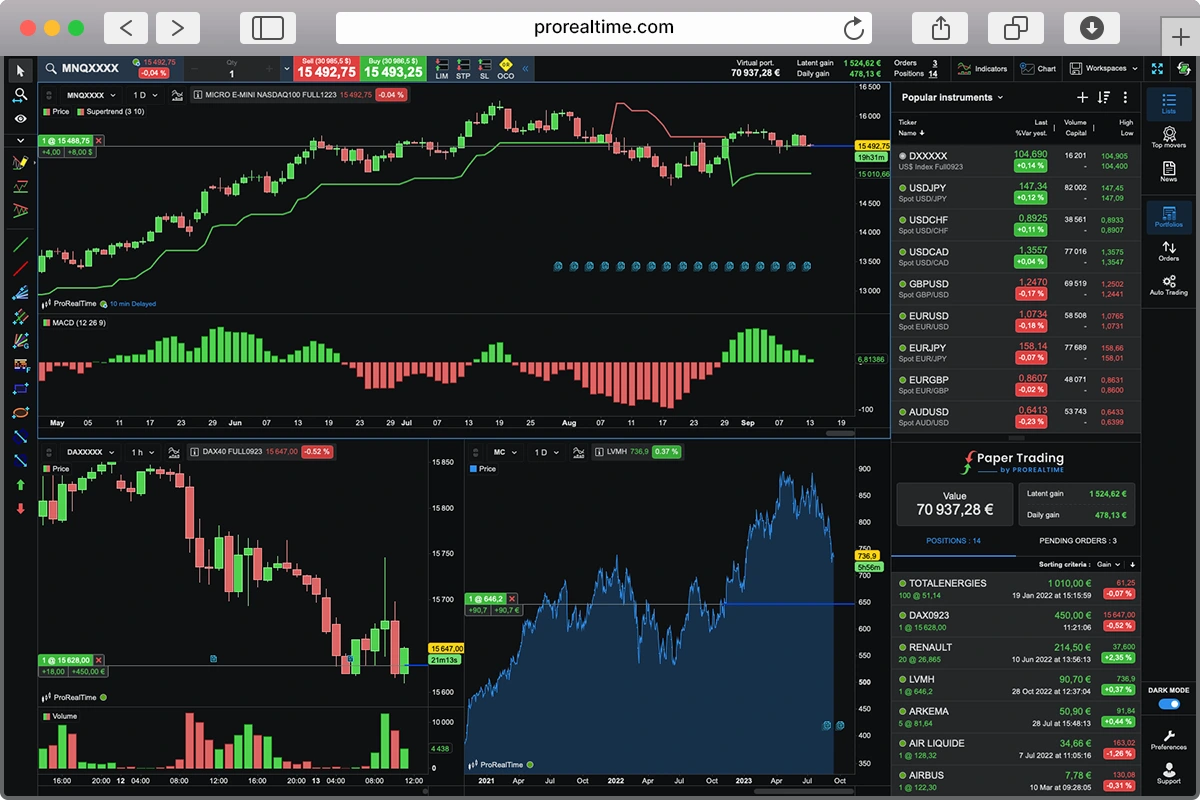
ProRealTime and IBKR work together to give you a premium setup. IBKR brings global market access. ProRealTime brings advanced charting. The result is one of the strongest combinations available today.
Interactive Brokers’ investment universe includes stocks, ETFs, options, futures contracts, spot currencies, bonds, mutual funds, and metals.
You also have the option to short sell or purchase fractional shares.
In addition to IBKR’s proprietary platforms, you have access to ProRealTime’s trading platforms, which include charting tools and technical analysis. Market data is non-aggregated but added tick by tick, with a direct connection to the exchanges.
You can also test your strategies with a free virtual portfolio and practice on historical data with the Market Replay feature.
In terms of pricing, transparency is paramount, and all fees are detailed by asset type and according to your investor status (See detailed terms and conditions).
2 – DEGIRO
DEGIRO is a Dutch broker, a subsidiary of flatexDEGIRO bank. It is appreciated by its clients for the simplicity of its platform and its wide range of tradable assets, which also includes cryptocurrencies.
On Trustpilot, contributors praise the professionalism and responsiveness of customer service, available by email and phone.
DEGIRO opens the door to an extensive selection of financial instruments: stocks, ETFs, bonds, futures contracts, options, exchange-traded products, investment funds, commodities, crypto trackers, and cryptocurrencies.
The fixed brokerage fee structure works in your favor when placing larger orders.
While the web and mobile trading platforms cater to both novice and seasoned traders, they fall short of the advanced functionality you’d find on a platform like ProRealTime.
3 – XTB

XTB is a Polish broker serving over two million clients. Its offering stands out on several fronts, including commission-free investing in stocks and ETFs up to €100,000, interest on uninvested cash, a payment card, and other features.
XTB also operates a branch in France, where it provides customer support in French. In addition, the broker has a presence in around twenty countries and offers support in 18 languages.
Free for ETF and real shares and 0.2% fee for transactions above EUR 100000.
Compared to Saxo, XTB gives you access to a smaller range of assets. You can trade stocks, ETFs, and CFDs*. For stocks, you’ll find European markets, as well as Swiss, UK, and US shares.
The zero-commission offer** on stocks and ETFs is a clear plus. It applies up to €100,000. After that, a 0.2% fee applies. Each order also requires a €10 minimum, and fractional shares aren’t supported, which can matter if you prefer smaller positions.
XTB’s xStation 5 platform is built in-house and doesn’t require a paid subscription. It includes charting tools, technical indicators, and practical features like a fee calculator and market sentiment. These tools don’t remove the risks of trading, but they can help you understand the market better and manage your decisions with more clarity.
*CFDs are complex instruments and carry a high risk of losing money quickly due to leverage. More than 70% of retail investor accounts lose money when trading CFDs with this provider. You should make sure you understand how CFDs work and whether you can afford to take the risk of losing your money. CFDs are also banned in several countries — including the United States — because of their complexity and the risks involved. Past performance is not a reliable indicator of future results.
**Zero-commission & PFOF
Zero-commission trading may involve Payment for Order Flow (PFOF), where the broker receives compensation for routing your orders to specific market makers. This can affect execution quality, including price and speed. Zero-commission does not mean zero cost — spreads, currency conversion fees, and other charges may still apply. Trading carries risks, and you should make sure the pricing structure fits your needs before investing. Always read the tiny prints on your favourite broker’s fees page to better understand what you’re doing.
Which Saxo alternative should you choose?
The right alternative depends on how you trade.
If you want professional charting and global market access, ProRealTime is the strongest setup.
If you want something simple with solid customer support, DEGIRO is the most user-friendly.
And if you want to keep fees low—especially on stocks and ETFs—XTB can make sense, even though its product range is smaller.
Before you switch, test each platform and check that the features match your needs. No broker is perfect, and the best choice is the one that fits your trading style.
| Broker | Best for | Markets | Platform level | Fees |
|---|---|---|---|---|
| ProRealTime | Advanced charting | ★★★★★ | Pro-grade | Competitive |
| DEGIRO | Simplicity & low cost | ★★★★☆ | Medium | Low |
| XTB | Free stock/ETF trades | ★★★☆☆ | Medium-high | Zero commission up to €100k |

Maxime holds two master’s degrees from the SKEMA Business School and FFBC. As founder and editor-in-chief of NewTrading.fr, he writes daily about financial trading.