Interactive Brokers vs Trade Republic: Which Is the Better Broker?


Interactive Brokers vs Trade Republic is a clash of the titans. The first is a US broker that positions itself as the sector’s international leader, while the second holds a banking licence and has set out to make stock market investing accessible to everyone.
Two well-known players, but two offers that are polar opposites in how they conceive trading. With Trade Republic, you buy a share the way you shop online, while with IBKR you can execute your orders like a professional trader.
Drawn to a gamified trading experience, you may be wondering whether Interactive Brokers wouldn’t suit your ambitions better?
Markets, fees, platforms, customer support… Here is a detailed comparison of what IBKR and Trade Republic have on the table, so you can work out which broker fits your trading profile.
Interactive Brokers vs Trade Republic: the scoreboard
The table below sums up the main conclusions of our detailed comparison.


Trade Republic vs IBKR: our verdict
With its “neo-broker” positioning, Trade Republic targets the general public. The broker bets on an app stripped down to the essentials and a flat fee structure. Its offer speaks to fans of passive investing rather than active traders.
You can trade stocks, ETFs, cryptos, and derivatives, but the catalogue remains limited, with no futures or options. Since July 2026, the Web Terminal has finally added charting and a screener, but the analysis toolkit still trails Interactive Brokers.
Interactive Brokers, on the other hand, opens access to 170 markets and a series of in-house platforms built to serve every trader profile. Its offer also stands out for order execution quality and competitive brokerage fees, especially on large volumes.
IBKR wins the match. Unless your plan is dollar-cost averaging, Interactive Brokers is the better broker for building a trading strategy and reaching different markets.
That said, beginners are sometimes thrown off by an offer that feels dense and a customer service that can be hard to reach.
Interactive Brokers vs Trade Republic: detailed comparison
1. Trading options and markets
Comparison criterion: we assess the brokers on the availability of different assets and markets, to help you work out whether they fit your trading strategies.
| Interactive Brokers | Trade Republic | |
|---|---|---|
| Stocks | ✅ | ✅ |
| Fractional shares | ✅ | ✅ |
| ETFs | ✅ | ✅ |
| Bonds | ✅ | ❌ |
| Options | ✅ | ❌ |
| Futures | ✅ | ❌ |
| Forex | ✅ | ❌ |
| Cryptocurrencies | ✅ (ETPs) | ✅ |
| Commodities | ✅ | ❌ |
| CFDs | ✅* | ❌ |
| Warrants | ✅ | ✅ |
| Margin trading | ✅ | ❌ |
| Short selling | ✅ | ❌ |
| International markets | ✅ | ✅ |
Interactive Brokers stands out for the sheer variety of its trading options, from stocks to currencies, metals, and futures. IBKR is a gateway to more than 170 markets worldwide. The US broker also supports margin trading and short selling.
On Trade Republic’s side, the possibilities are far more limited. You can only invest in stocks, ETFs, cryptocurrencies, and derivatives.
IBKR wins hands down, with its 170 markets worldwide.
2. Commissions and fees
Comparison criterion: we assess the broker’s pricing policy. The goal of this section is to work out which broker gives you the most cost-effective trading experience.
| Interactive Brokers* | Trade Republic | |
|---|---|---|
| European stocks | 0.05%, minimum €3 per order | €1 per order |
| US stocks | $0.005 per share, minimum $1 per order | €1 per order |
| ETFs | 0.05%, minimum €3 per order | €1 per order |
| European options | €1 per contract | N/A |
| US futures | $0.85 per contract | N/A |
| Cryptocurrencies | 0.12% to 0.18%, minimum $1.75 per order | €1 per order |
| Inactivity fees | None | None |
| Withdrawal fees | 2 free withdrawals per month, then €1 (SEPA) or €8 (non-SEPA wire) | None |
| Fee schedule | IBKR fees | Trade Republic fees |
IBKR charges a minimum fee of €3 per order on European stocks or ETFs. That system penalises users who want to invest relatively small amounts. On top of that, the broker charges a fee from the third withdrawal in a month onwards.
Minimum commissions on US stocks, however, are just $1. And on other assets, IBKR’s pricing is highly competitive against the rest of the market, with no third-party fees.
Trade Republic stands out with a very simple fee structure: €1 per order in Best Price, the default mode, whatever the product. Since July 2026, a Direct Price mode lets you pick your own execution venue for €2 per order. The German platform charges neither inactivity nor withdrawal fees.
Hard to separate the two brokers here.
Trade Republic’s €1 flat fee is appealing, especially when you trade very liquid assets.
Interactive Brokers is less attractive on European stocks but matches the German broker on the US market.
You should also factor in the spreads, which can run higher at Trade Republic and eat into your gains.
3. Trading platform and user experience
Comparison criterion: we assess the broker’s trading platform(s) on ease of use, features, customisation, and performance. Our review covers charting tools, order execution, and stability.
Your broker’s platform should let you apply your trading plan as efficiently as possible.
| Interactive Brokers | Trade Republic | |
|---|---|---|
| Trader level | Beginner, intermediate, or advanced | Beginner or intermediate |
| Account types | Cash, Margin | Cash |
| Demo account | ✅ | ❌ |
| Price alerts | ✅ | ✅ |
| Technical analysis tools | ✅ | ✅ |
| Fundamental analysis tools | ✅ | ✅ |
| Options trading tools | ✅ | ❌ |
| Copy trading | ❌ | ❌ |
| Automated trading | ✅ ProRealTime | ✅ |
| Backtesting | ✅ | ❌ |
| Third-party platform connections | ProRealTime | ❌ |
| Order types | All types (limit, market, stop, market on close, etc.) | Limit, market, stop |
| Order execution quality | Market price optimisation through SmartRouting (in-house system) | Routed through an intermediary => less favourable |
| Currency handling | Multi-currency account | Euro account |
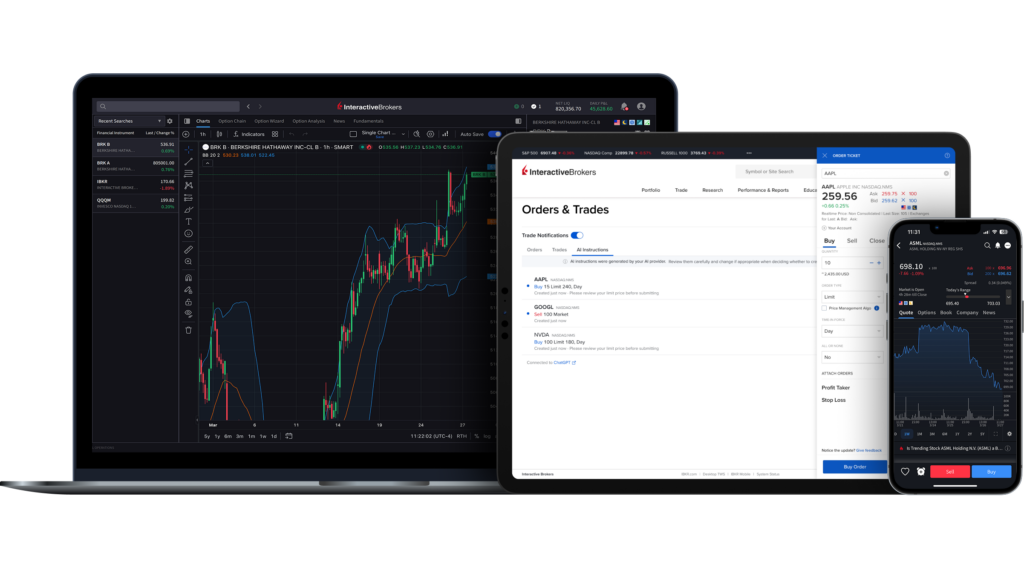
Interactive Brokers runs several trading platforms across mobile, desktop, and web. Some, like IBKR Global Trader or IBKR Desktop, are aimed at beginner to intermediate traders. Others, such as Trader Workstation, are built for more complex strategies.
These platforms carry the fundamental and technical data you need for your analysis.
Trader Workstation is a benchmark platform for active traders, but it is sometimes seen as dated and cluttered.
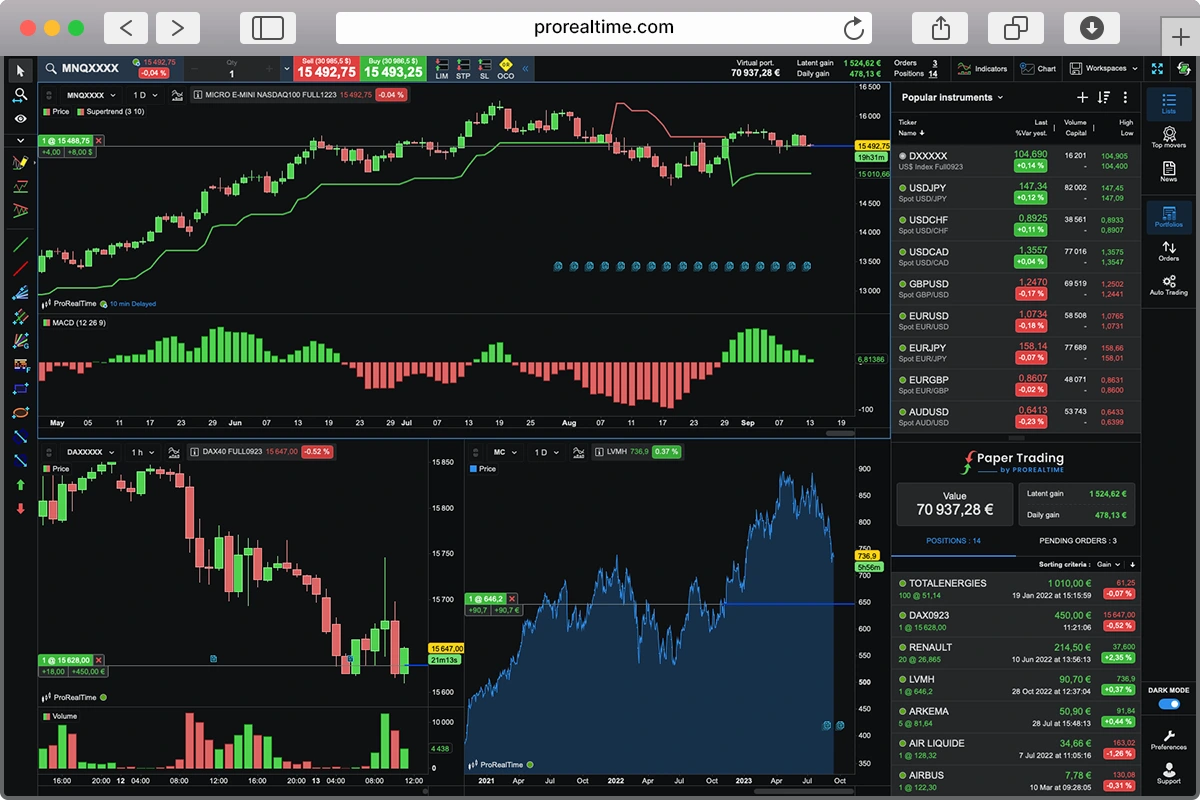
ProRealTime is known for the quality of its data feeds and charting interface. It lets you trade from the order book or straight from the charts, and build automated trading systems without writing code.
If you don’t know the French platform yet, you can try ProRealTime for free with a demo account, with no time limit.
Trade Republic used to be a mobile-only broker with no analysis tools. The Web Terminal, launched in July 2026, changes that: a web interface, 18 chart types, indicators, and a multi-criteria screener. The app also lets you buy or sell and schedule investment plans (weekly, monthly, quarterly, and so on).
The Web Terminal now brings a multi-criteria screener and real-time market data, but fundamental analysis remains thinner than at Interactive Brokers.
Interactive Brokers takes this round, thanks to its trading platforms and order execution quality. Its trading universe may feel dense to some users, but it has the merit of serving every profile with a fitting solution.
4. Customer support and security
Comparison criterion: we assess the educational resources, research tools, customer service, and reliability of each broker, to work out which one backs your trading best.
| Interactive Brokers | Trade Republic | |
|---|---|---|
| Educational content | ✅ | ❌ |
| Customer support | Chat, email, phone | Chat + phone, round the clock |
| Regulation | FINRA, SEC (US), Central Bank of Ireland (Europe) | BaFin (Germany), AMF (France) |
| Fund protection | 90% protection, up to €20,000 | Deposit guarantee: up to €100,000. Securities guarantee: up to €20,000 |
| Asset segregation | ✅ | ✅ |
Both brokers offer a very satisfactory level of security and financial strength.
Trade Republic is a German bank, supervised by BaFin, and claims the title of Europe’s largest savings platform. It counts 10 million customers and €150 billion in assets. Your cash is covered by the deposit guarantee scheme up to €100,000.
Interactive Brokers, for its part, is a US broker in business since 1978, with shares listed on the Nasdaq. It manages more than 4 million client accounts and executes 3.62 million trades a day.
IBKR stands out for its track record. Being able to reach customer support by phone is also a plus, even if the wait can be long.
Interactive Brokers wins by a narrow margin, but both players struggle to fully satisfy their clients on this front.
Interactive Brokers and Trade Republic are both regularly criticised for the effectiveness of their support. ProRealTime is known for the quality of the support it gives its users, who get a dedicated account manager.
5. Mobile app experience
Comparison criterion: we assess the broker’s mobile app on features, ease of use, and integration with the desktop platform, so you can manage your portfolio wherever you are.
| Interactive Brokers | Trade Republic | |
|---|---|---|
| Design & ergonomics | 3.5/5 | 4/5 |
| Features | Trading, portfolio breakdown, currency conversion, news… | Basic: placing orders, tracking performance, automated investing. |
IBKR’s GlobalTrader app is clean and aimed at beginners. It lets you track your positions and execute your orders from your smartphone. It makes a good companion to the other platforms.
IBKR Mobile is more complete and mirrors the environment of the Client Portal, the web interface.
At Trade Republic, the mobile app was the only trading tool until the Web Terminal arrived in July 2026. The German broker stands out with simple, interactive navigation, cut down to the essentials.
The app does tend to gamify investing, though. It mainly serves to place orders. The charts are there to look pretty, not to analyse prices.
Interactive Brokers wins this one too. With its two apps, you can choose between a clean interface and a more complete tool that lets you view the charts.
If you connect your IBKR account to ProRealTime, you get access to a third app that makes an excellent middle ground between GlobalTrader and IBKR Mobile.
You can try ProRealTime Mobile by opening a demo account.
Trade Republic vs IBKR: extra services
Both brokers add side services to stand out with prospective clients. For instance, both deliver a detailed annual tax report.
On top of that, Trade Republic has:
- interest on uninvested cash, at 2% a year, from the first euro;
- a bank card with a saveback scheme.
Interactive Brokers’ services centre on brokerage itself. The broker also pays interest on your cash, but only above $10,000.
Trade Republic takes the extra-services round. Earning interest on uninvested amounts keeps your money from sitting idle in your account.
Interactive Brokers wins the IBKR vs Trade Republic match
Each broker has its strengths, and they don’t target the same profiles. Trade Republic can be a good pick for a passive investor, thanks to an ultra-simple fee structure and an intuitive interface.
Still, Interactive Brokers opens more doors over the long run, with far broader trading options. The US broker also packs very complete analysis tools to help you spot the assets to trade and review your performance.
Going for ProRealTime can sharpen the quality and relevance of your analysis.
The French platform is a benchmark for technical analysis, with detailed charts, good instrument coverage, and a broad set of indicators (moving averages, Bollinger Bands, and more).
| Other comparisons |
|---|
| Interactive Brokers vs Saxo |
| Charles Schwab vs Interactive Brokers |
FAQ
Interactive Brokers or Trade Republic: which suits beginners best?
Trade Republic is easier for a beginner to pick up. The German broker runs an intuitive platform and a simplified fee structure: you know in advance what you’ll pay.
Over the longer run, IBKR’s educational content and analysis tools can help you sharpen your results if you want to build up your investing skills. The US company also opens a far wider trading universe, at prices just as competitive.
Interactive Brokers vs Trade Republic: which broker is cheaper?
It depends on your trader profile and the amounts you want to trade. With a flat €1 fee per order, Trade Republic stays cheaper than Interactive Brokers for trading European stocks. But the two brokers are neck and neck on US stocks, for example.
Compare the fees for the exchanges you actually target, and don’t overlook the impact of the spread on the total cost of your trade.

Audrey holds a Diploma in Accounting and Financial Studies (DECF) and has over 15 years of professional experience in the banking and accounting sectors.
Enjoy free trading practice on
ProRealTime Paper Trading Simulator.