Binance Leaves the EU on July 1: The MiCA-Licensed Crypto Platforms


Binance is heading for the exit. From July 1, 2026, the platform leaves the European Union. It never landed its MiCA licence, and it has begun telling clients so by email.
No need to panic: your funds stay recoverable. But two questions come up: what to do with your crypto before the deadline, and which platforms keep the right to operate in the EU. Binance isn’t the only one affected, either. Here’s where things stand.
Why Binance is losing the right to operate in the EU
MiCA, the European regulation that has governed crypto-assets since 2024, is reaching a turning point. It requires every platform to hold a single licence to provide crypto services across the European Union. On July 1, 2026, its transitional regime ends: without that licence, a platform has to stop operating in the EU. No licence, no service.
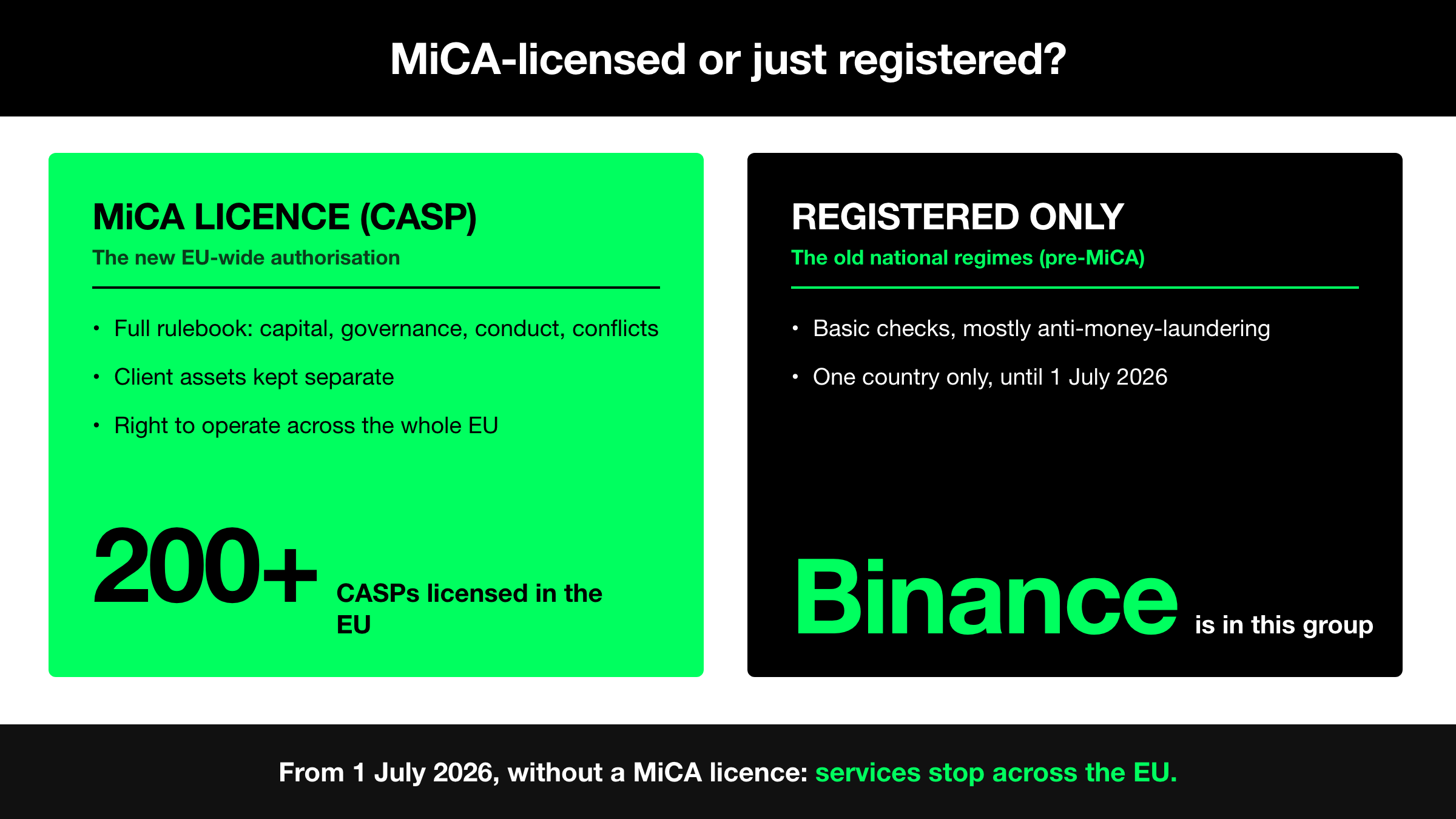
Binance didn’t get that licence. On June 24, the platform withdrew the application it had filed in Greece, before the regulator ruled on it. It says it wants to refile in another member state, with France mentioned as a possibility.
Binance has started writing to clients to warn them that it will no longer provide crypto-asset services from July 1. It began with its French entity, and on June 25 it confirmed that similar messages were going out to other European markets.
On the official registers, Binance still appears, but only with “registered” status, the old national regime it held before MiCA, never the licence itself.
On the holdings side, Binance is playing reassurance: client funds “stay accessible at all times” and can be withdrawn.
What changes for your crypto
Do you have a Binance account? Then this concerns you. From July 1, the platform shuts down its crypto services in the EU. Withdrawals stay open, though: Binance commits to keeping funds accessible at all times.
No reason to panic, then, but a good reason to take stock. Leaving your crypto on a platform that’s closing its doors means risking a stretch of limbo while everything gets sorted out.
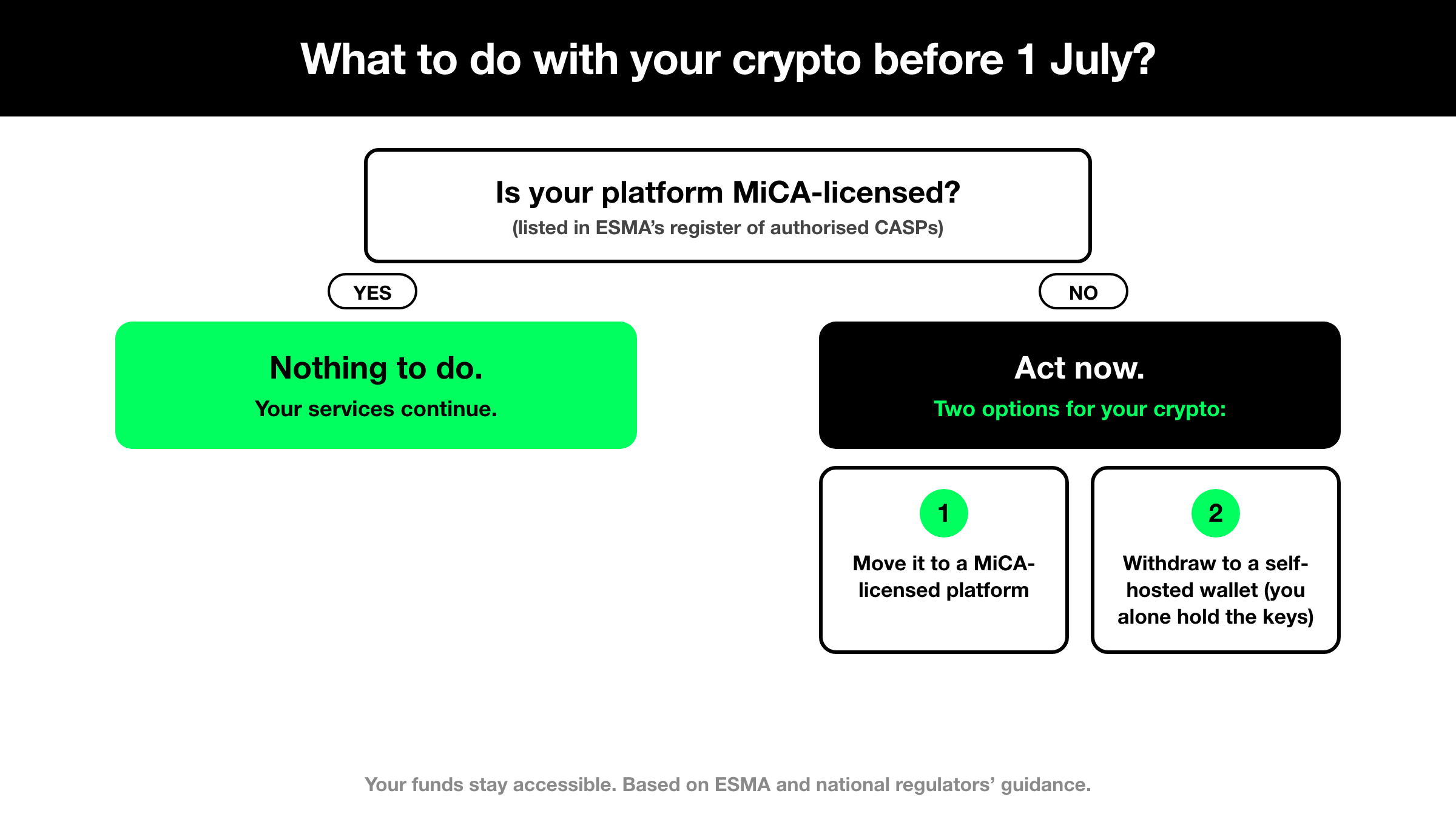
Regulators have mapped out the exit. ESMA wants unlicensed platforms to wind down in an “orderly” way, giving clients advance notice. [1] For your holdings, you have two options:
- move them to a MiCA-licensed platform, one that keeps the right to operate;
- bring them back to a self-hosted wallet, where you alone hold the keys.
The MiCA-licensed platforms
To know which platforms are licensed, one source is authoritative: ESMA’s public register of authorised crypto-asset service providers. It lists, in black and white, which providers keep the right to operate across the EU. Several mainstream names are on it, four of which we’ve put under the microscope.
- Bitpanda is the most “pure crypto” option on the list. This Austrian platform, MiCA-licensed, gives you a broad catalogue of cryptocurrencies, but also stocks, ETFs, and precious metals, all in an app built for beginners.
- eToro blends crypto, stocks, and CFDs in one interface. Its signature feature is still copy trading, which lets you automatically copy other traders’ positions. Handy to get started, as long as you keep in mind that copying a trader doesn’t remove the risk.
- Revolut tucks crypto straight into its banking app. If you already have an account there, buying a bit of crypto takes two clicks. The choice of assets is narrower, and the tool leans toward buy-and-hold rather than active trading.
- Trade Republic places crypto alongside stocks and ETFs, with tight fees. Here too, the profile fits buy-and-hold more than advanced trading.
One word of caution, though: a MiCA licence isn’t a quality stamp. It says a platform follows European rules, not that it’s the cheapest or the most convenient. It’s the legal minimum to stay in the game, not a ranking.
| Platform | MiCA status (EU) | Available in the EU |
|---|---|---|
| Bitpanda | Licensed | Yes |
| eToro | Licensed | Yes |
| Revolut | Licensed | Yes |
| Trade Republic | Licensed | Yes |
| Coinbase | Licensed | Yes |
| Kraken | Licensed | Yes |
| Binance | Registered, not licensed | No, from July 1 |
Binance out of the EU: the takeaways
Binance’s departure is making plenty of noise, but the event is telling: MiCA is redrawing the crypto map in Europe, and leaving out, at least for now, some of the sector’s giants, Binance among them.
In practice, for you as a retail trader, that means taking stock of your holdings and possibly switching crypto platform. Moving to a compliant provider or a personal wallet is a decision to make now.
One thing left to watch: Binance hasn’t said its last word. A fresh application, possibly filed through France, could bring it back into the game within a few months. Until the regulator decides, its European clients will need to have found somewhere else to land.
To compare compliant providers beyond crypto alone, see our pick of the best trading platforms.

Audrey holds a Diploma in Accounting and Financial Studies (DECF) and has over 15 years of professional experience in the banking and accounting sectors.
Enjoy free trading practice on
ProRealTime Paper Trading Simulator.