SpaceX Lists on the Nasdaq: Should You Buy SPCX Stock?


A rocket, an AI, and the most media-friendly boss in tech: as it joins the Nasdaq on 12 June, SpaceX has everything it needs to spark a stampede.
But is the most anticipated stock of the year actually worth buying? Behind the first-day euphoria, the numbers from Elon Musk’s company and the data on IPOs tell a more complicated story than it looks.
SpaceX: a $1.75 trillion valuation on $18.7 billion in sales
SpaceX joins the Nasdaq under the ticker SPCX, at an offer price of $135 per share. The deal values the company at $1.75 trillion and raises $75 billion. It’s the biggest IPO in history, ahead of Saudi Aramco, which raised “only” $29 billion in 2019.
| Metric | Value |
|---|---|
| Offer price | $135 |
| Valuation | $1.75 trillion |
| Amount raised | $75 billion |
| 2025 revenue | $18.7 billion |
| 2025 net loss | $4.9 billion |
| Starlink operating profit | $4.4 billion |
| Price / sales | ≈ 94x |
Behind those numbers sits a more down-to-earth reality. In 2025, SpaceX posted $18.7 billion in revenue and a net loss of $4.9 billion [1] . At the offer price, the stock already trades at nearly 94 times annual sales.
One division makes money: Starlink. The satellite internet business generated $4.4 billion in operating profit in 2025 and counts 10.3 million subscribers across 164 countries.
The other segments run at a loss: the space business, launches included, lost $0.7 billion, and artificial intelligence, the xAI segment folded in at the start of 2026, burned through $6.4 billion.
All in, and despite Starlink, the group posts a $2.6 billion operating loss.
The first-day reflex: don’t miss the windfall
The temptation to buy Space Exploration Technologies (SPCX) on day one is understandable. SpaceX means Elon Musk, space, and Starlink: a story few IPOs can match.
And the appetite for the IPO proved real. According to Reuters, the order book approached $250 billion, and the deal was nearly four times oversubscribed. Retail investors got an unusually large slice of the offering and placed more than $100 billion in orders on their own [2] .
With that much demand for a small allotment, many are filled sparingly, or not at all. For them and everyone else, the next step is a market order once trading opens.
That’s when one of the most powerful psychological drivers kicks in: the fear of missing out, or FOMO, pushes you to take a position before everyone else. The trader’s reasoning fits in one line: if everyone piles in, the stock will jump at the open, so you might as well be there.
The statistics seem to back that up. Since 1980, a US IPO gains an average of 19% on its first day of trading [3] . In 2025, that average climbed to 29%. And tech stocks do even better, at 31.2% on average since 1980.
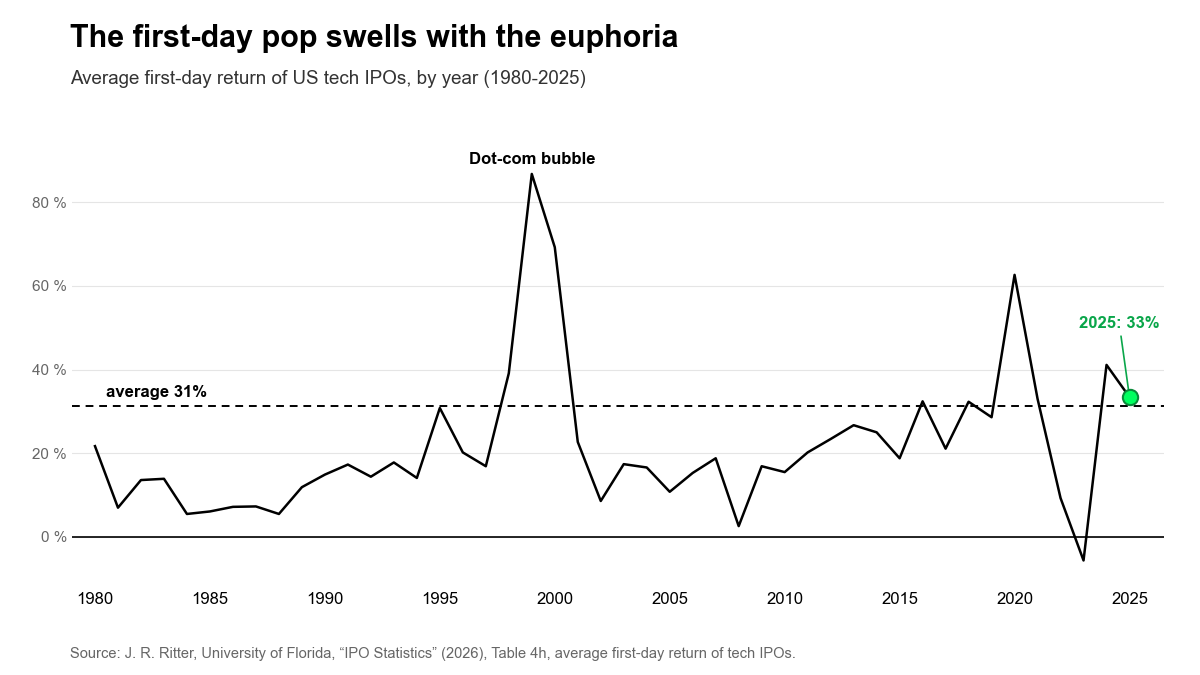
Hence the reflex on 12 June: buy at the open to grab the best price before the stock takes off.
But be careful, the outcome of your trade also depends on how long you hold. The IPO statistics tell a very different story, far less flattering for anyone who buys on day one and keeps the stock.
Buying on the first day: what the IPO numbers say
That average 31.2% return is measured from the offer price to the first day’s closing price. It goes to the trader who got an allocation at the IPO, at $135, not to the one who buys the stock on the market once trading is underway.
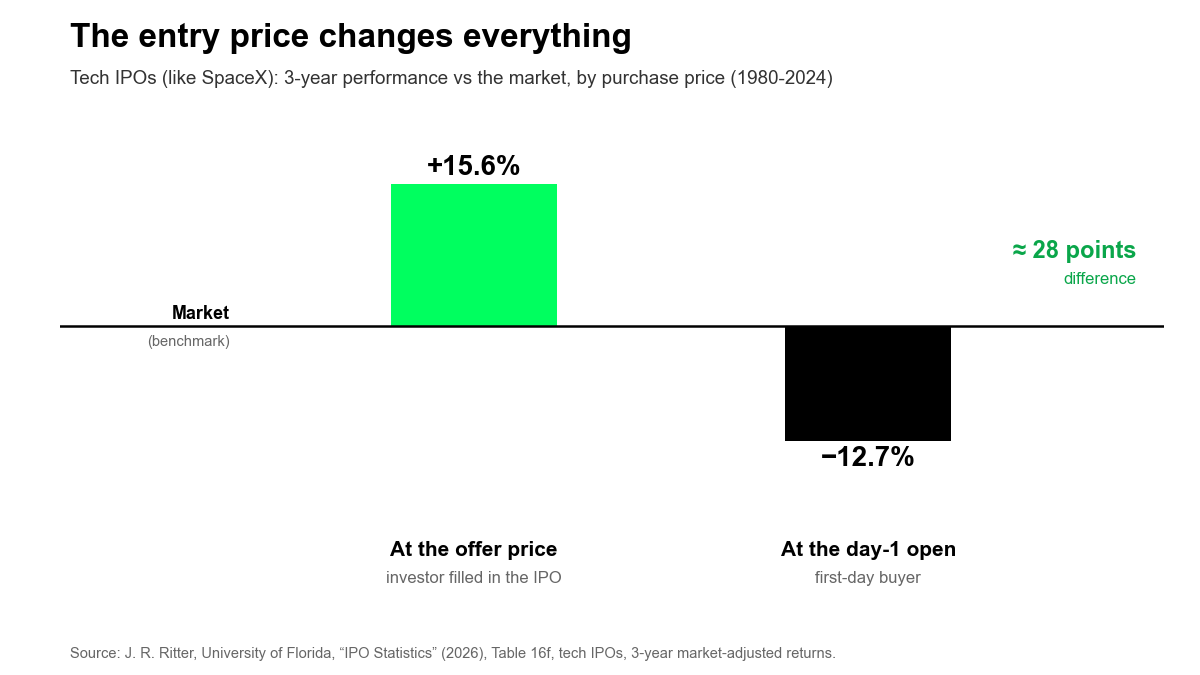
And for a tech stock like SpaceX, the medium-term return gap is striking. Since 1980, tech IPOs bought at the offer price and held have beaten the market by 15.6% over three years.
Bought at the first-day open, they underperformed it by 12.7% instead.
SpaceX is far from an ordinary tech company, and its quirks call for caution.
At the offer price, the stock already trades at 94 times sales: IPOs priced above 40 times sales underperform the market by 58.5% over three years. Morningstar, for that matter, values the company at less than half its offer price [4] .
And since it loses money, it joins another category: lossmaking IPOs, which tend to underperform the market by 30.7%.
In the short term, though, two opposing forces will clash.
- Scarcity supports the price: the offering covers just 555 million shares. The free float works out to around 4%, and the market value will play out on a small slice of the share capital.
That scarcity is reinforced by forced buying from index funds. SpaceX benefits from early index inclusion: MSCI about ten sessions after its debut, then the Nasdaq 100. The biggest passive pool stays shut, though: the S&P 500 requires twelve months of listing and profitable accounts, two conditions SpaceX won’t meet before 2027 at the earliest.
- Selling pressure comes later. The insider resale lock-up runs for 180 days, lifted in stages, and 366 days for Elon Musk. According to Morningstar, the true measure of demand won’t show until the lock-up expires, when more shares can change hands.
A supported price in the first few weeks is plausible, then. But over a three-year horizon, the IPO numbers are telling: an IPO this expensive and lossmaking, bought on day one, has underperformed the market far more often than not.
Buying SpaceX stock from Europe
In practice, you buy SPCX from an ordinary brokerage account with access to the US markets. You search for the stock by its ticker, SPCX, as soon as trading opens. On fees, the commission isn’t necessarily the issue and can come down to a dollar or a euro per order. On a session this volatile, the thing that matters is market access.
Two brokers stand out.
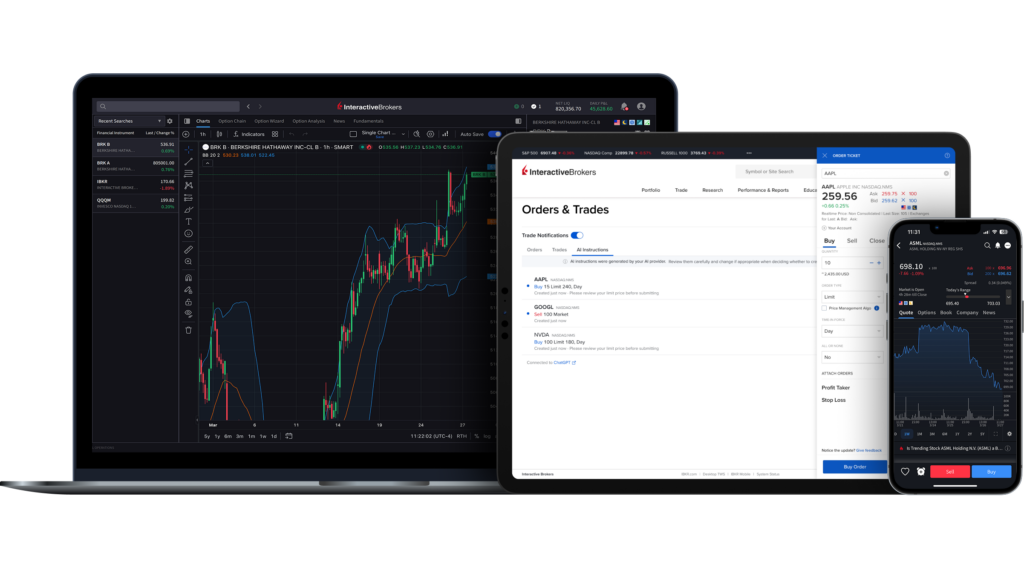
Interactive Brokers routes orders straight to the US exchanges, the Nasdaq and the NYSE, in real time. Its fixed pricing on US stocks is $0.005 per share, with a $1 minimum per order.
Saxo also gives access to the US exchanges, as an agent, through routing that seeks the best price on the main venues. Its commission is 0.08%, again with a $1 minimum per order.
Trade Republic is cheaper, at €1 per order in Best Price mode. Since July 2026, its Direct Price mode can also route orders straight to the Nasdaq for €2.
DEGIRO, for its part, does give access to the US exchanges, for €2 per order.
| Broker | Commission | Market access |
|---|---|---|
| Interactive Brokers | $0.005/share, min $1 | US exchanges direct (Nasdaq, NYSE) |
| Saxo | 0.08%, min $1 | US exchanges, as agent (best price) |
| Trade Republic | €1 (Best Price), €2 (Direct Price) | Nasdaq direct via Direct Price |
| DEGIRO | €2 | US exchanges (Nasdaq, NYSE) |
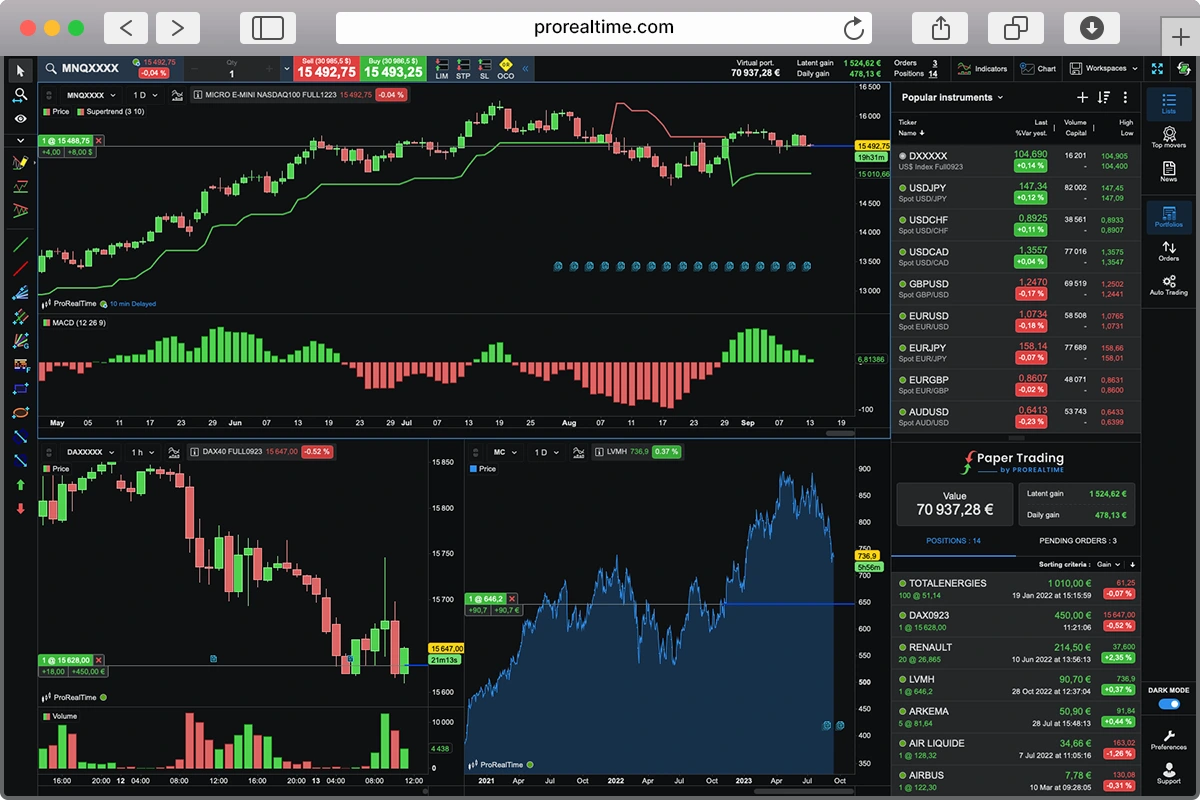
To follow the session’s volatility, you can connect your Interactive Brokers account to ProRealTime, whose real-time charts are built for exactly this kind of setup.
SpaceX on the market: the takeaways
SpaceX is going public through the front door, and the event deserves the attention it’s getting. That leaves the much harder question to answer: “should you buy the stock?”
For anyone looking at a medium- or long-term investment, the numbers call for caution. A valuation at 94 times sales, a $4.9 billion net loss, and a track record with no ambiguity: since 1980, expensive, lossmaking IPOs bought on day one have most often underperformed the market. Morningstar, for that matter, values the company at less than half its offer price.
For anyone trading short-term, intraday or swing, the question is different. The float, cut to 4%, points to heavy volatility, and the calendar offers serious catalysts: entry into the MSCI indices and then the Nasdaq 100, and the gradual lifting of the resale lock-ups.
Two of those catalysts have now landed. SpaceX published its first set of accounts on 4 August, and the first lock-up tranche frees up to 911.5 million shares on 6 August. We went through both in our piece on the Q2 2026 results.
Plenty of openings for movement, but on this kind of stock, volatility has a price: wider spreads and price gaps can catch the trader out in both directions.
Either way, the choice of broker can be decisive: direct market access and execution quality matter more than saving a few euros in commissions. To compare the serious brokers, our ranking of the best stock brokers goes through the best options for a European trader.
Article sources

Audrey holds a Diploma in Accounting and Financial Studies (DECF) and has over 15 years of professional experience in the banking and accounting sectors.
Enjoy free trading practice on
ProRealTime Paper Trading Simulator.