US Stock Market Hours: When Wall Street Opens and Closes

The US stock market is open Monday to Friday, 9:30 AM to 4:00 PM Eastern Time (New York). For European traders, that translates to 3:30 PM to 10:00 PM CET in summer, or 2:30 PM to 9:00 PM CET in winter.
Whether you trade the Dow Jones, S&P 500, or Nasdaq-100, knowing these hours matters. They determine when you can place orders, when volatility peaks, and when thin liquidity can catch you off guard with wider spreads.
Below you’ll find the full schedule for NYSE, NASDAQ, and CME Group, including extended hours, US holidays for 2026, and the best time windows to trade.
For a real-time view of all 17 exchanges with live status, countdown timers, and automatic timezone conversion, see our interactive stock market hours tool.
The key US exchanges
Three groups of exchanges handle the bulk of US trading:
- NYSE (New York Stock Exchange): the world’s largest stock exchange by market capitalisation. Home to most blue-chip stocks.
- NASDAQ: known for its tech-heavy listings (Apple, Microsoft, Amazon). Same regular hours as NYSE.
- CME Group: four derivatives exchanges (CME, CBOT, NYMEX, COMEX) covering futures and options on indices, commodities, currencies, and interest rates. Nearly 24-hour trading on weekdays.
NYSE and NASDAQ trading hours
Both the NYSE and NASDAQ share the same regular session. Extended hours vary slightly.
| Session | ET (New York) | CET winter (Paris, Berlin) | CEST summer (Paris, Berlin) |
|---|---|---|---|
| Pre-market (NASDAQ only) | 4:00 AM – 9:30 AM | 9:00 AM – 2:30 PM | 10:00 AM – 3:30 PM |
| Regular session | 9:30 AM – 4:00 PM | 2:30 PM – 9:00 PM | 3:30 PM – 10:00 PM |
| After-hours | 4:00 PM – 8:00 PM | 9:00 PM – 1:00 AM | 10:00 PM – 2:00 AM |
Pre-market and after-hours sessions have lower liquidity and wider spreads. Prices can move sharply on thin volume, so position sizing matters more than during regular hours.
CME Group trading hours (futures and options)
CME Group products trade nearly around the clock on weekdays, with a brief daily maintenance break.
| Products | US Eastern Time (ET) |
|---|---|
| CME and CBOT (indices, rates) | Sunday 6:00 PM – Friday 6:45 PM |
| CME OTC FX | Sunday 7:00 PM – Friday 6:45 PM |
| NYMEX and COMEX (energy, metals) | Sunday 6:00 PM – Friday 5:00 PM |
Triple and quadruple witching days
A triple witching day is a session where three types of derivative contracts expire at the same time: index options, stock options, and index futures. On a quadruple witching day, single-stock futures expire as well.
Volatility and trading volume typically spike on these days, as many positions are unwound while others are rolled over to the next expiry.
Triple witching falls on the third Friday of March, June, September, and December. These are also the quadruple witching dates when single-stock futures are included.
US stock market holidays in 2026
US exchanges close entirely on these dates. Some holidays also have early-close days (markets close at 1:00 PM ET the day before).
| Holiday | 2026 date | Notes |
|---|---|---|
| New Year’s Day | Thursday, January 1 | Closed |
| MLK Jr. Day | Monday, January 19 | Closed |
| Presidents’ Day | Monday, February 16 | Closed |
| Good Friday | Friday, April 3 | Closed |
| Memorial Day | Monday, May 25 | Closed |
| Juneteenth | Friday, June 19 | Closed |
| Independence Day | Sat, July 4 (observed Fri, July 3) | Closed July 3; early close July 2 |
| Labor Day | Monday, September 7 | Closed |
| Thanksgiving | Thursday, November 26 | Closed; early close Nov 27 |
| Christmas | Friday, December 25 | Closed; early close Dec 24 |
Best times of day to trade Wall Street
Not all trading hours are equal. Here are the windows that consistently see the highest volume and volatility on US markets:
- The first 30 minutes (9:30 – 10:00 AM ET): overnight orders flood in, gaps form, and price discovery is fast. The highest-volume window of the day. High opportunity, but also high risk for beginners.
- The lunch lull (11:30 AM – 1:30 PM ET): volume drops, spreads can widen, and moves tend to be choppy. Many day traders step aside during this window.
- The last hour (3:00 – 4:00 PM ET): institutional traders rebalance, closing auction volume picks up, and trends often accelerate or reverse. The second most active window.
- US economic data releases: scheduled releases (jobs report, CPI, Fed decisions) move prices sharply. Most major releases land at 8:30 AM ET (pre-market) or 2:00 PM ET (Fed).
Remember to account for daylight saving time changes when planning your sessions. The US switches clocks on different dates than Europe, creating a one-to-two-week window (usually in March and November) where the time difference shifts by one hour.

Maxime holds two master’s degrees from the SKEMA Business School and FFBC. As founder and editor-in-chief of NewTrading.fr, he writes daily about financial trading.
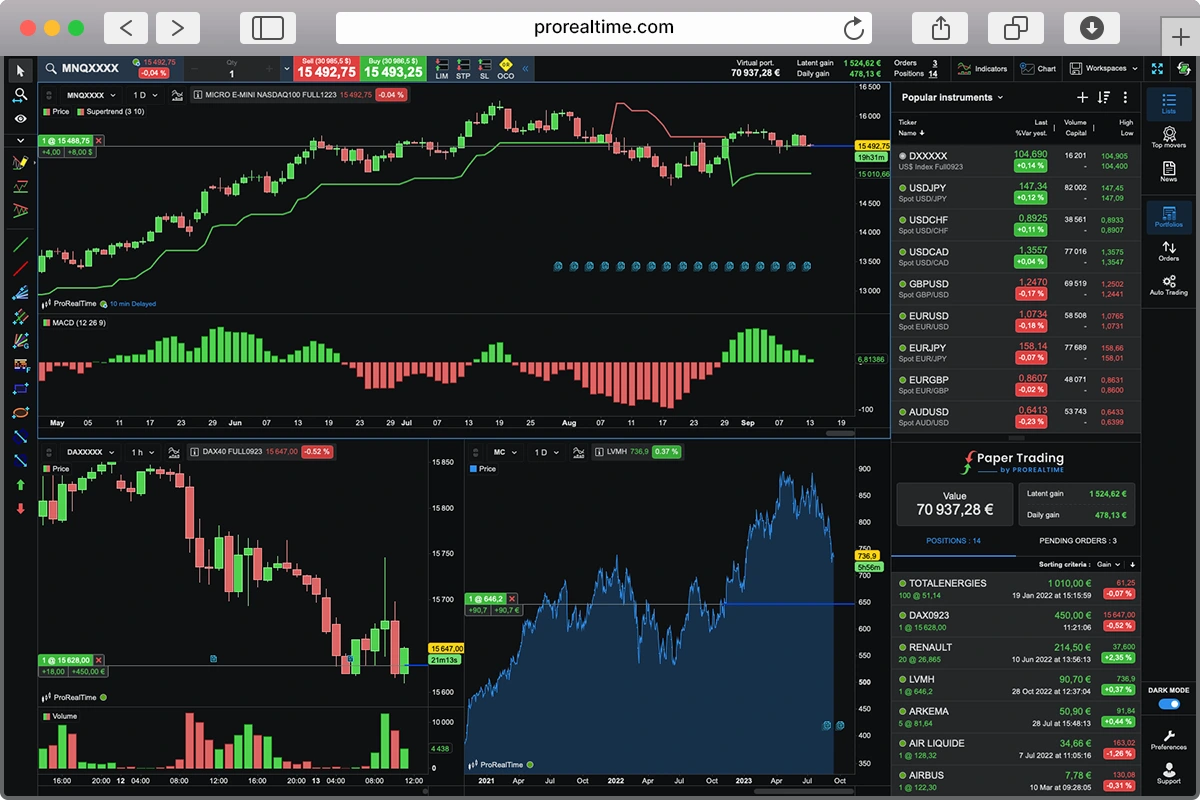
Enjoy free trading practice on
ProRealTime Paper Trading Simulator.