Interactive Brokers vs Saxo: Which Broker Should You Choose?


Interactive Brokers dominates with market depth and execution quality. Saxo attracts traders with its European roots, banking licence and intuitive platforms suited to all trading levels.
Still weighing up these two heavyweight brokers? Interactive Brokers’ global reach versus Saxo’s premium positioning?
Fees, markets, platforms, security… This detailed comparison helps you decide based on your profile and trading goals.
Interactive Brokers vs Saxo: The scorecard
Find the key conclusions from our detailed comparison in the cards below.

Interactive Brokers vs Saxo: Our verdict
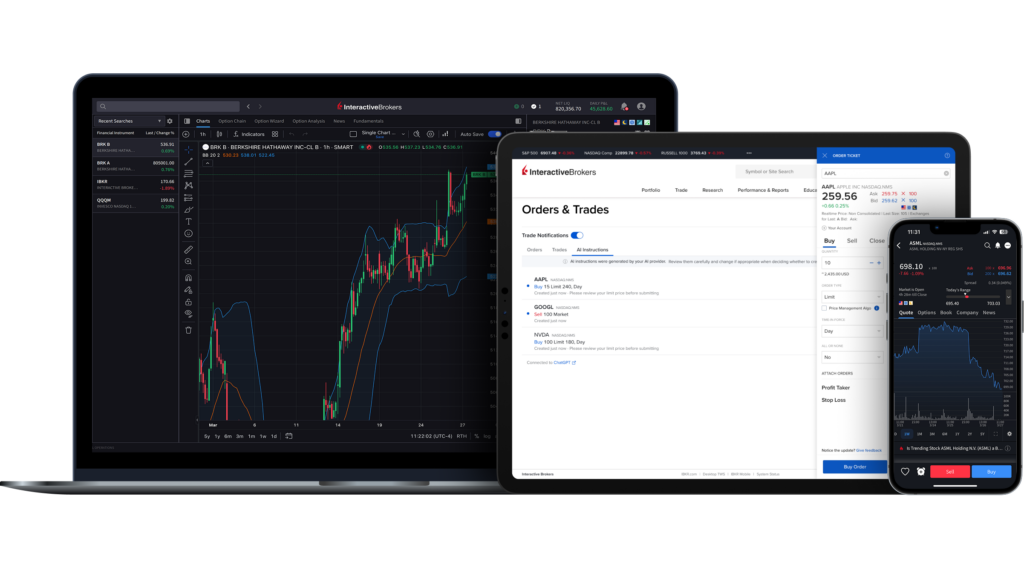
Interactive Brokers (IBKR) is the go-to American broker for demanding traders. Listed on the Nasdaq and active since 1978, it connects clients to more than 170 global exchanges.
Its catalogue covers all asset classes: stocks, ETFs, options, futures, bonds, currencies and metals. The execution quality, powered by SmartRouting, and integrated analysis tools make it a natural choice for intermediate and advanced traders.
Saxo is the European subsidiary of Saxo Bank, a Danish group founded in 1992 with a European banking licence. Saxo claims more than 1.5 million clients and €118 billion in assets under management.
The broker gives access to more than 71,000 financial instruments with or without leverage, and has two distinct platforms: SaxoInvestor for beginners and SaxoTrader for more advanced profiles.
Interactive Brokers retains the edge for active traders seeking maximum market depth and optimal execution. Its instrument catalogue and geographic coverage remain unmatched.
Saxo is a serious competitor, particularly for European traders. Its banking licence, customer support, annual tax statement production and quality platforms make it a credible alternative, especially for those who favour a locally regulated environment.
Your choice depends on your priorities: if market diversity and instruments matter most, IBKR wins. If you want a European banking framework with good balance between features and accessibility, Saxo deserves your attention.
You can also choose another broker! Discover the alternatives to IBKR and the alternatives to Saxo.
Interactive Brokers vs Saxo: Detailed comparison
1. Trading options and markets
Comparison criteria: we evaluate both brokers based on asset and market availability to help you determine if they match your trading strategies.
| IBKR | Saxo | |
|---|---|---|
| Stocks | ✅ | ✅ |
| Fractional shares | ✅ | ❌ |
| ETFs | ✅ | ✅ |
| Bonds | ✅ | ✅ |
| Options | ✅ | ✅ |
| Futures | ✅ | ✅ |
| Forex | ✅ | ✅ |
| Cryptocurrencies | ✅ (ETPs) | ❌ |
| Commodities | ✅ | ✅ |
| CFDs* | ✅ | ✅ |
| Warrants / Turbos | ✅ | ✅ |
| Margin trading | ✅ | ✅ |
| Short selling | ✅ | ✅ |
| International markets | 170+ | ✅ |
Both brokers have extensive multi-asset offerings. Unlike other brokers, Interactive Brokers and Saxo both give access to bonds, listed options and futures.
Interactive Brokers outperforms Saxo by number of accessible markets with more than 170 exchanges. This depth gives a decisive advantage for traders operating in emerging markets or secondary exchanges.
However, Saxo doesn’t handle fractional share trading, which penalises traders who want access to expensive stocks with small amounts. The lack of direct cryptocurrency exposure (no crypto ETPs listed at time of writing) is also a limitation.
Interactive Brokers wins with a much broader trading universe. Saxo still holds its own with more than 71,000 financial products.
2. Commissions and fees
Comparison criteria: we evaluate each broker’s pricing policy. The goal is determining which broker makes trading most cost-effective.
| IBKR Fixed | Saxo | |
|---|---|---|
| European stocks | 0.05%, min. €3 | 0.08%, min. €2 |
| US stocks | $0.005/share, min. $1 | 0.08%, min. $1 |
| ETFs | Same as stocks | Same as stocks |
| Options (Europe) | €1/contract | €0.75/contract |
| Futures (US) | $0.85/contract | $1/contract |
| Inactivity fees | None | None |
| Currency conversion | 0.03% | 0.25% |
| EUR withdrawal | 1st withdrawal free/month, then €1 SEPA | Free |
Both brokers’ pricing relies on a percentage of the order amount, with minimum thresholds or fixed per-contract fees.
For European stocks, Saxo is more accessible for small orders thanks to its €2 minimum (versus €3 at IBKR). However, the 0.08% commission rate exceeds IBKR’s 0.05%. Beyond roughly €4,000 per order, IBKR becomes more competitive.
An often overlooked point: currency conversion fees widen the gap. IBKR charges only 0.03%, while Saxo takes 0.25%. For a portfolio exposed to US markets, this difference significantly impacts total cost.
Both brokers have volume discounts for their most active clients. At Saxo, Platinum status (from €200,000 initial deposit) and VIP status (from €1,000,000 initial deposit) considerably reduce commissions. At IBKR, the Tiered pricing adjusts fees based on monthly volume.
Overall, both brokers have competitive pricing and take turns having the advantage depending on asset classes.
IBKR wins thanks to significantly lower currency conversion fees and more competitive pricing on larger volumes.
3. Trading platform and user experience
Comparison criteria: we evaluate each solution based on ease of use, features, customisation level and performance. Our study includes charting tools, order execution and platform stability.
The trading platform is the cornerstone of your strategy, it should let you execute your trading plan as efficiently as possible.
| Interactive Brokers | Saxo | |
|---|---|---|
| Trader level | Intermediate to advanced | Beginner to advanced |
| Demo account | ✅ | ✅ |
| Price alerts | ✅ | ✅ |
| Technical analysis tools | ✅ | ✅ |
| Fundamental analysis | ✅ | ✅ (limited) |
| Copy trading | ❌ | ❌ |
| Stock screener | ✅ | ✅ |
| Options trading tools | ✅ | ✅ |
| Automated trading | ✅ | ✅ |
| Third-party platform connections | ✅ (e.g. ProRealTime, Mexem…) | ✅ (e.g. ProRealTime, TradingView, MultiCharts…) |
| Currency management | Multi-currency account | Multi-currency account |
On this criterion, both brokers play in the same league: each has a multi-level platform ecosystem, from beginner to advanced trader. You can test both trading solutions free via a demo account.
Interactive Brokers builds around Trader Workstation (TWS), a professional platform packed with advanced features: algorithmic trading, backtesting, portfolio analysis and multi-asset position management. IBKR Desktop has a modernised interface for intermediate profiles. The Client Portal is a more intuitive access point.
Saxo developed two complementary platforms.
- SaxoInvestor targets self-directed traders with a clean interface and simple tracking tools.
- SaxoTrader addresses more active profiles with advanced charting and derivatives access. The desktop version of SaxoTrader supports multi-screen environments.
Both brokers support third-party platforms like ProRealTime.
IBKR maintains a slight advantage thanks to its more developed platform ecosystem.
However, Saxo deserves consideration, as its trading environment is complete enough to implement complex strategies, and easier to grasp than Interactive Brokers’.
4. Customer support and security
Comparison criteria: we evaluate educational resources, research tools, customer service and reliability to determine which broker best supports your trading activity.
| Interactive Brokers | Saxo | |
|---|---|---|
| Educational content | ✅ (IBKR Campus) | ✅ (articles, webinars) |
| Customer support | Chat, Email, Phone (mainly English) | Chat, Email, Phone (8:30am-8pm weekdays) |
| Regulation | Central Bank of Ireland + ACPR | DFSA (Denmark) + ACPR |
| Fund security | IB Ireland for maximum €20,000 coverage | Up to €100,000 (Danish deposit guarantee) |
| Asset segregation | ✅ | ✅ |
| Annual tax statement | ✅ (Detailed tax report) | ✅ |
| Trustpilot rating | 3.6 / 5 | 3.5 / 5 |
This is where Saxo stands out most clearly, thanks to three structural advantages.
- The banking licence. Saxo Bank A/S is a credit institution, not just a broker. Your cash deposits are therefore covered by the Deposit Guarantee Scheme up to €100,000 — five times the protection ceiling from the Irish scheme covering IBKR (€20,000 at 90%). For traders who keep substantial cash in their account, this guarantee difference is significant.
- The annual tax statement. Saxo supplies a tax statement each year that simplifies declaring your trading income. IBKR provides detailed tax reports — you must reconstruct your tax situation from these reports yourself.
Saxo wins this round thanks to its banking licence, responsive customer support and annual tax statement delivery.
Interactive Brokers compensates with exceptional financial strength and the broadest market access.
5. Mobile app experience
Comparison criteria: we evaluate each solution’s mobile app for features, ease of use and consistency with the desktop version.
| IBKR Mobile / Global Trader | SaxoInvestor / SaxoTrader | |
|---|---|---|
| Design & ergonomics | 3.5 / 5 | 4 / 5 |
| Availability | iOS & Android | iOS & Android |
| Charts | ✅ | ✅ |
| Order placement | ✅ | ✅ |
| Price alerts | ✅ | ✅ |
Interactive Brokers has two complementary apps.
- GlobalTrader has simplified navigation for occasional traders.
- IBKR Mobile reproduces an environment closer to IBKR Desktop, with greater analytical depth.
Saxo also has mobile versions of its two platforms.
- SaxoInvestor suits long-term investors with a clear dashboard and thoughtful ergonomics.
- SaxoTrader integrates advanced charting and analysis tools for more active traders.
The Saxo app benefits from more modern design and better mobile ergonomics. It also integrates the Programmed Savings Plan (PEPS), which automates recurring purchases on a selection of ETFs and funds.
IBKR has greater functional depth, particularly for technical analysis on the go and complex position management (options, futures).
A draw. Saxo wins on ergonomics. IBKR keeps an advantage for mobile analytical power.
Who wins the Interactive Brokers vs Saxo match?
After thorough analysis of each criterion, Interactive Brokers and Saxo finish neck and neck with an identical score of 415/500. This result isn’t surprising given how both brokers excel, each in their own way.
Interactive Brokers takes the lead on pure trading thanks to its financial instrument catalogue and commissions. Its platform, though complex, creates a complete trading environment.
IBKR represents the natural choice for active, experienced traders seeking the broadest possible access to global markets.
Saxo, for its part, distinguishes itself clearly through quality customer support and regulatory reliability — essential criteria for those who want to trade with peace of mind. Its more intuitive platform compensates for a slightly narrower catalogue with polished user experience.
Both brokers match perfectly on mobile experience (80/80), proof that each invests seriously in mobile trading.
In summary: your choice depends on priorities. If market access and reduced fees matter most, turn to Interactive Brokers. If you value solid customer support and smoother onboarding, Saxo will be your ally. Either way, you’re in good hands.
| Other Comparisons |
|---|
| Interactive Brokers vs Trade Republic |
| Interactive Brokers vs ProRealTime |
| Interactive Brokers vs DEGIRO |
| Interactive Brokers vs XTB |
| Interactive Brokers vs eToro |
FAQ
Interactive Brokers or Saxo: which is cheaper?
It depends on the market and your order size. For small European stock orders, Saxo is slightly more accessible (€2 minimum versus €3 at IBKR). For US stocks and large orders, IBKR takes the lead with a lower commission rate.
A key differentiator is currency conversion fees: 0.03% at IBKR versus 0.25% at Saxo. If you regularly trade international markets, this difference can represent several hundred euros per year.
Interactive Brokers or Saxo: which is better for beginners?
Saxo is more accessible. SaxoInvestor has a clean interface, and the Programmed Savings Plan makes automatic investing easy.
Interactive Brokers also has adapted platforms (IBKR Desktop, GlobalTrader) and IBKR Campus for education, but the environment is denser.
Interactive Brokers or Saxo: which is safer?
Both brokers are reliable and solidly regulated. Saxo has a structural advantage thanks to its banking licence: your deposits are guaranteed up to €100,000 by the deposit guarantee scheme.
Interactive Brokers compensates with massive capitalisation ($19.5 billion in equity) and Nasdaq listing that imposes strict financial transparency.
Interactive Brokers or Saxo: which is simpler for tax declaration?
Saxo, without question. The broker issues an annual tax statement that simplifies your declaration. Dividend and capital gains amounts are pre-filled.
Interactive Brokers supplies detailed tax reports. You have all the information, but reconstructing your situation for tax reporting remains your responsibility.

Audrey holds a Diploma in Accounting and Financial Studies (DECF) and has over 15 years of professional experience in the banking and accounting sectors.
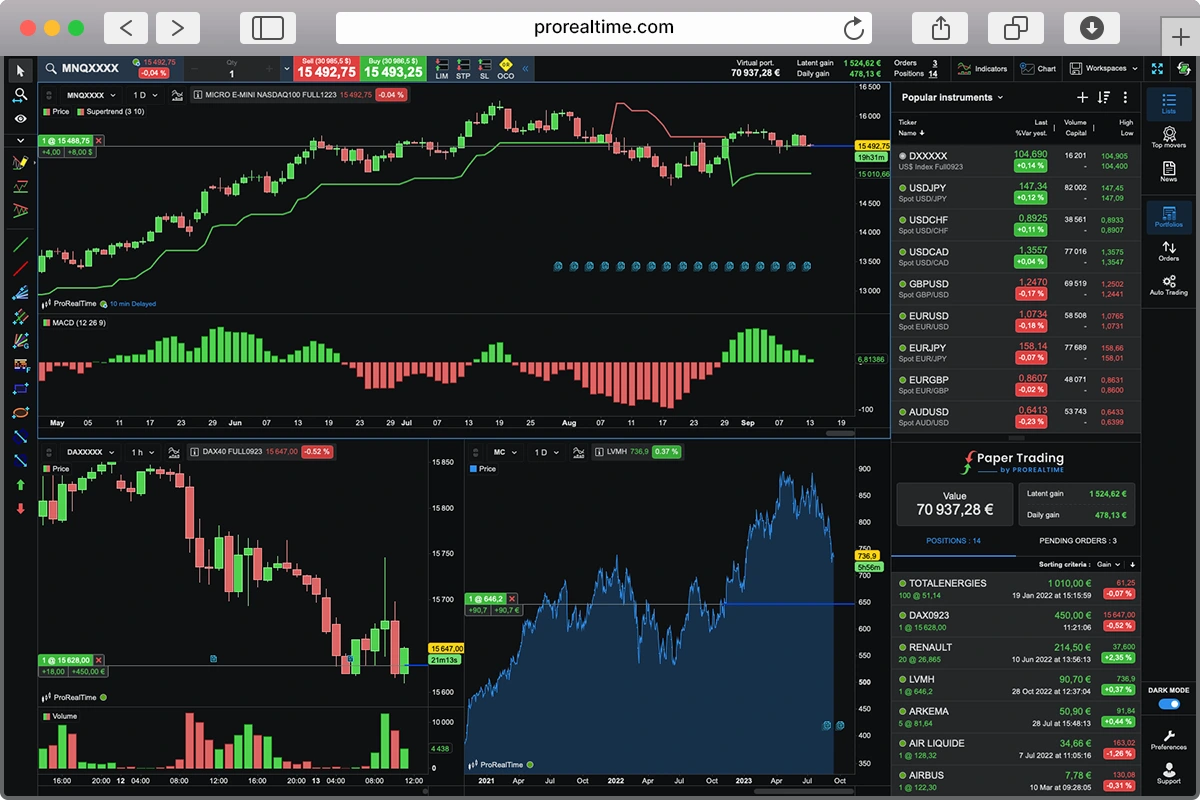
Enjoy free trading practice on
ProRealTime Paper Trading Simulator.