
History repeats



Trading legend Paul Tudor Jones is betting on the rally continuing. His killer argument: the AI revolution looks eerily similar to the arrival of early software, and since history repeats itself, we’re on the verge of massive productivity gains.
In this cross-generational analogy, Claude is the new Microsoft, and we’ve got another 12 to 18 months of bull market before watching indices plummet more than 30% in a matter of weeks…
Will his 2027 crash prediction be as accurate as his 1987 call? We’ll see.
But Paul Tudor Jones isn’t the only one digging through the archives to make sense of today’s market. Future Fed Chair Kevin Warsh is doing the same to push for looser U.S. monetary policy.
From his perspective, today’s revolution mirrors the tech boom of the ’90s. The productivity gains promised by AI (structurally deflationary) would justify cutting rates without worrying about inflation taking off.
Problem is, other monetary policy heavyweights are using the exact same historical analogy to reach completely opposite conclusions.
According to the Chicago Fed president, even if AI delivers productivity gains similar to those of the ’90s, if market expectations outpace reality, the economy could overheat and enter stagflation.
The current monetary debate boils down to this: will AI drive prices down, or will overinvestment send them soaring? We’ll get the next clue Tuesday with the CPI release.
My trading plan
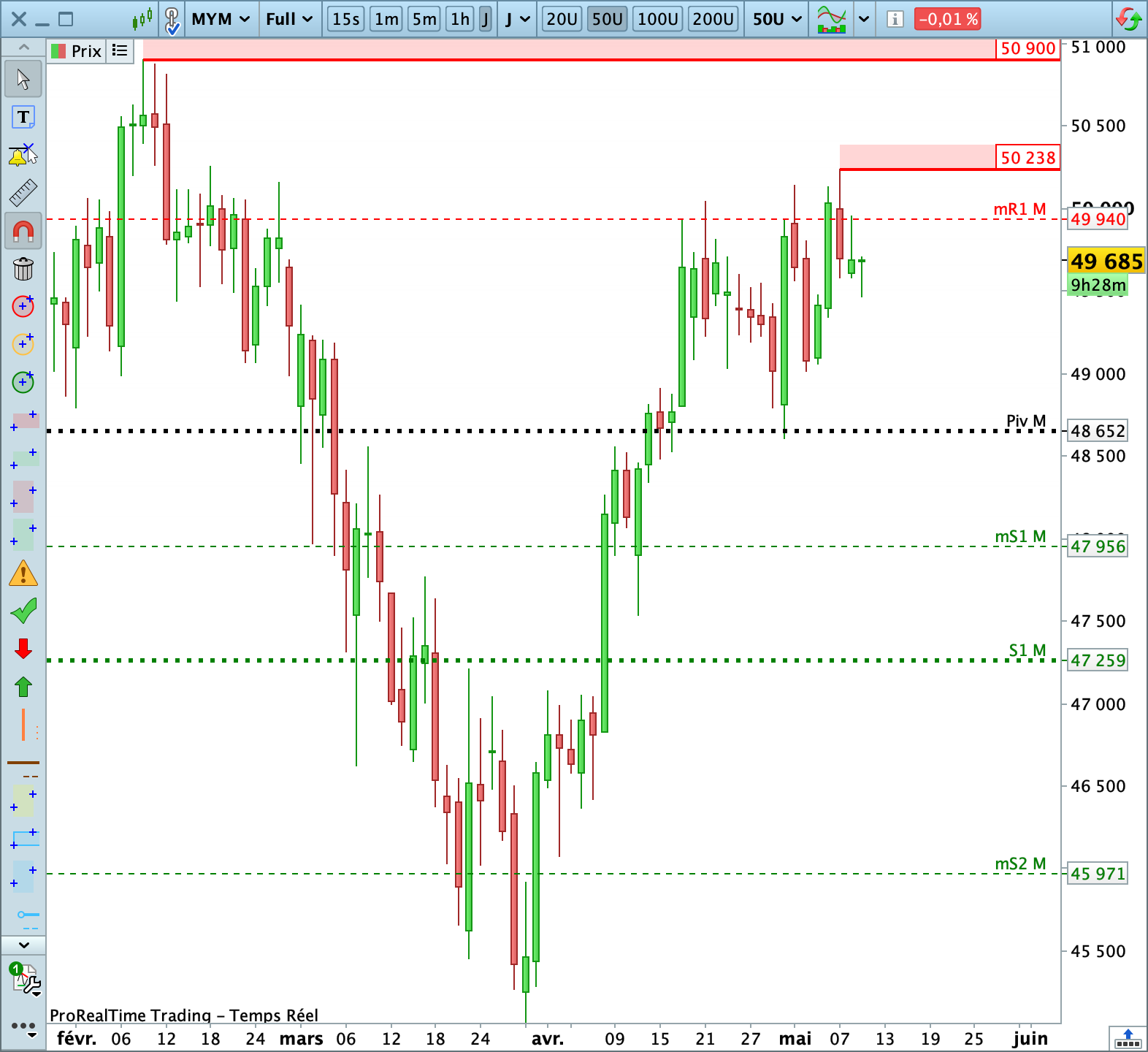
Until proven otherwise, buyers remain in control.
The market pushed to a weekly high above the symbolic 50,000-point threshold for the third consecutive week before taking profits, which once again shows the market’s cautious stance.
In this context, I’ll again favor bullish trades targeting short sellers’ stop-losses above the 50,238-point resistance (with potential to reach those above 50,900 points on good news).
Happy trading!

Maxime holds two master’s degrees from the SKEMA Business School and FFBC. As founder and editor-in-chief of NewTrading.fr, he writes daily about financial trading.
The vise tightens

Dead cat bounce

Perfect timing