How Much Can You Make as a Day Trader?


Day trading is often sold as the fastest way to financial freedom. Open a trading account, learn a few strategies, and you’ll be on your way to making thousands—or so the story goes.
But what’s the reality behind the dream?
How much do the top 1% of traders really earn? How long does it take to go from beginner to break-even to truly profitable? And what separates those who scale up… from those who burn out?
To cut through the hype, we dug into multiple academic studies and real-world trading data. Here’s what we found—backed by numbers, not promises.
How Much Does a Profitable Day Trader Make?
Unlike institutional traders who often earn six-figure salaries, retail traders see wildly different results. Earnings depend on experience, account size, and risk tolerance — and the range is massive.
Still, based on multiple studies [1] , here’s what top-performing, consistently profitable retail traders manage to earn net of fees:
- Per day: +0.379%
- Per month: +7.86%
- Per year: +147.95%
Yes, you read that right. Some of the best retail traders double their account in a year. That kind of performance would place you among the elite. But before you start dreaming of triple-digit returns, here’s the other side of the coin…
For the average trader, the outcome isn’t a gain. It’s a loss of €10,887. [1]
That’s the average result across thousands of retail trading accounts. So while a few traders crush it, most end up with less money than they started with.
These figures come from in-depth regulatory studies conducted over several years. And if you’re wondering whether they still apply, just take a quick scroll through any trading forum. You’ll find endless stories and testimonies—accounts blown up, dreams chased, the same cycle repeating itself. The data may not reflect the latest platforms or trends, but the pattern is hard to ignore: a few win, most lose.
And even among those generating a daily return of +0.379%, there’s a crucial question: are they truly skilled, or just lucky?
The AMF (France’s financial regulator) found that the more trades a person places over time, the more likely they are to lose money. In other words, as randomness fades, skill (or lack of it) becomes more apparent — and most come up short.
Does that mean all winning traders are just lucky? Not at all. Some traders do develop an edge and manage to consistently outperform. But the number of people with that level of skill is far smaller than most assume.
Even Ray Dalio, one of the world’s most successful hedge fund managers, once said:
“Beating the market is harder than winning an Olympic medal.”
For context, the 2024 Paris Olympics awarded just 987 medals. That puts things into perspective.
What Really Drives a Trader’s Performance?
When someone tells you they made a 10% return in a month, your first instinct might be to think: “That’s impressive.” But is it?
The truth is, a trader’s performance is only meaningful when you understand how that result was achieved.
Three key factors shape a trader’s outcomes:
- Win rate – the percentage of trades that end in profit.
- Risk-reward ratio – how much they win on average vs. how much they lose.
- Position size – how much capital is risked on each trade.
These three metrics tell you far more than a single performance number ever could.
For example:
Imagine a day trader with €5,000 who risks €4,500 on a single trade and doubles it. Impressive? Maybe. But if that trade goes wrong, they’re out of the game.
A +7% monthly return is excellent if it came from low-risk, consistent trading. But if that same return came from risking 90% of the account on a single coin-flip trade, it’s a disaster waiting to happen.
That’s why smart traders don’t just look at profits — they evaluate the quality of those profits.
Two key metrics help with that:
- Maximum drawdown – the biggest peak-to-trough loss in your account balance.
- Profit factor – the total amount won divided by the total amount lost.
These numbers show you whether a trader earned their returns through controlled risk-taking or reckless bets. At the end of the day, real performance is always about return per unit of risk.
Use this trade return calculator to simulate your profit >
Is There a “Best” Asset Class for Day Traders?
At first glance, it might seem like crypto traders earn more than stock traders. The wild swings in Bitcoin or the 100x leverage offered on Forex platforms can make it feel that way.
But once you adjust for risk, the difference mostly disappears.
Crypto’s volatility or Forex’s leverage might inflate the appearance of profitability, but what you’re really seeing is just more risk being taken. More risk doesn’t mean more skill — it just means bigger wins or bigger losses.
When you normalize performance based on risk, the returns tend to level out across all major asset classes: stocks, currencies, commodities, and even crypto.
Good to know:
In long-term investing, different asset classes may offer different returns. But in short-term speculative trading — a zero-sum game — your risk-adjusted performance doesn’t depend on what you trade.
So no, there isn’t a “best” market. What matters more is how you manage risk, not whether you’re trading Tesla or Ethereum.
What’s the Most Profitable Trading Strategy?
Most traders obsess over finding the perfect strategy. But the truth? Even the “best” strategy will fail in the hands of someone who can’t manage risk.
That’s why it all comes down to money management—how you control risk and take profits.
No trading style has a built-in advantage. Short-term strategies like scalping or day trading don’t inherently outperform longer-term approaches like swing trading or position trading. The difference lies in execution, discipline, and how well the strategy fits the trader’s psychology and routine.
The strategy itself doesn’t make you profitable. It’s how you handle your losses, size your trades, and stay consistent that defines your edge.
What’s the Most Profitable Financial Product?
Again, it’s not about the product — it’s about how you use it.
At equal levels of risk, no financial product is inherently more profitable than another. Whether you trade stocks, options, futures, CFDs, or crypto, your results depend more on your skills than on the instrument.
That said, certain products like futures and options tend to show better performance stats.
Why? Their users are typically more experienced, and the trading fees are often lower. In contrast, retail-friendly instruments like CFDs, turbos, and warrants often come with higher costs and attract less seasoned traders.
So while the product matters from a cost and complexity standpoint, there’s no magic instrument. The edge still comes from the trader, not the tool.
What Percentage of Day Traders Actually Make Money?
Only around 3% of retail traders end up making money. And if you narrow it down to those who earn consistently over time, that number drops to just 1%.
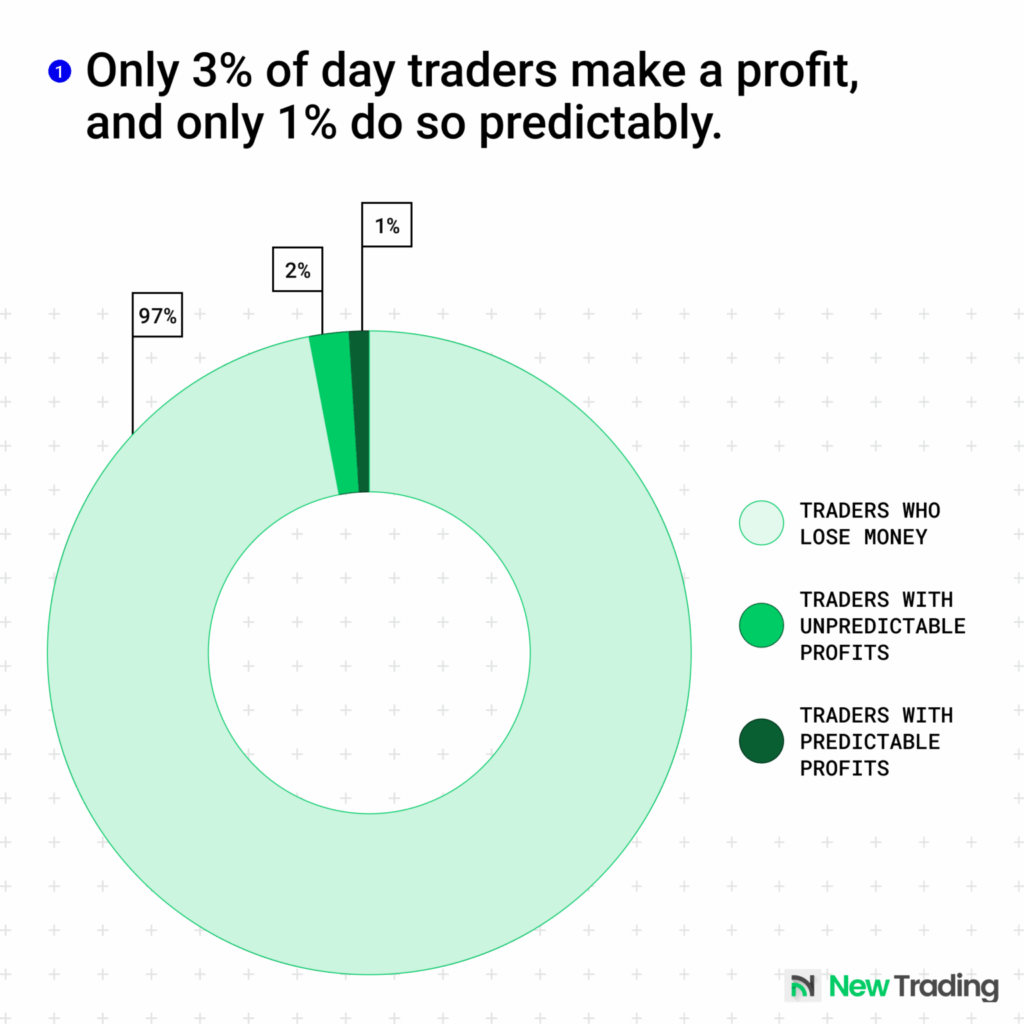
The odds aren’t exactly in your favor.
Far from the dream of easy money pushed by trading ads, the data tells a different story—one that’s far less glamorous. Peer-reviewed studies and regulator reports agree: the majority of retail traders lose money.
But here’s the nuance: while most struggle, a small group does manage to beat the odds. With the right tools, discipline, and experience, some retail traders do carve out a path to long-term profitability. It’s rare—but not impossible.
How Much does a Beginner Trader make?
As you might expect, beginner traders earn less than those with experience. But here’s the good news: you don’t need years of trading to start seeing improvement.
Studies show that after just 50 trading days, performance starts to get noticeably better [3] . Practice helps — and early.
That said, experience doesn’t guarantee success.
Among traders with more than 400 days of trading behind them, only 9% end up profitable [4] . That’s better than the 3% success rate across all traders, but it still means that 91% of experienced traders lose money.
So while time on the charts helps, it’s no magic bullet. Skill, discipline, and mindset matter far more than just racking up trades.
How Much Do the Best Traders Make?
This is where the gap becomes massive.
While most retail traders aim for a few hundred or thousand euros a month, top professionals have posted results that are in another league entirely—and we know this because it’s on the record.
Paul Tudor Jones reportedly made $100 million in a single day by shorting the 1987 market crash. In interviews, he credits risk management above all:
“The most important rule of trading is to play great defense, not great offense.”
George Soros earned over $1 billion in 1992 during his famous trade against the British pound. He’s spoken often about the role of reflexivity in markets—how trader beliefs can shape outcomes—and how vital it is to understand when you’re wrong:
“I’m only rich because I know when I’m wrong.”
Jim Simons, founder of Renaissance Technologies, ran the Medallion Fund with an average annual return of 66%, net of fees, for over two decades. That figure is from documented fund performance—not rumor. Unlike discretionary traders, Simons relied on complex statistical models and built a system where execution was everything.
These are outliers by every definition, but they show what’s possible at the highest level.
So what separates them from the rest?
Not a secret strategy. Not instinct. But structure, risk control, and a deep understanding of their edge.
Their interviews and public letters don’t talk about setups—they talk about discipline, models, and knowing when not to trade.
How Much Should I Aim to Make as a New Trader?
It’s a fair question. But the truth is, setting a fixed income target early on — like €2,000 per month or 20% per year — is more likely to distract you than help you.
Trading isn’t like a salaried job. Your results won’t be linear, and pushing for a specific number too soon often leads to overtrading, oversized positions, revenge trading or burnout. That doesn’t mean you shouldn’t have goals, it just means they need to evolve with your level of experience.
Here’s how to approach profit goals based on where you are in your journey:
If You’re Just Starting Out
Your real goal: Don’t lose money while learning.
Profit is not the priority yet. Your focus should be on understanding how markets move, testing your strategies, and avoiding beginner mistakes — all without burning through your capital.
What to do:
- Use a simulator or demo account for at least 50–100 trades.
- Practice one setup repeatedly until it becomes second nature.
- Log every trade in a journal and review your decision-making.
What to track:
- Are you following your rules?
- Do you understand your strategy’s edge?
- Can you stay calm after a losing streak?
Profit target: 0%. Breaking even while learning is a win. Most traders lose money in their first year. If you’re flat, you’re ahead.
If You’re Considering Trading Full Time
Your real goal: Trade like a business, not a hustle.
If you’ve built a consistent track record and are thinking about going pro, your profit goal needs to reflect the full picture: taxes, downtime, volatility, and opportunity cost.
What to do:
- Analyze your results net of taxes and fees.
- Compare your returns to passive investing or freelance income.
- Plan for months with no income, and build a financial buffer.
What to track:
- Your best and worst month
- Time spent vs. income earned
- Whether you could scale your strategy with more capital
Profit target: Enough to meet your needs without relying on unrealistic performance. For most professional traders, 15–30% annual returns with tight risk control is already excellent.
Good to know:
Your net profitability will depend heavily on where you live and how your trading is taxed. Using the right account structure (like tax-advantaged wrappers or professional status) can make a big difference.
The Real Question
It’s easy to ask “How much can I make?” But a better question is:
“Can I trade in a way that’s sustainable, repeatable, and worth the effort?”
Because if you get those things right and start making profits, they’ll actually mean something.
Final Thoughts
Making money on a trading simulator is a milestone.
Turning a real profit with real money is another. And building lasting wealth through trading?
That’s something else entirely.
The transition from paper trading to live capital brings unexpected challenges — especially psychological ones. The emotional swings, the fear of loss, the pressure to perform… these are the real tests that separate theory from execution.
For your early months in live markets, keep your position sizes small. Focus on staying aligned with the track record you built in simulation. If you can match that performance under real pressure, that’s a big win.
And once you’re consistently profitable, it’s time to ask a deeper question:
Is this worth it?
Compare your results to passive investing. Simulate your profits with a trade return calculator. Adjust for taxes and inflation. Then weigh those gains against the hours, focus, and emotional capital you’ve spent along the way.
Because in the end, the most important metric isn’t just how much you make — it’s what it cost you to get there.
Article sources

Maxime holds two master’s degrees from the SKEMA Business School and FFBC. As founder and editor-in-chief of NewTrading.fr, he writes daily about financial trading.
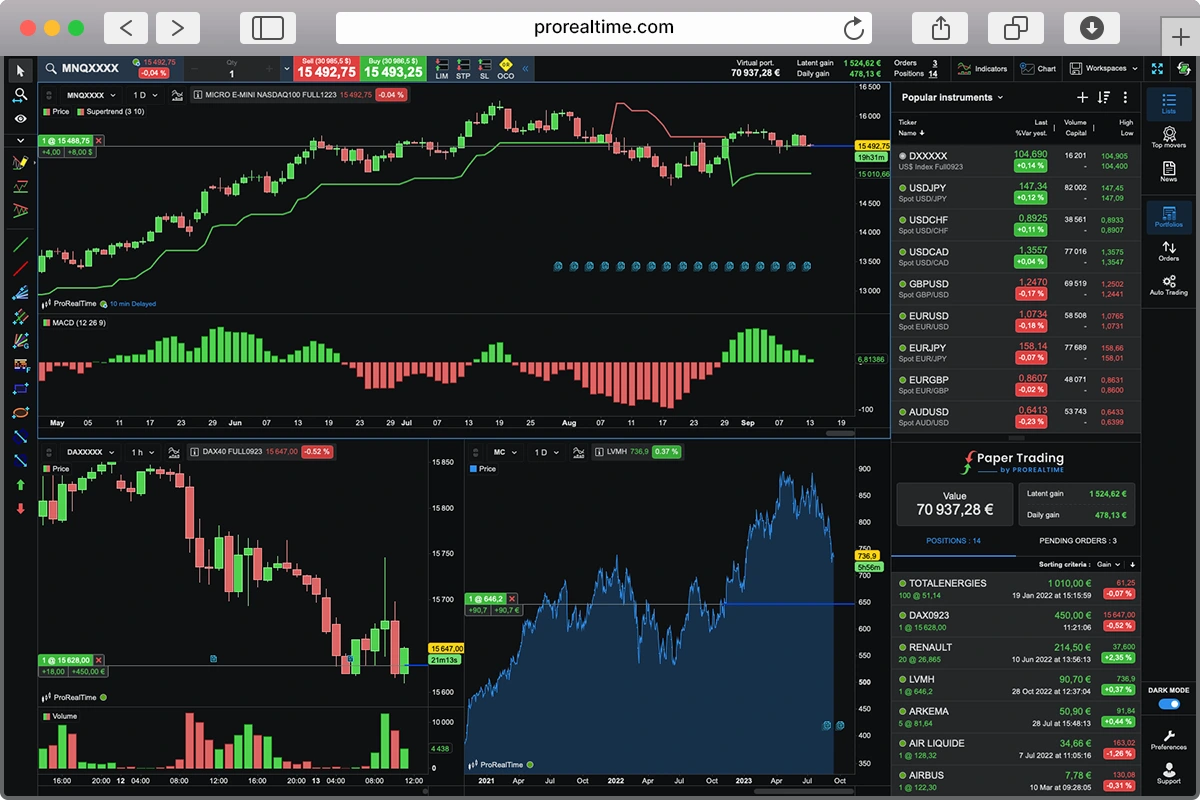
Enjoy free trading practice on
ProRealTime Paper Trading Simulator.