
Trading 212 Review 2026: Zero Commissions, But Is It Enough?


Four and a half million funded accounts. Over €30 billion in client assets. And not a single commission on stock or ETF trades.
Trading 212 built its reputation as one of the first zero-commission brokers in Europe. In a market where DEGIRO still charges per-trade fees and eToro takes 0.5% on every currency conversion, that matters. But free doesn’t mean simple, and the platform has grown into something more complex than a “free stock app” label suggests.
We put Trading 212 through a full review to see where the value actually is, and where the cracks show.
Here’s what we cover:
- How Trading 212 actually makes money (and what it costs you indirectly)
- Pies and AutoInvest: the feature that sets it apart from every other broker
- Regulation across three jurisdictions (FCA, CySEC, BaFin)
- Where it falls short for active traders
- How it stacks up against DEGIRO, eToro, Interactive Brokers, and ProRealTime

Trading 212 is a zero-commission broker built for passive investors in Europe. AutoInvest Pies, fractional shares from €1, and no platform fees. Basic charting and above-average CFD spreads hold it back for active traders.
Capital at risk. Not financial advice.
Our Take on Trading 212
Trading 212 is one of the strongest zero-commission brokers in Europe for passive investors. The AutoInvest feature gives it an edge over DEGIRO and eToro for anyone running a DCA strategy. Fractional shares from €1, daily interest on uninvested cash, and no platform fees. For building a long-term portfolio on autopilot, few brokers match that combination.
But that’s where the praise stops. The charting tools are basic. There’s no API for algorithmic trading. CFD spreads run above the industry average. And the share lending programme, enabled by default, is a detail most users don’t realize they’ve opted into.
Trading 212 does one thing very well: hands-off, low-cost investing. If that’s what you need, it’s a solid pick. If you need anything beyond that, you’ll hit walls fast.
| Category | Score |
|---|---|
| Ease of Use | 90% |
| Pricing & Fees | 88% |
| AutoInvest & Pies | 92% |
| Charting & Analysis | 45% |
| Asset Selection | 75% |
| Overall | 78% |
Best for: Passive investors who want zero-commission DCA into stocks and ETFs, with automated rebalancing.
Skip if: You’re an active trader who needs advanced charting, algorithmic tools, or deep market analysis.
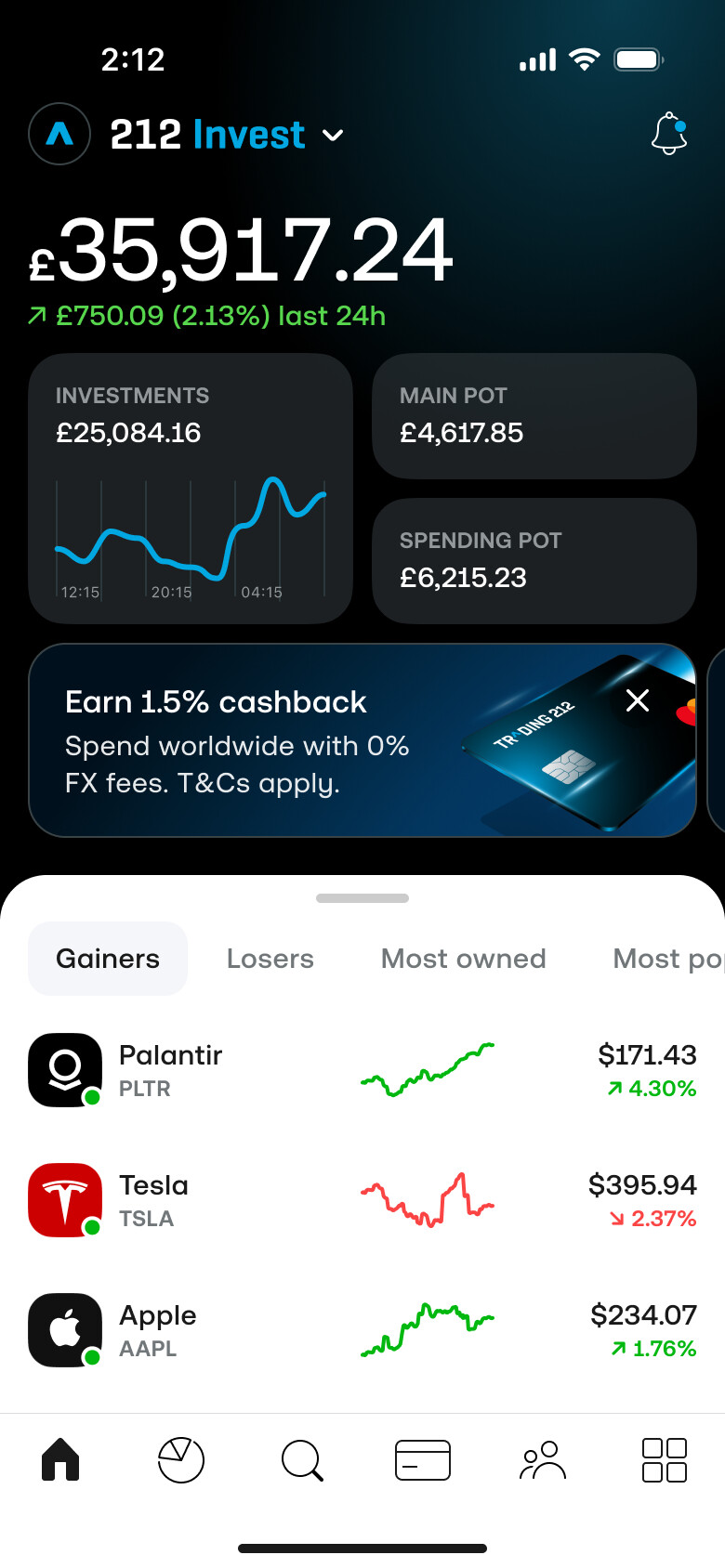
Who Is Trading 212 For?
Not every broker fits every trader. Here’s the quick filter.
You’ll get the most out of it if you are:
- A passive investor building a long-term portfolio with monthly contributions and automated rebalancing
- A beginner making your first stock or ETF purchases and wanting zero friction
- A small-capital investor who needs fractional shares (buy from €1, even for stocks priced at €500+)
- Someone switching from a savings account who wants interest on uninvested cash plus easy market access
Look elsewhere if you are:
- An active day trader. The charting is basic, there are no advanced order types, and there’s no API for custom tools.
- A forex or crypto trader. CFD spreads are above average (EUR/USD at roughly 1.5 pips vs the 1.0 industry norm), and there’s no dedicated crypto wallet.
- An advanced investor who needs research tools, screeners, or options and futures.
- Someone who values full control over share lending. It’s on by default, and while you can opt out, most users don’t realize it’s active.
Trading 212 is built for people who want investing to run in the background. If you open your broker app more than once a week, you’ll probably outgrow it.
Is Trading 212 Safe?
When a broker charges zero commissions, the first question is always the same: what’s the catch, and can I trust them with my money?
Regulation
Trading 212 holds licenses across three jurisdictions:
- EU (outside Germany): CySEC-regulated (license 398/21) through Trading 212 Markets Ltd in Cyprus. ICF protection up to €20,000.
- Germany: Operates through FXFlat Bank GmbH, which Trading 212 acquired to get a BaFin licence. German Investor Compensation Scheme covers up to 90% of claims, capped at €20,000.
- UK: FCA-regulated (FRN 609146). Client funds protected under the FSCS up to £120,000 per person (raised from £85,000 in December 2025).
Client money sits in segregated accounts at JP Morgan, Barclays, and other major banks. This means your cash isn’t mixed with Trading 212’s operating funds.
Ownership and financials
Trading 212 was founded in 2004 in Bulgaria (originally as Avus Capital) and is now headquartered in London. The company is privately held and profitable: £194 million in revenue for 2024 (roughly €225 million), up from £116 million in 2023. Net profit hit £44 million. For a fintech broker, those numbers signal stability, not a company burning through venture capital.
The team spans 650+ people across offices in London, Sofia, Plovdiv, Limassol, Berlin, Dusseldorf, Sydney, and Dublin.
What actual users say
Trustpilot: 4.6/5 from over 40,000 reviews. One of the higher ratings among European brokers.
The praise concentrates on zero fees, the clean mobile app, and fast account opening. The complaints cluster around three areas:
- Customer support response times. The chatbot handles most queries, and reaching a human takes persistence.
- KYC verification issues. Some users report being asked for bank statements from long-closed accounts or selfie-with-passport requests to process withdrawals.
- Share lending concerns. Users who discover it was enabled without their explicit consent feel uneasy, even though the risk is mitigated by 102% collateral.
The regulatory setup is solid for European investors. Three separate licences, segregated accounts, and a profitable business behind the brand. Most EU clients fall under CySEC or BaFin supervision, both with ICF protection up to €20,000.
Plans and Pricing
Zero commissions sounds straightforward. The reality has more layers.
Account types
Trading 212 has three account types:
- Invest: Zero-commission stocks and ETFs. No minimum deposit. Fractional shares from €1. This is the account most EU investors will use.
- CFD: Contracts for difference on forex, indices, commodities, and crypto. Spreads apply (no commission).
- ISA (UK only): Same as Invest, but tax-sheltered under the UK ISA wrapper. Not available to EU residents.
Where the money actually goes
Trading 212 doesn’t charge platform fees, inactivity fees, or deposit/withdrawal fees. So how does a company with £194 million in revenue make money from free trades?
1. FX conversion fee: 0.15%
Every time you buy a stock denominated in a currency other than your account’s base currency, Trading 212 takes 0.15%. For a European investor buying US stocks, this applies to almost every trade. The workaround: buy EUR-denominated ETFs instead of individual US stocks.
For context, DEGIRO charges 0.25%, eToro charges 0.5%, and Interactive Brokers charges roughly 0.03%. Trading 212 sits in the middle.
2. CFD spreads
The Invest account is free. The CFD account is where Trading 212 makes money from spreads. EUR/USD trades at roughly 1.5 pips, which is above the industry average of about 1.0. Add overnight financing fees, and CFDs get expensive for anything held beyond intraday.
3. Share lending
Trading 212 lends your shares to institutional borrowers and keeps 50% of the interest earned. This is enabled by default on all Invest accounts. You can opt out in settings, but most users don’t know it’s active. When your shares are lent: you lose voting rights, and dividends become “manufactured dividends” (which may have different tax treatment depending on your country). For EU clients, the collateral is 102% in cash.
4. Interest on uninvested cash
Trading 212 earns a spread on the interest rate it gets from banks vs what it pays you. You still get paid daily on your uninvested balance, but Trading 212 keeps a margin.
212 Card
A Mastercard debit card linked to your Invest account. 0.5% cashback on purchases (down from 1.5% for earlier users), zero FX fees for international spending, and a “Spend & Invest” feature that rounds up purchases and invests the spare change. The monthly cashback cap is around €17. Physical card costs roughly €6, virtual card is free.
Nice-to-have, not a reason to open an account.
For passive investors buying ETFs in their base currency, Trading 212 is close to free. The costs show up when you trade in foreign currencies (0.15% FX fee) or use the CFD account (above-average spreads). Know where the fees are and you can keep them near zero.
Pies and AutoInvest
Most brokers let you buy stocks. Trading 212 lets you build a portfolio that runs itself.
How Pies work
A Pie is a custom portfolio of up to 50 securities with target allocations (down to 0.1% per slice). You set the percentages, and Trading 212 handles the rest. When you deposit money, it distributes across your Pie according to your targets. When allocations drift, you can rebalance with one tap.
Think of it as building your own ETF without the management fee.
AutoInvest
Schedule recurring deposits (daily, weekly, or monthly) that automatically buy into your Pie. Combined with fractional shares, this means you can run a proper dollar-cost averaging strategy on individual stocks and ETFs without touching the app.
For example: set up a Pie with 60% global ETFs, 30% European stocks, 10% bonds. Schedule a €200 monthly deposit. Trading 212 splits that €200 across all positions proportionally, buying fractions where needed. No manual orders, no missed contributions.
What makes it different
DEGIRO has no equivalent. eToro has CopyTrader, but that copies another person’s trades (with their biases and timing) rather than letting you build your own allocation. Scalable Capital has savings plans for individual ETFs, but not the portfolio-level pie structure with rebalancing.
AutoInvest is a major reason to choose Trading 212 over competitors if you’re a passive investor. Few European brokers come close for automated, diversified, fractional investing at zero cost.
If you use Trading 212, use Pies. The rest of the platform is competitive. AutoInvest is where it’s ahead.
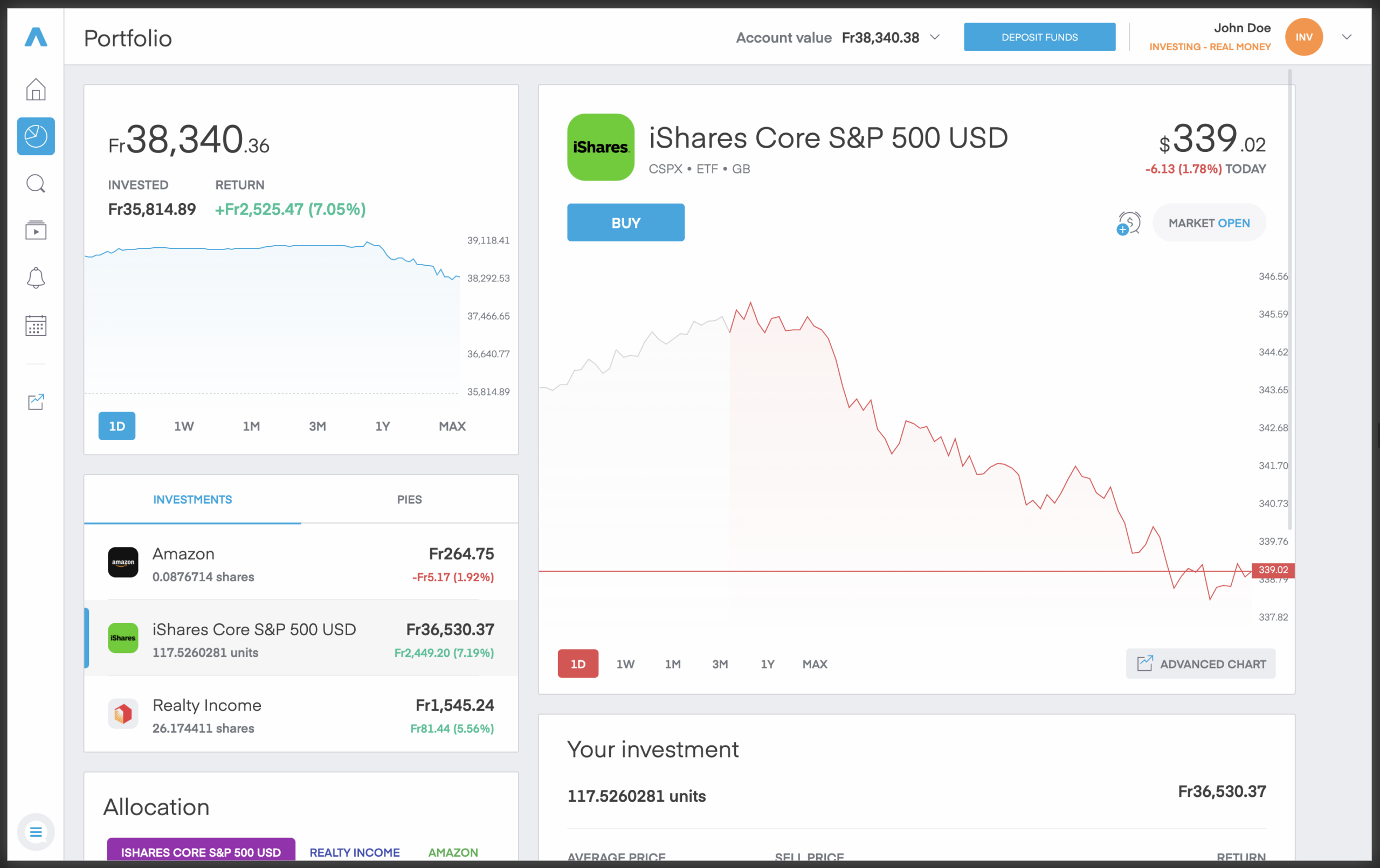
3 Things Trading 212 Gets Right
1. The cost structure is honest
Zero-commission brokers have a credibility problem. When the product is free, you wonder what you’re paying with. Trading 212’s model is transparent: 0.15% FX fee, CFD spreads, and share lending interest. There are no platform fees, no inactivity fees, no hidden subscription tiers.
Compare that to eToro, where the 0.5% FX fee is triple the rate and withdrawal costs $5. Or to Scalable Capital, where the free plan limits you to one savings plan per ETF and charges €0.99 per manual trade. Trading 212 puts everything on the Invest account with no paywall.
2. The mobile app is well-designed
Trustpilot reviews, BrokerChooser ratings, and Reddit threads agree on one thing: the Trading 212 app is clean. Portfolio overview, Pie management, market data, and order execution all work without friction on mobile. For a platform aimed at beginners, this matters more than charting depth or API access.
The 2025 rebrand modernised the look, though it wasn’t without controversy. A “bubble-style” portfolio layout drew backlash from users who found it harder to read, and Trading 212 reversed the change within weeks. That responsiveness to user feedback is itself a positive signal.
3. Fractional shares unlock real diversification
Buying a single share of ASML costs over €600. A share of Berkshire Hathaway Class A costs over $700,000. Fractional shares from €1 mean portfolio size doesn’t dictate portfolio quality. A student investing €50/month can hold the same diversified allocation as someone investing €5,000/month.
Combined with Pies, this turns small, regular deposits into a properly weighted portfolio. It’s the feature that makes Trading 212’s zero-commission model actually useful for small investors, rather than just a marketing line.
3 Things It Doesn’t
1. Share lending is opt-out, not opt-in
When you open an Invest account, your shares are automatically enrolled in Trading 212’s lending programme. Institutional borrowers pay interest to borrow your shares (often for short selling), and Trading 212 keeps 50% of that interest.
The risk is mitigated: collateral sits at 102% of the loaned value, held in cash for EU clients. If the borrower defaults, the collateral covers you. But you lose voting rights on lent shares, and dividends become “manufactured dividends” with potentially different tax treatment.
The real issue isn’t the risk. It’s the default. Most retail investors don’t know their shares are being lent. An opt-in model, like Interactive Brokers uses, would be more transparent. You can turn it off in Settings > Share Lending, but you have to know it exists first.
2. Active traders will hit a ceiling fast
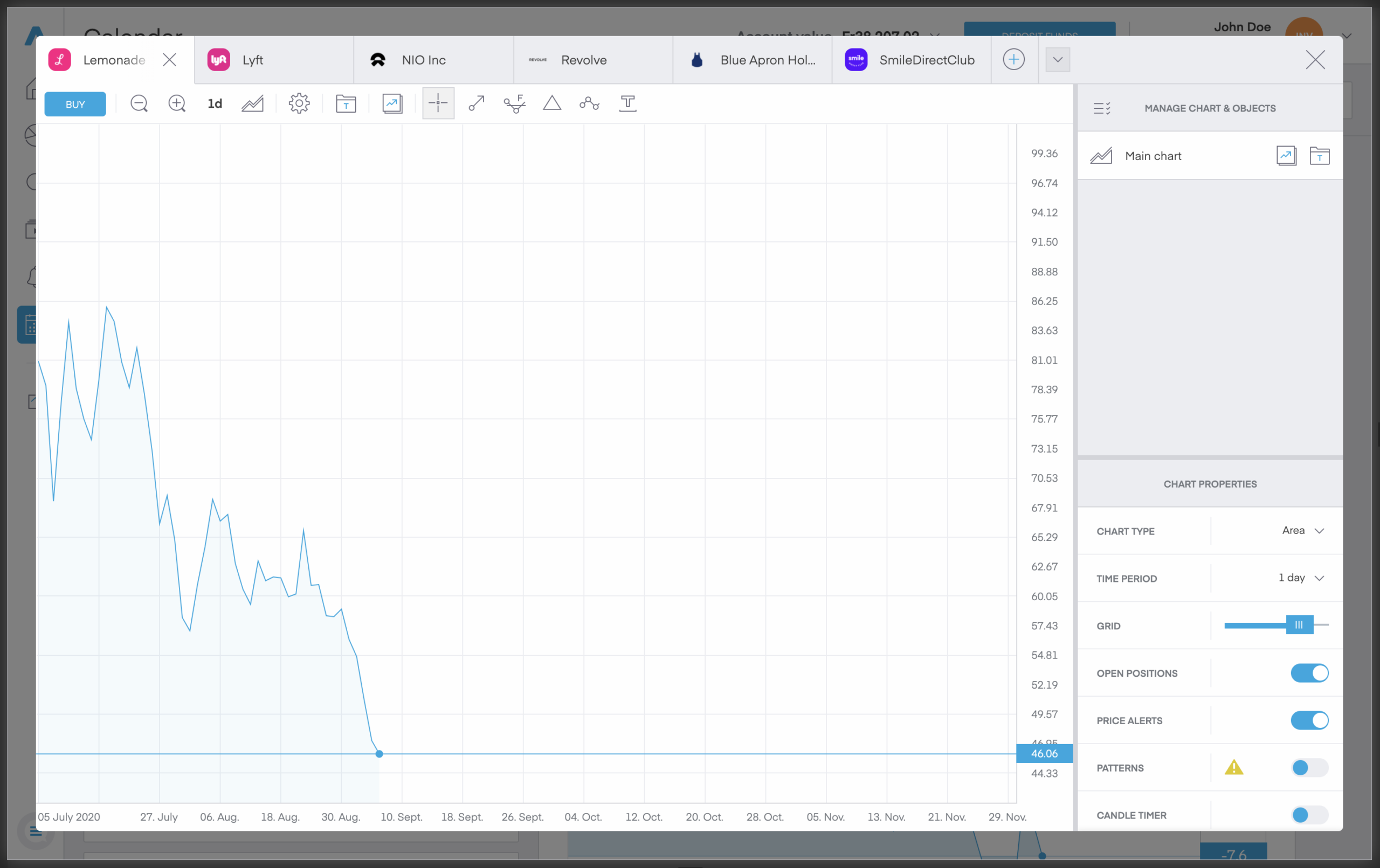
Trading 212’s charting is basic. You get candlestick charts with a handful of indicators, but no drawing tools worth using, no multi-chart layouts, no order flow data, no volume profile. There’s no API for algorithmic trading and no support for custom indicators.
For the target audience (passive investors), this doesn’t matter. But if your strategy involves any form of technical analysis beyond checking a price chart, you’ll need an external tool. ProRealTime, TradingView, or even Interactive Brokers’ Trader Workstation are all multiple levels above what Trading 212 gives you.
3. CFD pricing undercuts the “free” message
Trading 212 markets itself on zero commissions, but the CFD account tells a different story. EUR/USD spreads run roughly 50% above the industry average. Overnight financing fees stack up fast on positions held for more than a day. And the platform’s own risk disclosure states that 72-75% of retail CFD accounts lose money.
If you’re considering Trading 212 for CFD trading specifically, compare the total cost (spread + overnight fees) against IG, Pepperstone, or CMC Markets. The Invest account is where the value is. The CFD account is where the margins are.
Comparing Trading 212 with Competitors
Choosing a broker depends on what you actually need. Here’s how Trading 212 lines up against the alternatives European traders consider most.
| Feature | Trading 212 | ProRealTime | DEGIRO | eToro | Interactive Brokers |
|---|---|---|---|---|---|
| Commission (stocks) | €0 | Via broker (IG/Saxo) | Low (from €1) | €0 | Low (from $1) |
| FX fee | 0.15% | Depends on broker | 0.25% | 0.5% | ~0.03% |
| Fractional shares | Yes (from €1) | No | No | Yes | Yes |
| AutoInvest / DCA | Pies + AutoInvest | No | No | CopyTrader | No |
| Charting | Basic | Advanced (200+ indicators, ProBacktest) | Basic | Basic | Advanced (TWS) |
| Backtesting | No | ProBacktest + ProOrder | No | No | Yes |
| CFDs | Yes | Yes (via broker) | No | Yes | Yes |
| Regulation | FCA, CySEC, BaFin | AMF (via brokers) | BaFin, AFM | CySEC, FCA, ASIC | Multiple (incl. FCA, SEC) |
| Best for | Passive investors | Active traders, analysis | Cost-conscious stock pickers | Social/copy trading | Advanced multi-asset |
Trading 212 wins on cost and automation for passive investing. ProRealTime wins on charting depth, backtesting, and tools for active traders. DEGIRO wins on low-cost stock picking without the CFD complexity. eToro wins on social features. Interactive Brokers wins on market access and lowest FX costs.
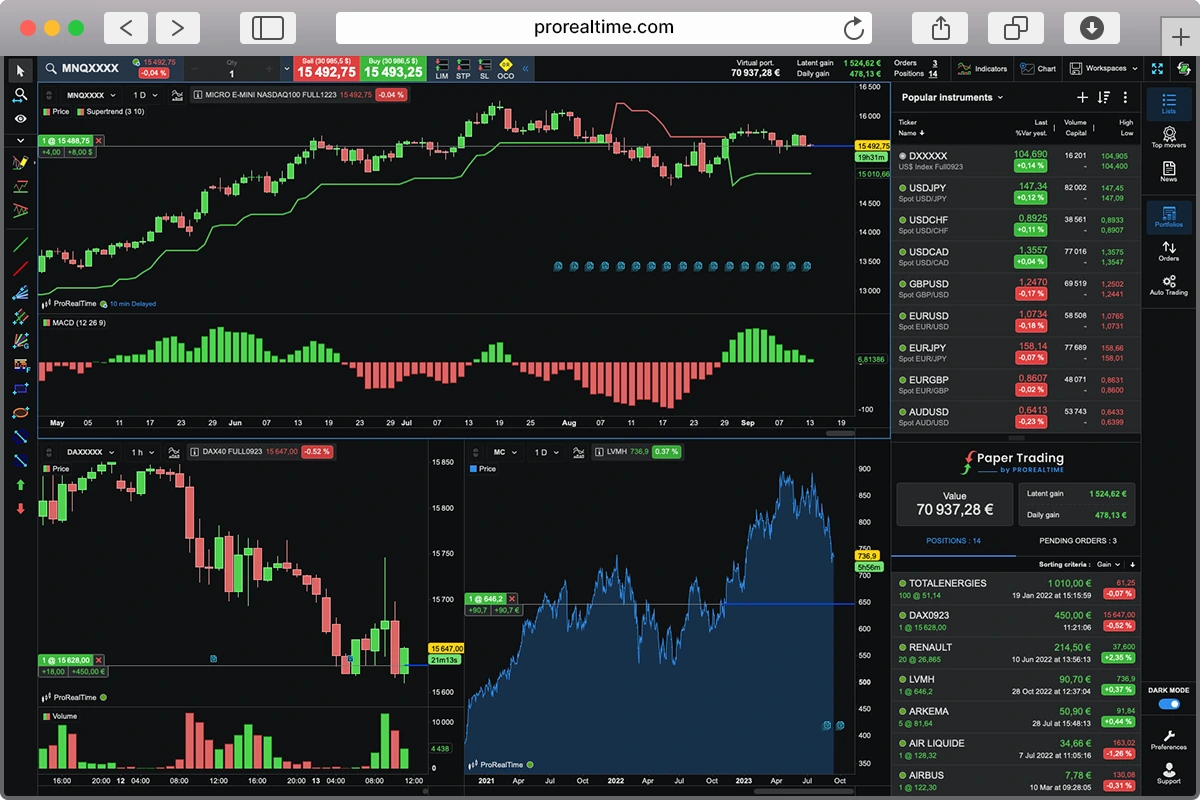
If you start with Trading 212 for long-term investing and later want advanced charting or backtesting, ProRealTime’s free version gives you 200+ indicators and ProBacktest without leaving your broker.
Alternatives to Trading 212
Trading 212 doesn’t fit everyone. Here’s where to look depending on what you need.
If you want lower FX costs: Interactive Brokers charges roughly 0.03% on currency conversions, twenty times less than Trading 212’s 0.15%. For investors who buy a lot of foreign-denominated stocks, the savings add up quickly. The trade-off: the interface is built for professionals, not beginners.
If you want advanced charting: ProRealTime gives you 200+ indicators, multi-chart layouts, ProBacktest for strategy automation, and drawing tools that actually work. The free version covers most traders. If you’re hitting Trading 212’s charting limits, this is the natural next step.
If you want proven low-cost stock investing: DEGIRO has been a go-to for European stock pickers since 2013. No fractional shares and no AutoInvest, but the fee structure is transparent and the core product is reliable. Best for investors who buy and hold individual stocks in larger amounts.
If you want social trading: eToro’s CopyTrader lets you mirror other investors’ portfolios. Higher FX fees (0.5%) and a more limited stock universe than Trading 212, but the social layer is unique.
If you want ETF savings plans with a local broker: Scalable Capital and Trade Republic are popular in Germany and expanding across the EU. Both have automated ETF savings plans, though neither matches Trading 212’s Pie structure for multi-asset portfolio building. Tax reporting is simpler since they handle withholding for EU tax residents.
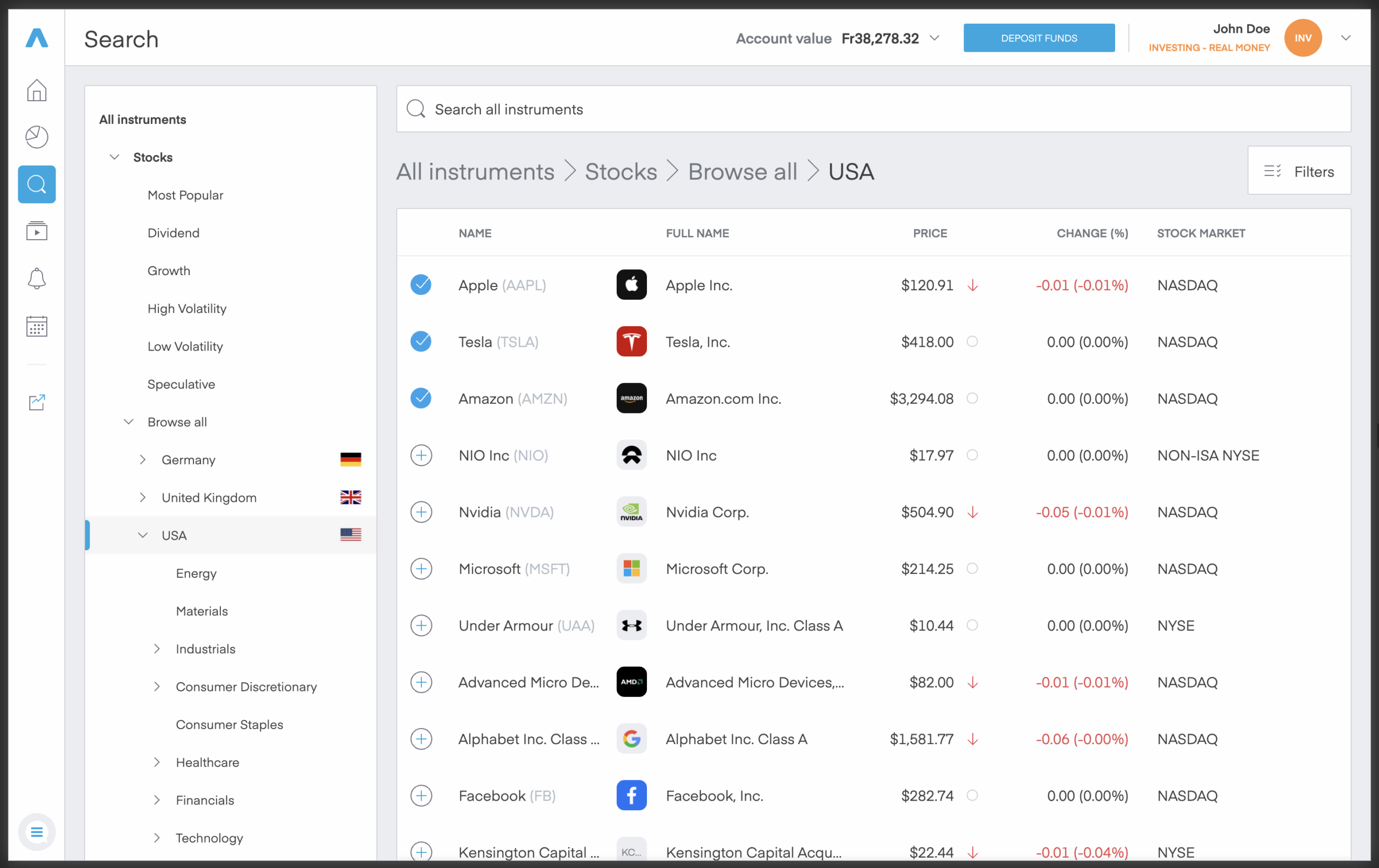
Final Words
Trading 212 found its niche: low-cost, hands-off investing for Europeans. Zero commissions, fractional shares from €1, and AutoInvest Pies that no competitor has matched. For someone putting €100-500 a month into a diversified portfolio and not looking at it daily, it’s a strong option.
The gaps are real but predictable. Basic charting, no API, above-average CFD spreads, and a share lending default that should be opt-in. These matter for active traders. They don’t matter much for the audience Trading 212 is built for.
If you’re starting out or building a long-term, hands-off portfolio, open an Invest account and set up a Pie. If you later need deeper analysis tools, pair it with ProRealTime’s free charting. And leave the CFD account alone unless you understand exactly what the spreads and overnight fees cost you.
FAQ
Is Trading 212 safe to use?
Yes. Trading 212 is regulated by the FCA (UK), CySEC (EU), and BaFin (Germany via FXFlat Bank). Client funds are held in segregated accounts at JP Morgan and Barclays. EU investors get ICF coverage up to €20,000. UK investors get FSCS protection up to £120,000. The company is profitable (£194 million revenue in 2024) and has been operating since 2004.
How does Trading 212 make money if there are no commissions?
Trading 212 earns from four sources: a 0.15% FX conversion fee on trades in foreign currencies, spreads on CFD trades, a 50% cut of the interest from its share lending programme, and the spread on interest paid on uninvested cash. The Invest account has no platform fee, inactivity fee, or subscription tier.
What is AutoInvest and how do Pies work?
A Pie is a custom portfolio of up to 50 stocks or ETFs with target allocations you set yourself. AutoInvest lets you schedule recurring deposits (daily, weekly, or monthly) that automatically buy into your Pie proportionally, using fractional shares. It’s automated dollar-cost averaging without manual orders. No major European broker has a direct equivalent yet.
Should I use Trading 212 Invest or CFD?
For most people, the Invest account. It has zero commissions on stocks and ETFs, fractional shares, and AutoInvest. The CFD account has above-average spreads, overnight financing fees, and Trading 212 discloses that 72-75% of retail CFD accounts lose money. Use the Invest account for long-term building. Only consider CFDs if you understand leverage and have a clear strategy.
Can I transfer my portfolio out of Trading 212?
Yes, since 2025 Trading 212 supports both inbound and outbound portfolio transfers for free. The one limitation: fractional shares cannot be transferred out. Only full share units move. If your portfolio is built on small fractional positions, you may need to sell some holdings before transferring.
How does tax reporting work for EU investors?
Trading 212 gives you an annual tax report with your realized gains, dividends, and interest earned. Tax treatment varies by country, so you’ll need to report according to your local rules. Trading 212 does not withhold taxes for most EU jurisdictions, unlike some local brokers (Scalable Capital, Trade Republic) that handle withholding automatically in Germany. Check with a local tax advisor if you’re unsure how to declare foreign brokerage income.

Maxime holds two master’s degrees from the SKEMA Business School and FFBC. As founder and editor-in-chief of NewTrading.fr, he writes daily about financial trading.
Start Trading on a Demo Account with
ProRealTime Paper Trading Simulator.
Saxo Review 2026: Read This Before You Start

eToro Review 2026: Read This Before Trading