Saxo Review 2026: Read This Before You Start

Saxo gives you access to 71,000 instruments across 50+ exchanges, from European stocks and ETFs to futures, options, and forex. The Danish broker, founded in 1992 and rated A- by S&P, has grown from a premium trading platform into one that also welcomes beginners through its SaxoInvestor interface.
But a wide product range means nothing if fees eat your returns or the platform doesn’t match your trading style.
In this Saxo review, we tested both SaxoInvestor and SaxoTrader, analyzed the three-tier pricing structure, and checked Saxo’s regulatory standing across multiple jurisdictions.
 Why trust us
Our reviews are built on real-world experience. We work closely with experienced traders who’ve spent dozens of hours testing these platforms to ensure each recommendation is reliable and practical. Visiting the tools we mention through the links on our website may generate a commission that helps support our mission to make trustworthy financial knowledge free and accessible for everyone—at no extra cost to you. Thank you for supporting us!
- Tested by traders, not marketers
- 30+ hours of testing
- Designed to help beginners

Saxo is a Danish online broker founded in Copenhagen in 1992. The group expanded across Europe, strengthened by the BinckBank acquisition in 2018, and now serves over 1.5 million clients. Saxo Bank is regulated by the Danish Financial Supervisory Authority (Finanstilsynet) and operates across the EU under passporting rules.
The offering covers more than 71,000 financial instruments (stocks, ETFs, bonds, futures, options, CFDs*, forex, turbos, warrants, margin trading) across 50+ exchanges.
The broker’s services are accessible through two platforms: SaxoInvestor for beginners and SaxoTrader for active traders, complemented by free ProRealTime and TradingView integration.
*CFDs are complex instruments and come with a high risk of losing money rapidly due to leverage. 62% of retail investor accounts lose money when trading CFDs with this provider. You should consider whether you understand how CFDs work, and whether you can afford to take the high risk of losing your money.
Our Take on Saxo
Saxo started as a premium brokerage for active traders and has gradually opened its doors to beginners. That shift matters: you get a broker built for complexity that now also has a simplified entry point.
It’s one of the few European brokers where you can trade stocks, ETFs, bonds, futures, options, CFDs, and forex from a single account. You also get to choose between multiple account types (individual, joint, corporate, derivatives) and two proprietary platforms.
Novice traders can start on SaxoInvestor, a stripped-down interface focused on stocks, ETFs, bonds, and funds. When you want to trade options or futures, you switch to SaxoTrader. Same account, same login, same history.
For more experienced traders, access to third-party platforms like ProRealTime and TradingView lets you work with professional charting tools without switching brokers. ProRealTime comes free for Saxo clients, which saves you the monthly fee you’d pay subscribing directly.
Another strong point: annual tax reporting documents. Saxo generates a yearly summary of your taxable transactions, though the scope and format depend on your country of residence (check with Saxo’s local entity for specifics). Not all brokers do this: Interactive Brokers, for example, leaves more of that work to you. For an active trader running dozens of trades yearly across multiple product types, that’s hours of paperwork eliminated.
On the downside, customer service is inconsistent. Trustpilot reviews (3.5/5, over 8,200 ratings) consistently flag slow administrative processes. Fund transfers, account verifications, and document requests can take longer than expected.
For pricing, Saxo ranks well against competitors on medium-to-large orders but can’t match flat-fee brokers like Trade Republic (€1 per trade) on small tickets. The €2 minimum on Euronext orders means a €100 trade costs you 2% in fees.
Who is Saxo for?
| The multi-market active trader |
|---|
If you trade across multiple asset classes (European stocks in the morning, US futures in the afternoon, some forex in the evening) you won’t need multiple brokers.
Saxo gives access to both investment products and leveraged products: index, commodity and rate futures, listed options on 20+ exchanges, CFDs, forex, turbos and warrants.
SaxoTrader, the multi-screen desktop application (up to 6 monitors) and free ProRealTime and TradingView integration let you work with professional-level technical analysis tools at no extra cost.
Saxo reports an average execution speed of 0.009 seconds on market orders (February 2026 statistic) and works to optimize your order fill rate and price level.
| The beginner trader who wants a scalable broker |
|---|
Contrary to popular belief, Saxo’s dense offering doesn’t exclude beginners. SaxoInvestor was designed precisely as a simplified entry point: the interface focuses on stocks, ETFs, bonds and funds, with streamlined navigation, educational information on each instrument and an intuitive search engine.
The advantage of starting with Saxo rather than a retail broker is that you won’t need to switch brokers as you advance. When you want to place options orders or trade futures, you simply switch to SaxoTrader. Same account, same login, same history.
| The investor structuring their portfolio |
|---|
The diversity of account types at Saxo is an often underestimated asset. You can open an individual securities account, joint account, corporate account and derivatives account. All manageable from the same client area with a single login. Few brokers in Europe match this flexibility.
The corporate securities account is a distinctive advantage, letting you invest through a holding company or commercial entity.
The annual tax report provided each year simplifies tax reporting for all these accounts. For an investor managing multiple accounts, that’s significant time savings and peace of mind.
Is Saxo Safe?
Few European brokers can match Saxo’s regulatory footprint. The group operates as a licensed bank, not just a brokerage, and that distinction carries real weight for your money.
Regulation
Saxo Bank A/S is regulated by the Danish Financial Supervisory Authority (Finanstilsynet, or DFSA) and operates across the EU under passporting rules. The group also holds a license from the FCA in the UK and states on its website that it operates under regulatory oversight in multiple jurisdictions including Australia (ASIC), Singapore (MAS), Hong Kong (SFC), Japan (JFSA), and Switzerland (FINMA).
For EU-based clients, your funds are protected under the EU Deposit Guarantee Scheme (up to €100,000 on cash deposits) and investor protection (up to €20,000 on securities). UK clients benefit from FSCS protection up to GBP 120,000.
Saxo holds segregated client accounts: your money is kept separate from the company’s operating funds, as required by EU regulation.
Ownership and Financial Strength
Saxo Bank was founded in Copenhagen in 1992. It’s not a fintech startup or a white-label broker. According to Saxo’s corporate page, the group:
- Holds an A- credit rating from S&P (investment grade)
- Is classified as a Systemically Important Financial Institution (SIFI) by Danish authorities
- Manages over €80 billion in client assets
- Processes approximately 220,000 trades daily
- Has 1.5 million clients across offices in 13 countries
The 2018 acquisition of BinckBank, the leading Dutch online brokerage, further expanded Saxo’s European client base and strengthened its position in the Benelux market.
What Trustpilot Says
Saxo holds a 3.5 out of 5 rating on Trustpilot, based on over 8,200 reviews.
The pattern is consistent: 5-star reviews almost unanimously praise individual advisors by name (quick resolutions, multilingual support) and the platform’s product range. 1-2 star reviews almost always concern a derailed administrative process: fund transfers taking longer than expected, account restrictions appearing without clear explanation, or 2FA login issues reported in early 2026.
Saxo’s problem isn’t the quality of its team. It’s slow internal coordination when multiple departments need to get involved. If your request is straightforward, support is generally fast. If it requires back-office processing, expect longer wait times.
Saxo Pricing: How Much Does It Cost?
Saxo uses three pricing tiers linked to your portfolio size or trading activity through the Saxo Rewards loyalty program. The more you trade or deposit, the lower your per-trade cost drops.
| Classic | Platinum | VIP | |
|---|---|---|---|
| Access requirement | Default (€0 min.) | €200,000 or 120k pts | €850,000 or 500k pts |
| INVESTMENT PRODUCTS | |||
| Euronext stocks/ETFs | 0.08% (min. €2) | 0.05% (min. €2) | 0.03% (min. €2) |
| US stocks/ETFs | 0.08% (min. $1) | 0.05% (min. $1) | 0.03% (min. $1) |
| Funds (UCITS) | €0 | €0 | €0 |
| Bonds | 0.2% (min. €20) | 0.1% (min. €20) | 0.05% (min. €20) |
| LEVERAGED PRODUCTS | |||
| Futures | €3/contract | €2/contract | €1/contract |
| Listed options | From €0.75/contract | From €0.75/contract | From €0.75/contract |
| Index CFDs | Variable spread and 5% minimum initial margin | Variable spread and 5% minimum initial margin | Variable spread and 5% minimum initial margin |
| Saxo Turbos | €0 (free) | €0 | €0 |
| Warrants | 0.08% (min. €2) | 0.05% (min. €2) | 0.03% (min. €2) |
| ADDITIONAL FEES | |||
| Custody fees | €0 | €0 | €0 |
| Inactivity fees | 0% | €0 | €0 |
| Currency conversion | 0.25% | 0.25% | 0.25% |
| Phone order surcharge | €50 | €50 | €50 |
| INCLUDED SERVICES | |||
| ProRealTime | ✅ | ✅ | ✅ |
| 24-hour support (Mon-Fri) | ✅ | ✅ | ✅ |
| Priority support | — | ✅ | ✅ |
| Dedicated manager | — | — | ✅ |
Cost Modeling: What You’ll Actually Pay
The percentage-based structure means Saxo’s competitiveness depends on your order size. Here’s what a Classic-tier client actually pays:
- €500 Euronext order: €2 (0.40%). Trade Republic charges €1, DEGIRO charges €2.
- €5,000 Euronext order: €4 (0.08%). Now competitive with most brokers, and you get ProRealTime included.
- €10,000 Euronext order: €8 (0.08%). The percentage rate is low, though flat-fee brokers still charge less in absolute terms.
- $2,000 NYSE order: $1.60 (0.08%). Competitive with Interactive Brokers’ fixed plan.
The breakeven point is roughly €2,500: below that, the €2 minimum makes Saxo more expensive than flat-fee alternatives. Above it, the 0.08% rate holds its own.
Hidden Costs to Watch
- Currency conversion: 0.25% on every trade in a foreign currency. If you buy US stocks, you’ll pay 0.25% on top of the commission each time, unless you hold a USD sub-account.
- Phone order surcharge: €50 per order placed by phone.
- Transfer out: Fees apply if you move your portfolio to another broker.
Saxo charges no custody fees and no inactivity fees on the EU entity. UK clients face a 0.12% annual custody fee on stocks and ETFs.
SaxoInvestor and SaxoTrader: Two Platforms, One Account
Most brokers give you one platform. Saxo built two, each targeting a different type of user, and lets you switch between them without creating a new account.
SaxoInvestor
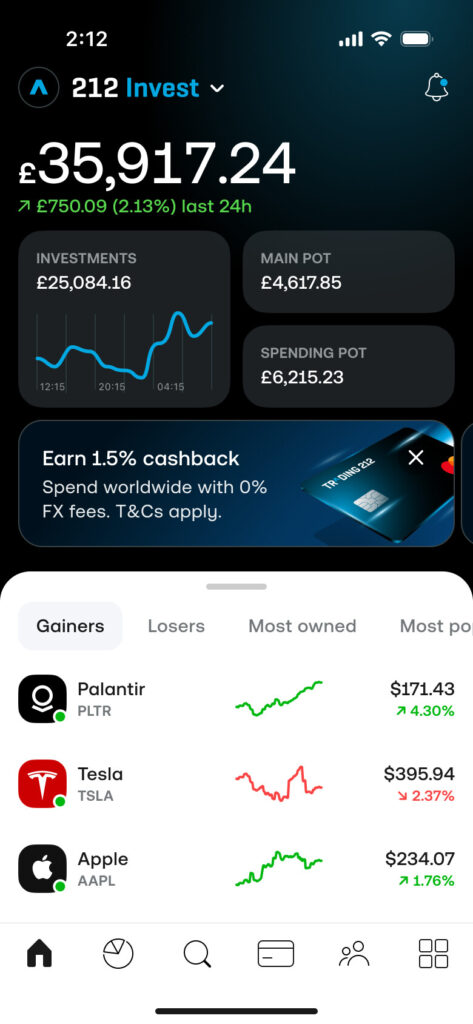
SaxoInvestor is Saxo’s simplified platform, built to compete with mobile-first brokers like Trade Republic and Trading 212. The interface strips away derivatives trading complexity and focuses on what most investors need: stocks, ETFs, bonds, and funds.
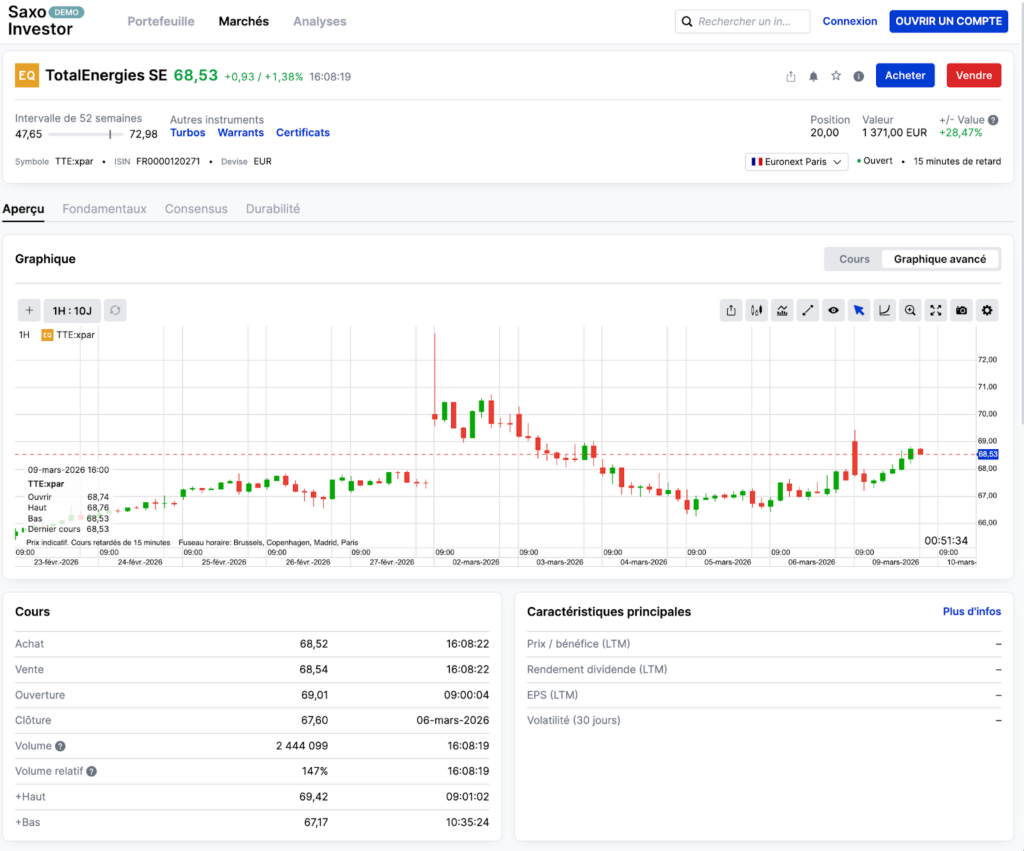
The search engine shows educational information for each instrument. You can filter by asset class, exchange, sector, or region. Order placement is straightforward: select, enter the amount, confirm.
If you’re new to investing, SaxoInvestor is a sensible starting point. You get access to Saxo’s full product catalogue for investment products without the cognitive overload of a trading terminal.
SaxoTrader
SaxoTrader is the full platform: web, mobile, and desktop versions. The desktop supports multi-screen setups with up to 6 monitors. You get access to every product Saxo carries, including futures, options, forex, and CFDs.
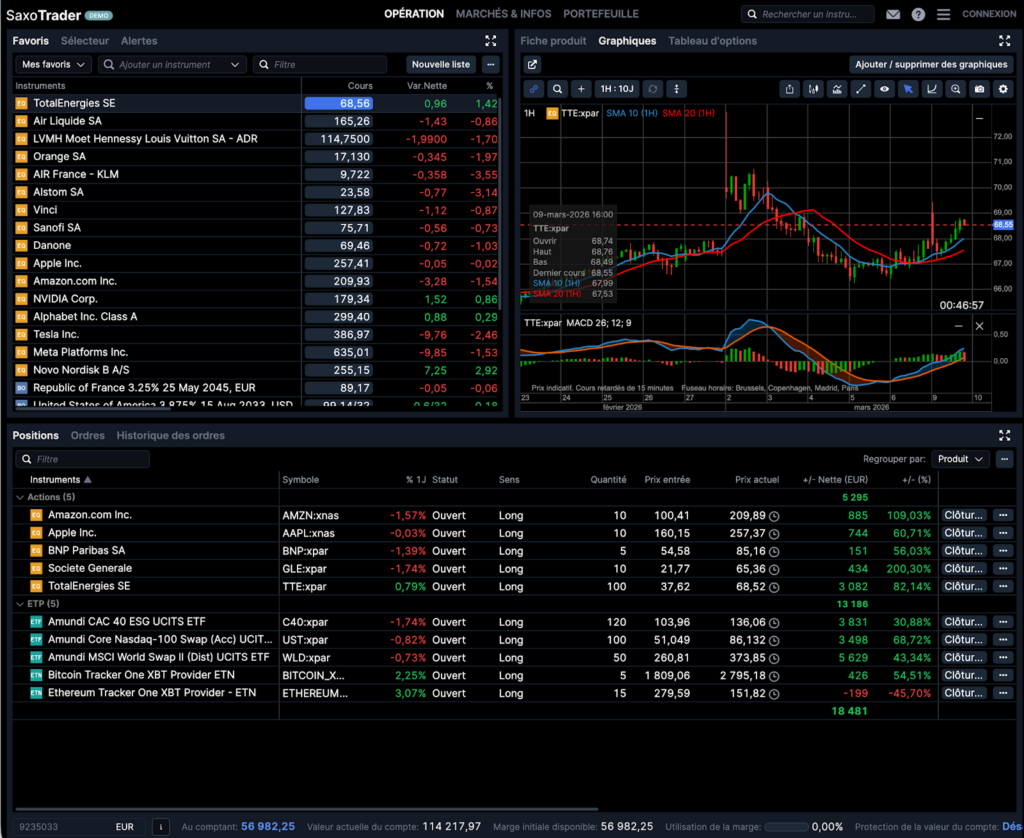
Key features for active traders:
- Algorithmic orders
- Risk management tools
- Level 2 order book trading
- 85+ technical indicators
- Advanced options trading tools
Third-Party Integrations
If neither SaxoInvestor nor SaxoTrader fits your workflow, Saxo connects with third-party software: TradingView, MultiCharts, and ProRealTime.
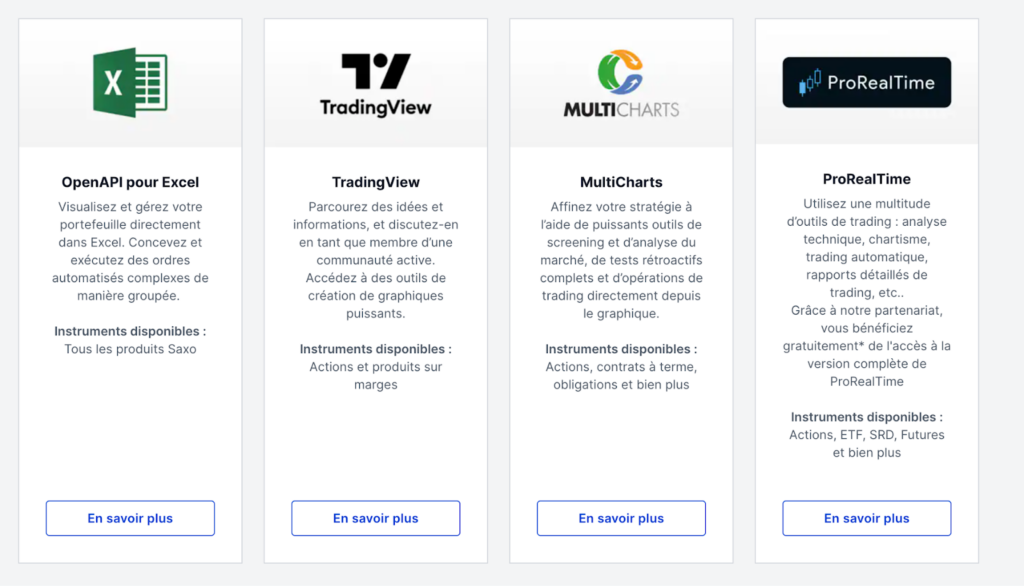
ProRealTime comes free for all Saxo clients, which normally costs a monthly subscription. TradingView integration adds a second charting option with its own indicator library and social features.
Saxo also has an OpenAPI for custom integrations, useful for developers building their own trading tools or connecting to portfolio management software.
Saxo’s 3 Key Strengths
1. 71,000 instruments across 50+ exchanges
With over 71,000 financial instruments, Saxo has one of the broadest product catalogues of any European broker. You can buy a European stock in the morning and short an S&P 500 future in the afternoon, without switching brokers.
This depth is hard to match. Only Interactive Brokers comes close, with access to 160+ markets but a steeper learning curve.
| Saxo | IBKR | DEGIRO | Trade Rep. | XTB | eToro | |
|---|---|---|---|---|---|---|
| Euronext stocks | ✅ | ✅ | ✅ | ✅ | ✅ | ✅ |
| US stocks | ✅ | ✅ | ✅ | ✅ | ✅ | ✅ |
| Asian stocks | ✅ | ✅ | ✅ | ✅ | ❌ | ✅ |
| ETFs | ✅ | ✅ | ✅ | ✅ | ✅ | ✅ |
| UCITS / Funds | ✅ | ✅ | ✅ | ❌ | ❌ | ❌ |
| Bonds | ✅ | ✅ | ✅ | ✅ | ❌ | ❌ |
| Futures | ✅ | ✅ | ✅ | ❌ | ❌ | ❌ |
| Options | ✅ | ✅ | ✅ | ❌ | ❌ | ❌ |
| Index CFDs | ✅ | ✅ | ❌ | ❌ | ✅ | ✅ |
| Stock CFDs | ✅ | ✅ | ❌ | ❌ | ✅ | ✅ |
| Forex | ✅ | ✅ | ❌ | ❌ | ✅ | ✅ |
| Turbos / Warrants | ✅ | ✅ | ✅ | ✅ | ❌ | ❌ |
| IPO | ✅ | ✅ | ❌ | ❌ | ❌ | ❌ |
| Cryptocurrencies | ✅ | ETP | ✅ | ✅ | CFD | ✅ |
| Total available | 14/14 | 13/14 | 10/14 | 7/14 | 6/14 | 8/14 |
Saxo scores 14/14 on product availability, compared to 13/14 for Interactive Brokers, 10/14 for DEGIRO, and 7/14 for Trade Republic. For traders who want to explore beyond stocks and ETFs, this breadth matters. Adding futures or options to your strategy is a platform switch away, not a broker migration.
2. Account diversity and tax reporting
Saxo covers a range of accounts that few brokers can match: individual securities account, joint account, corporate account, derivatives account and professional client status.
Your accounts are accessible from a single interface, which makes it easy to move liquidity between them.
| Saxo | IBKR | Trade Rep. | |
|---|---|---|---|
| SECURITIES ACCOUNTS | |||
| Individual account | ✅ | ✅ | ✅ |
| Joint account | ✅ | ✅ | ❌ |
| Corporate account | ✅ | ✅ | ❌ |
| Derivatives account | ✅ | ✅ | ❌ |
| Professional status | ✅ | ✅ | ❌ |
| TAX & CURRENCY SERVICES | |||
| Multi-currency (sub-accounts) | ✅ | ✅ | ❌ |
| Annual tax report | ✅ | ❌ | ✅ |
To help manage the tax implications of trades executed across different accounts, Saxo generates an annual tax report summarizing all your taxable transactions.
The corporate securities account is a distinctive advantage. If you invest through a holding company or commercial entity, Saxo is one of the few European brokers that makes this straightforward. Trade Republic and DEGIRO don’t support corporate accounts.
To help manage the tax implications across these accounts, Saxo generates an annual tax report summarizing all your taxable transactions. Interactive Brokers does not, which means more manual work at tax time.
3. Free ProRealTime and TradingView access
Saxo includes ProRealTime at no cost for all clients. This is a genuine competitive advantage: ProRealTime normally requires a monthly subscription. For a trader placing even a few orders per month through Saxo, this effectively pays for itself.
TradingView integration adds a second charting option. Between ProRealTime’s backtesting tools and TradingView’s social features and indicator library, you have access to two of Europe’s leading charting platforms without paying a subscription for either.
Interactive Brokers also connects to ProRealTime but charges a monthly fee unless you generate enough commissions. With Saxo, it’s free across all tiers: Classic, Platinum, and VIP.
Saxo’s 3 Weaknesses
1. Customer service
Saxo’s customer service doesn’t always meet user expectations. Looking at Trustpilot reviews, the broker has two faces.
Occasional phone interactions are generally praised. Multilingual advisors, capable of solving technical problems in minutes.
But when a request involves an administrative process (account transfer, document verification, account unlocking), delays stretch and frustration mounts.
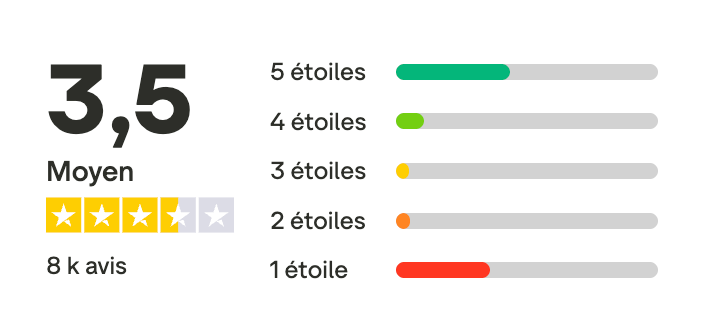
The 3.5/5 rating reflects this duality. 5-star reviews almost unanimously praise advisor quality and the platform. 1-2 star reviews almost always concern a derailed administrative process (transfer, KYC, unlocking).
Saxo’s problem isn’t team competence. It’s slow internal processes when multiple departments need to coordinate.
2. Cash interest
Saxo pays interest on uninvested cash, but this offer comes with very restrictive conditions.
- You need VIP client status, meaning an initial deposit of €850,000 or holding 500,000 points.
- Interest applies from €10,000 in available funds.
By comparison, Trade Republic, XTB or eToro pay interest from the first euro. For Saxo, cash interest remains marginal, reserved for wealthy clients.
3. Fees on very small orders
From €2,500 or more, the 0.08% brokerage fee per order starts to be competitive.
But until then, Saxo applies a €2 minimum per order on Euronext. This floor penalizes small tickets: €2 on a €100 order is 2% in fees.
In this segment, Trade Republic (€1 flat) is cheaper. DEGIRO charges the same €2 flat fee, but Trade Republic’s €1 is hard to beat on pure cost.
| Case 1 – €100 order – The €2 minimum weighs heavily | |||
|---|---|---|---|
| Broker | Fees charged | % of order | Verdict |
| Saxo (Classic) | €2.00 | 2.00% | ❌ More expensive |
| Trade Republic | €1.00 | 1.00% | |
| DEGIRO | €2 | 2.00% | Same |
| Case 2 – €1,000 order – The gap narrows significantly | |||
|---|---|---|---|
| Broker | Fees charged | % of order | Verdict |
| Saxo (Classic) | €2.00 | 0.20% | |
| Trade Republic | €1.00 | 0.10% | ✅ Cheaper |
| DEGIRO | €2 | 0.20% | Same |
| Case 3 – €2,500 order – The 0.08% rate works in Saxo’s favour | |||
|---|---|---|---|
| Broker | Fees charged | % of order | Verdict |
| Saxo (Classic) | €2.00 | 0.08% | |
| Trade Republic | €1.00 | 0.04% | ✅ Cheaper |
| DEGIRO | €2 | 0.08% | Same |
So Saxo isn’t best positioned for small orders. The broker seems to target active traders placing orders of significant size.
Saxo vs the Competition
To position Saxo against its direct competitors, here’s a comparison using concrete trading scenarios:
| Scenario | Saxo (Classic) | Trade Republic | Interactive Brokers (fixed) |
|---|---|---|---|
| €500 Euronext | €2 | €1 | €3 |
| €5,000 Euronext | €4 | €1 | €3 |
| €10,000 Euronext | €8 | €1 | €5 |
| $2,000 NYSE | $1.60 | €1 | $0.005 per share, min.$1 |
| $10,000 NYSE | $8 | €1 | $0.005 per share, min.$1 |
| Europe futures | €3/contract | ❌ | $1/contract |
| Europe options | From €2/contract | ❌ | €1/contract |
| Inactivity fees | €0 | €0 | €0 |
| Annual tax report | ✅ | ✅ | ❌ |
| ProRealTime | Free | — | Paid |
Saxo can’t compete with Trade Republic‘s flat trading fees. However, for a fair comparison, you’d also need to compare spread levels across brokers for different assets.
Interactive Brokers also seems more competitive on certain products, but depending on amounts and exchanges, Saxo could prove more advantageous.
Studying fee schedules should consider your trading habits and the broker’s overall offering. Tax reporting support, access to options, or a high-performance trading platform might, from your perspective, justify paying higher brokerage fees.
Discover a detailed comparison of Saxo and Interactive Brokers offerings.
Fee competition is fierce in brokerage, and many brokers are cheaper than Saxo on individual trades. But few can match its combination of product range, platform tools, and tax reporting.
| Saxo | IBKR | DEGIRO | Trade Republic | |
|---|---|---|---|---|
| Corporate account | ✅ | ✅ | ❌ | ❌ |
| Markets | 50+ | 160+ | 45+ | 40+ |
| €5,000 Euronext order | €4 | €3 | €2 | €1 |
| Annual tax report | ✅ | ❌ | ❌ | ✅ |
| ProRealTime | Free | ✅ | — | — |
| Cash interest | VIP clients >€10k | From €10,000 | ❌ | From €1 |
| Ideal for | Active trader | Active trader | General public | Mobile investor |
| Profile | Best choice | Why |
|---|---|---|
| Active multi-asset trader | Saxo | 71,000 instruments, ProRealTime free, tax report |
| Cost-first stock investor | Trade Republic | €1 flat fee, cash interest from €1 |
| Global market coverage | Interactive Brokers | 160+ markets, lowest derivatives pricing |
| European stock/ETF investor | DEGIRO | Low fees, simple interface |
The Verdict
Saxo is one of the most complete brokers available to European traders. The combination of 71,000+ instruments, a dual-platform approach (SaxoInvestor for beginners, SaxoTrader for pros), and free ProRealTime access creates a package that very few competitors can match.
The annual tax report, corporate account support, and multi-currency sub-accounts add practical value that goes beyond trading features. For an active trader managing a diversified portfolio, these tools justify Saxo’s slightly higher fees on small orders.
The weaknesses are real but specific: customer service struggles with complex administrative requests, cash interest is locked behind VIP status, and the €2 minimum makes Saxo a poor fit for very small orders.
If you trade across multiple asset classes, value tax compliance support, and plan to use professional charting tools, Saxo is a strong choice. Start on SaxoInvestor, graduate to SaxoTrader when you’re ready, and you’ll have a broker that scales with your skills.
If you mainly buy stocks with small monthly amounts and want the lowest possible fees, Trade Republic or DEGIRO will serve you better.
FAQ
Is Saxo a reliable broker?
Saxo is a regulated Danish bank, founded in 1992. The group holds licenses from the DFSA (Denmark), FCA (UK), ASIC (Australia), MAS (Singapore), and several other tier-1 regulators. Saxo carries an A- credit rating from S&P and is classified as a Systemically Important Financial Institution (SIFI). Your deposits are protected up to €100,000 under the EU Deposit Guarantee Scheme.
Is there a minimum deposit to open an account with Saxo?
No minimum deposit is required to open an individual securities account. The corporate securities account requires a higher initial deposit (check Saxo’s website for current requirements).
What are Saxo’s brokerage fees on Euronext?
Brokerage fees are 0.08% of the order amount (minimum €2) with Classic status; 0.05% with Platinum (from €200,000 in assets); and 0.03% with VIP (from €850,000).
Does Saxo provide annual tax documents?
Yes. Saxo generates an annual tax report summarizing all your taxable transactions across all account types. This simplifies your tax filing regardless of your country of residence.
What types of accounts can you open with Saxo?
Individual securities account, joint account, corporate account, derivatives account, and professional status. UK clients can also open a Flexible ISA and a SIPP. All accounts are manageable from a single client area with one login.
Does Saxo pay interest on uninvested cash?
Only for VIP clients (€850,000+ in assets) and from €10,000 in available funds. Most retail clients won’t qualify. If cash interest matters to you, Trade Republic or XTB pay interest from the first euro.
What’s the difference between SaxoInvestor and SaxoTrader?
SaxoInvestor is Saxo’s simplified platform for stocks, ETFs, bonds, and funds. SaxoTrader is the full trading platform with access to all products (futures, options, forex, CFDs) plus advanced charting, algorithmic orders, and multi-screen desktop support. Both are accessible with the same login.
How does Saxo compare to Interactive Brokers?
Both are serious multi-asset brokers for European traders. Saxo has a simpler onboarding path (SaxoInvestor), free ProRealTime, and annual tax reporting. Interactive Brokers covers more markets (160+) and is cheaper on derivatives. We wrote a detailed comparison.
Is Saxo available in my country?
Saxo operates across the EU under passporting rules from its Danish license. The group also holds licenses in the UK (FCA), Australia (ASIC), Singapore (MAS), Hong Kong (SFC), Japan (JFSA), and Switzerland (FINMA). Check Saxo’s website for country-specific availability.

Maxime holds two master’s degrees from the SKEMA Business School and FFBC. As founder and editor-in-chief of NewTrading.fr, he writes daily about financial trading.
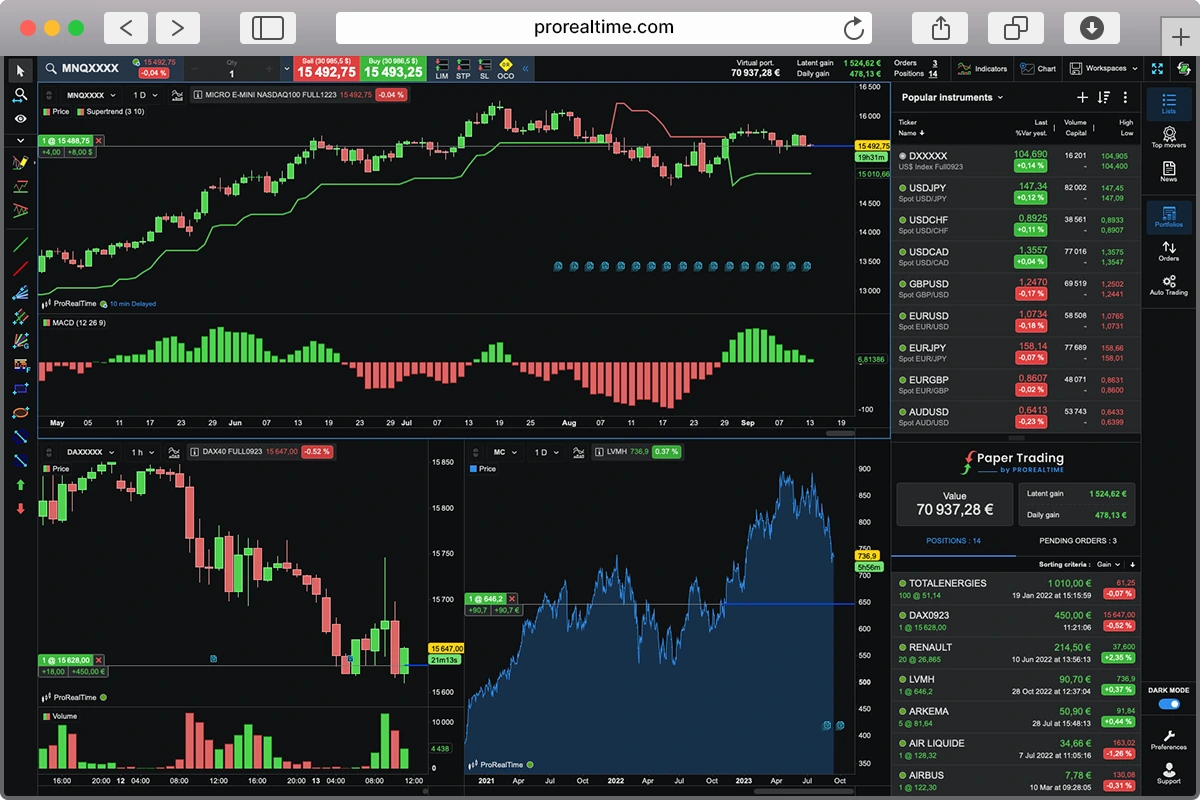
Start Trading on a Demo Account with
ProRealTime Paper Trading Simulator.