DEGIRO Review 2026: Read Before Trading


DEGIRO has built a solid reputation across Europe by combining ultra-transparent flat pricing with a product catalogue worthy of a professional broker.
The broker targets self-directed traders who want to minimise transaction costs without necessarily requiring extensive support or advanced analysis tools.
Does their offering align with your trading strategy?
Financial instruments, fees, trading tools, customer service: here are our test results and a detailed review of DEGIRO’s strengths and weaknesses.

Founded in 2013 in the Netherlands and acquired by the German flatexDEGIRO group in 2020, the broker now serves over 3 million clients across Europe. DEGIRO is regulated by the AFM (Dutch Authority for the Financial Markets) and operates its banking licence through flatex, supervised by BaFin (German financial regulator).
DEGIRO has established itself as one of Europe’s most popular brokers with a simple promise: give access to international markets with low, transparent brokerage fees.
Its financial product catalogue includes over 9 instrument categories across 45 global stock exchanges. This diversity places DEGIRO among multi-asset brokers, alongside Interactive Brokers or Saxo, but with a significantly simpler fee structure.
The web and mobile platform aims to be intuitive, though the lack of advanced trading tools puts it behind Interactive Brokers or Saxo for power users.
Our DEGIRO Review
With its multi-asset offering and fee structure, DEGIRO sits at the crossroads between Trade Republic (simple but limited) and Interactive Brokers (comprehensive but complex).
Its main strength lies in transparent, predictable costs. A flat €2 fee per order on major European exchanges means you know exactly what you’ll pay regardless of the traded amount. This simplicity contrasts with Saxo’s tiered pricing or Interactive Brokers’ variable structure.
The catalogue covers all the essentials for an active trader: stocks, ETFs, futures, options, warrants, turbos, bonds, and even cryptocurrencies. This diversity supports complex strategies: portfolio hedging via futures, covered call writing, turbo arbitrage, bond diversification.
Unlike neo-brokers focused on passive investing, DEGIRO clearly targets traders. Access to leveraged products, margin trading capability, and per-contract pricing make it a tool suited for active trading.
However, DEGIRO falls short of premium brokers in three areas.
- First, the platform remains functional without being sophisticated: no advanced analysis tools, no backtesting, no algorithmic orders. Traders accustomed to Interactive Brokers’ Trader Workstation or SaxoTrader will find the interface basic.
- Second, DEGIRO does not generate local tax reports for most EU countries. You will need to handle capital gains reporting yourself or use a third-party tax tool, which adds admin work compared to brokers that pre-fill your return.
- Third, customer service, though available in multiple European languages, suffers from sometimes lengthy delays on complex administrative cases.
Who is DEGIRO for?
| The futures and options trader optimising costs |
|---|
If you regularly trade futures or options, DEGIRO’s fixed pricing is particularly competitive. A Euro Stoxx 50 futures contract costs you €0.75 at DEGIRO versus €3 at Saxo (Classic profile) or €2 at Interactive Brokers.
You get access to major European markets, plus CBOE and CME.
Be aware of platform limitations though. DEGIRO doesn’t have volatility analysis tools or complex position simulators. If you trade multi-leg strategies (iron condor, butterfly, straddle), you’ll need third-party tools like ProRealTime V13 to analyse your positions before executing them on DEGIRO.
| The multi-market trader who refuses opaque fees |
|---|
Want to trade German stocks in the morning, US futures in the afternoon, and Dutch warrants by close? With DEGIRO, you can.
Plus, the broker charges fixed, predictable fees on each trade. This transparency contrasts with the complex fee structures of some brokers and simplifies managing your trading budget. You know in advance how much your strategy will cost, letting you optimise your fee-to-performance ratio.
For a trader executing 200 trades per month across different products, this predictability eliminates budget creep risk.
One thing to weigh up: tax reporting. DEGIRO does not generate a country-specific annual tax report for most EU jurisdictions. If you trade actively, you will spend time calculating and declaring your capital gains. Brokers like Saxo or Trade Republic handle more of this for you.
Calculate your trading gains with our profit simulator.
| The derivatives beginner learning without breaking the bank |
|---|
Want to learn futures or options trading without committing thousands of euros? DEGIRO is a less expensive training ground than premium brokers, while still giving access to real regulated markets (not CFDs).
Fixed per-contract fees let you test strategies with reasonable amounts. This pricing accessibility eases the learning phase, where mistakes are inevitable.
No inactivity fees removes psychological pressure. You can take time to observe markets, test micro-positions, and refine your strategy without fearing monthly penalties. Unlike brokers charging €10 per month for inactivity, DEGIRO lets you progress at your own pace.
However, the platform doesn’t let you test strategies with a virtual portfolio. DEGIRO has no trading simulator. You can pair it with a free charting platform like TradingView for paper trading before going live.
DEGIRO Pricing: How Much Does It Cost?
DEGIRO applies a simple, transparent flat pricing structure detailed in the following table.
Shares
| Market | Fee per order |
|---|---|
| Euronext Paris | €1 + €1 handling fee |
| Athens Stock Exchange Bolsa de Madrid Budapest Stock Exchange Euronext Amsterdam, Brussels, Dublin, Lisbon, Milan Istanbul Stock Exchange London Stock Exchange Nasdaq Copenhagen AB, Helsinki AB, Stockholm AB Oslo Borse Prague Stock Exchange Swiss Stock Exchange Tradegate Vienna Stock Exchange Warsaw Stock Exchange XETRA | €3.90 + €1 handling fee |
| NASDAQ NYSE Toronto Stock Exchange | €1 + €1 handling fee |
| Australian Stock Exchange Börse Frankfurt Hong Kong Stock Exchange Singapore Stock Exchange Tokyo Stock Exchange | €5 + €1 handling fee |
ETFs
| Market | Fee per order |
|---|---|
| Core selection of ETFs, listed on Tradegate | €0 + €1 handling fee |
| Other exchanges | €2 + €1 handling fee |
Derivatives
| Product | Fee per contract |
|---|---|
| Futures | €0.75 |
| Options | €0.75 |
| Warrants / Turbos | €0.50 to €2 |
Bonds
| Product | Fee per order |
|---|---|
| Bonds | €2 + €1 handling fee |
Note: Cryptos have variable pricing of 0.50%.
Additional fees:
- Custody fees: €0
- Inactivity fees: €0
- Currency conversion (automatic): 0.25%
- Currency conversion (manual): €10 + 0.25%
- Connectivity fees: €2.50/year per exchange (free for Euronext Paris/Brussels)
DEGIRO vs the Competition
To position DEGIRO against its competitors, here’s a comparison using concrete trading scenarios:
| Scenario | DEGIRO | Trade Republic | IBKR (fixed) | Saxo (Classic) |
|---|---|---|---|---|
| €500 Euronext | €2/order | €1 | €3 | €2 |
| €2,000 Euronext | €2/order | €1 | €3 | €2 |
| €5,000 Euronext | €2/order | €1 | €3 | €4 |
| €10,000 Euronext | €2/order | €1 | €5 | €8 |
| $2,000 NYSE | €2/order | €1 | $0.005 per share (min. $1) | $1.60 |
| $10,000 NYSE | €2/order | €1 | $0.005 per share (min. $1) | $8 |
| Euronext Future | €0.75/contract | ❌ | €2 | €3 |
| Euronext Option | €0.75/contract | ❌ | €1.5 | €0.75 |
| Euronext Warrant | €2/order | €1 | 0.05% per order (min.€3) | 0.08% per order (min.€2) |
For shares, Trade Republic remains unbeatable. This gap becomes significant for active traders: the more orders you place, the more brokerage fees impact your performance. However, Trade Republic doesn’t have futures or options, nor certain international markets.
For Euronext orders above €2,500, DEGIRO beats Saxo thanks to flat pricing. For traders favouring large tickets, this difference is notable.
For futures, DEGIRO has the lowest rate.
Check out our detailed comparisons:
DEGIRO’s 3 Strengths
1. Transparent flat pricing across all products
DEGIRO chose simplicity: fixed, predictable fees with no nasty surprises. This approach contrasts with the complex pricing of most multi-asset brokers.
For Euronext shares, you pay €2 per order, full stop. No complications with variable fees that increase with order size, tiers to watch, or per-order minimums that change by market. Whether you buy €500 or €5,000 of ASML, TotalEnergies or Siemens shares, the bill stays the same.
This uniformity also applies across European markets, though the entry ticket is higher. Buying German (SAP, Siemens), Dutch (ASML, ING), Italian (Ferrari, Prada) or Spanish (Inditex, Santander) shares consistently costs €4.90. Traditional banks typically charge more for orders on foreign markets.
For derivatives, the logic remains the same: flat per-contract pricing. A Euro Stoxx 50 future costs €0.75 and a Euronext option costs €0.75. You can calculate your budget precisely: 100 Euro Stoxx 50 futures contracts = €75 in fees.
This predictability simplifies risk management and strategy optimisation. You know exactly how much each trade will cost, letting you determine your breakeven point and adjust position sizes accordingly.
2. A complete multi-asset catalogue matching premium brokers
DEGIRO goes beyond shares and ETFs. Its offering covers all financial products an active trader needs to build diversified strategies.
- Futures on indices and commodities: Eurex (DAX, Euro Stoxx 50, German bonds), Euronext (AEX, CAC 40, BEL 20), CME (S&P 500, Nasdaq 100). This coverage gives exposure to major global markets with regulated leverage.
- Options on shares and indices: 8 exchanges including Euronext Amsterdam, Paris, Brussels, Xetra, and US markets (CBOE, CME). You can implement covered call strategies, put protection, vertical spreads or straddles.
- Warrants and turbos: these products allow leveraged trading on shares, indices, currencies and commodities with risk limited to invested capital.
- Government and corporate bonds on European markets.
- Investment funds from managers such as Amundi, Vanguard or BlackRock.
- Cryptocurrencies: Bitcoin, Ethereum, Cardano, Solana, etc.
This diversity places DEGIRO on par with Interactive Brokers and Saxo in terms of catalogue depth. Interactive Brokers has a wider range, but DEGIRO covers the essentials for a European trader.
Product offering comparison:
| DEGIRO | Trade Republic | IBKR | Saxo | |
|---|---|---|---|---|
| Shares | ✅ | ✅ | ✅ | ✅ |
| ETFs | ✅ | ✅ | ✅ | ✅ |
| Bonds | ✅ | ✅ | ✅ | ✅ |
| Funds | ✅ | ❌ | ✅ | ✅ |
| Futures | ✅ | ❌ | ✅ | ✅ |
| Options | ✅ | ❌ | ✅ | ✅ |
| Warrants/Turbos | ✅ | ✅ | ✅ | ✅ |
| CFDs | ❌ | ❌ | ✅ | ✅ |
| Forex | ❌ | ❌ | ✅ | ✅ |
| Cryptos | ✅ | ✅ | ETP | ETP |
3. No hidden fees or inactivity penalties
DEGIRO applies a clear pricing policy: you only pay for what you trade.
- Zero custody fees: Your securities generate no storage costs. You can hold a €100,000 portfolio for 10 years without paying a cent in custody fees. Traditional banks typically charge between 0.10% and 0.50% annually, meaning €100 to €500 per year for this amount.
- Zero inactivity fees: If you decide not to trade for several months (waiting for opportunities, holidays, learning period), no penalty applies. Unlike brokers charging €10 monthly for inactivity, DEGIRO respects your pace.
- Zero account maintenance fees: Opening and maintaining your account is free. No monthly subscription, no minimum order requirements, no tier to maintain.
- Zero minimum deposit: You can open an account with €0 and start investing with just a few dozen euros. This accessibility eases the discovery phase for beginners.
The only additional fees concern specific services:
- Automatic currency conversion: 0.25%
- Manual currency conversion: €10 + 0.25%
- Connectivity fees: €2.50/year per exchange (free for Euronext Paris and Brussels)
These fees remain on the low end of the market. The 0.25% automatic conversion is identical to Saxo and slightly lower than Interactive Brokers.
DEGIRO’s 3 Weaknesses
1. Limited tax reporting for EU investors
DEGIRO does not generate country-specific tax reports for most European jurisdictions. Unlike brokers with local entities in each country, DEGIRO operates from the Netherlands and Germany, so the tax documentation it produces follows a generic format.
What this means in practice:
- DEGIRO gives you an annual overview of your transactions, dividends, and realised gains. But it won’t pre-fill your local tax return.
- You need to calculate your capital gains according to your country’s rules (FIFO, average cost, or other method depending on where you live).
The admin burden adds up for active traders. If you execute 100+ trades per year across multiple holdings, reconciling everything yourself takes several hours. The risk of errors on your tax return is real.
You must also declare your DEGIRO account as a foreign brokerage account if your country requires it (most EU countries do).
| Broker | Annual tax report | Local tax form pre-fill | Tax declaration |
|---|---|---|---|
| DEGIRO | Generic overview | ❌ | Manual |
| Trade Republic | ✅ (DE tax report) | Partial | Semi-automated |
| Interactive Brokers | ✅ (detailed) | ❌ | Manual (detailed reports available) |
| Saxo | ✅ | Varies by country | Semi-automated |
Who can live with this?
- Traders comfortable doing their own tax admin or using a third-party tax tool
- Investors with a small number of trades per year (manageable to report manually)
- Traders who prioritise low brokerage fees over tax convenience
2. A functional platform without advanced tools
DEGIRO takes a clear stance: give you an efficient web and mobile platform for executing orders, without claiming to rival Interactive Brokers’ or Saxo’s professional tools.
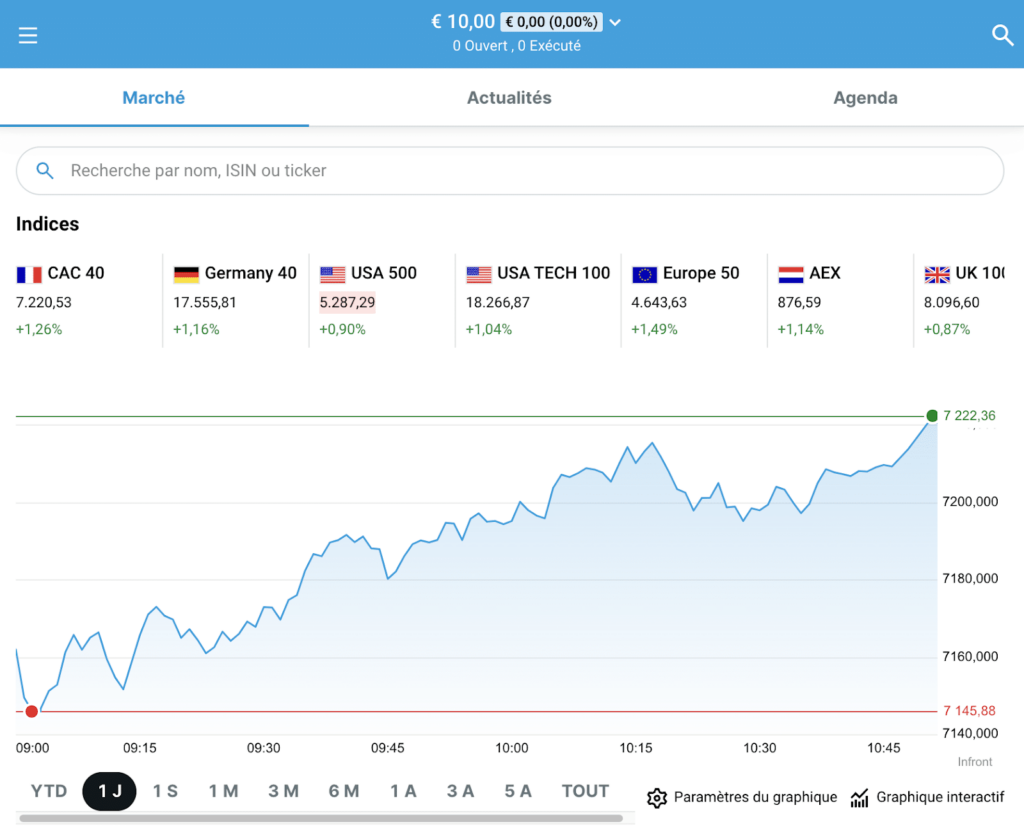
The broker has neither trading software to install on your computer nor connections to high-performance third-party platforms.
For an active trader, many features are missing, such as:
- advanced technical analysis charts and indicators
- sophisticated risk management tools
- specific options trading modules
- backtesting to test strategies on historical data
Tool comparison:
| DEGIRO | IBKR (TWS or IBKR Desktop) | Saxo (SaxoTrader) | Trade Republic | |
|---|---|---|---|---|
| Advanced charting | Basic | ✅ | ✅ | Basic |
| Custom indicators | ❌ | ✅ | ✅ | ❌ |
| Algorithmic orders | ❌ | ✅ | ✅ | ❌ |
| Integrated backtesting | ❌ | ✅ | ❌ | ❌ |
| Options tools | ❌ | ✅ | ✅ | ❌ |
| TradingView integration | ❌ | ✅ | ✅ | ❌ |
| ProRealTime integration | ❌ | ✅ | ✅ | ❌ |
This simplicity can be an advantage for beginners overwhelmed by complex trading software. Experienced traders can pair DEGIRO with an independent platform such as TradingView, MetaTrader or ProRealTime for their analysis.
3. Customer service falls short on complex cases
The 2,300+ Trustpilot reviews (average rating 4.6/5) reveal a two-speed customer experience at DEGIRO.
Positive points consistently mentioned:
- clear and intuitive interface
- transparent and competitive fees
- wide choice of financial products
- fast order execution
But there are also recurring friction points:
- long processing times on certain administrative cases
- opaque communication on complex request progress
- phone support sometimes saturated at peak hours
- temporary account blocks without prior notification
Despite these criticisms, DEGIRO sits in the upper average for overall satisfaction, but fails to handle atypical cases efficiently.
For self-directed traders who only need to execute standard orders, customer service does its job. For someone anticipating complex needs, better to choose a broker with premium support.
| Broker | Trustpilot Rating | Support |
|---|---|---|
| DEGIRO | 4.6/5 | Phone + email, multiple EU languages |
| Trade Republic | 3.3/5 | Chat 24/7 |
| Interactive Brokers | 3.5/5 | Phone + ticket, mainly English |
| Saxo | 3.5/5 | Phone + email 5d/7 8:30am-8pm |
Alternatives to DEGIRO
DEGIRO’s offering focuses primarily on multi-asset brokerage with an attractive fee structure and a catalogue extensive enough to satisfy many traders.
However, the broker falls short on trading tools and tax reporting. Other, more comprehensive brokers have advanced proprietary platforms and better tax documentation for specific EU countries.
Here’s an overview of DEGIRO alternatives.
| DEGIRO | Saxo | IBKR | Trade Republic | |
|---|---|---|---|---|
| Account types | Basic, Active, Trader | Classic, Platinum, VIP | Individual, Joint, IRA | Standard |
| Markets | 45+ | 50+ | 160+ | 40+ |
| Futures and options | ✅ | ✅ | ✅ | ❌ |
| €2,000 Euronext order | €2 | €2 | €3 | €1 |
| Tax reporting | Generic overview | Country-specific | Detailed reports | DE tax report |
| ProRealTime | ❌ | ✅ | ✅ | ❌ |
| Cash remuneration | ❌ | VIP clients >€10k | From €10,000 | From €1 |
| Ideal for | Multi-asset trader on budget | Professional multi-asset trader | Professional multi-asset trader | Mobile-first beginner |
DEGIRO Review: Key Takeaways
DEGIRO combines a neo-broker’s pricing simplicity with a professional broker’s catalogue depth.
Its main asset is cost predictability. This transparency simplifies budget management and eliminates nasty surprises. The absence of custody, inactivity, or account maintenance fees reinforces this advantage.
The catalogue covers the essentials for an active European trader and allows building multi-asset strategies without multiplying accounts.
In return, DEGIRO’s tax reporting is limited, which adds admin work for traders who want everything handled for them. The platform remains functional but basic, and customer service shows limitations on complex administrative cases.
DEGIRO suits self-directed multi-asset traders who are comfortable handling their own taxes. If you want country-specific tax reports or professional analysis tools, Interactive Brokers or Saxo will be more suitable.
FAQ – Frequently Asked Questions about DEGIRO
Is DEGIRO a reliable broker?
Yes. DEGIRO is part of the flatexDEGIRO group, listed on the Frankfurt Stock Exchange. The broker is regulated by the AFM (Dutch Authority for the Financial Markets) and operates through flatex, which holds a German banking licence supervised by BaFin. Your funds are protected up to €100,000 by the German deposit guarantee scheme.
What account types does DEGIRO offer?
DEGIRO has three account profiles: Basic, Active, and Trader. The Basic account covers standard buy and sell orders. Active and Trader profiles unlock margin trading, short selling, and access to more complex derivatives. You can upgrade your profile at any time from the platform settings.
Can I trade futures and options with DEGIRO?
Yes. DEGIRO gives access to futures (Eurex, Euronext, CME) and options on 8 stock exchanges. Fees are competitive: €0.75 for a futures contract, for example. You need an Active or Trader profile to access these products.
Does DEGIRO handle my tax reporting?
Partially. DEGIRO gives you an annual overview of transactions, dividends, and realised gains. However, it does not generate country-specific tax forms for most EU countries. You will need to calculate and report your capital gains yourself, or use a third-party tax tool. Remember to declare your DEGIRO account as a foreign brokerage account if your country’s tax authority requires it.
Is there a minimum deposit to open a DEGIRO account?
No. There’s no minimum deposit required. You can open an account with €0 and start trading with just a few dozen euros.
Is DEGIRO’s platform suitable for beginners?
Yes, for executing simple orders, the interface is clear and intuitive. However, DEGIRO doesn’t have a demo account or virtual portfolio for practice. You can pair it with a free charting platform like TradingView if you want to paper trade first.

Maxime holds two master’s degrees from the SKEMA Business School and FFBC. As founder and editor-in-chief of NewTrading.fr, he writes daily about financial trading.
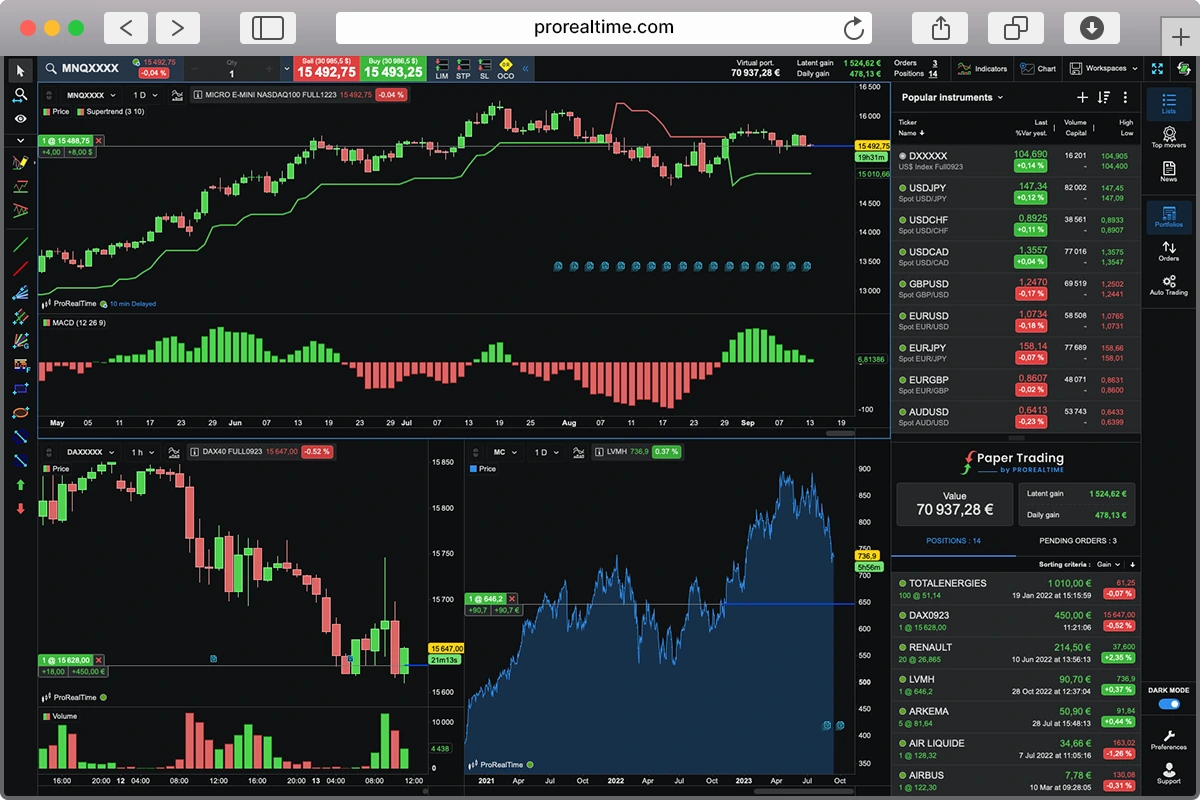
Start Trading on a Demo Account with
ProRealTime Paper Trading Simulator.