
Controlled Skid


Risk on! Bullets still whistling through the Strait of Hormuz? Who cares. Indices are flooring it and the top performers are even pushing their luck with fresh records.

Does this mean investors have lost their minds? Not necessarily.
While peace hasn’t been officially signed, last week confirmed weekend hopes on the geopolitical front: the military conflict isn’t spiraling out of control. Better yet, armed confrontation is slowly but surely morphing into economic arm-wrestling.
Sure, Washington isn’t completely out of the woods and Tehran plans to negotiate every clause of the future peace deal tooth and nail, but investors have good reason to celebrate: World War III can wait.
And inflation? Also a controlled skid.
Inflation is picking up from the energy shock, but it’s not going haywire.
In fact, after crying wolf for so long, investors are wondering: if Covid, tariffs, and energy shocks haven’t awakened the inflation monster, does it even exist?
Add a Fed that seems perfectly comfortable with inflation above its official 2% target, and despite appearances, the setup isn’t half bad for stock indices.
The cocktail of high inflation plus status quo on rates could actually favor large US companies that can pass price increases to customers while taking advantage of favorable bond conditions to refinance their Covid debt.
The only fly in the ointment (and it’s a big one): Iran’s show of force in the Strait of Hormuz revealed the Achilles’ heel of the globalized economy.
Iran’s willingness to give up its nuclear arsenal is quite telling. After all, why maintain such an expensive and vulnerable research program when a flotilla of low-cost drones and speedboats can hold the global economy hostage?
More than military conflict and its inflationary consequences, the market now faces the heavy task of pricing this new asymmetric threat capability.
The retrospective
Dow futures confirmed their breakout from a multi-week consolidation phase last week, closing at 47,700 points after testing support at 47,100. The move came with solid volume, suggesting genuine buying interest rather than short covering.
The technical picture remains constructive with the 20-day moving average now acting as dynamic support. The RSI sits comfortably in bullish territory without being overbought, leaving room for further upside.
My trading plan
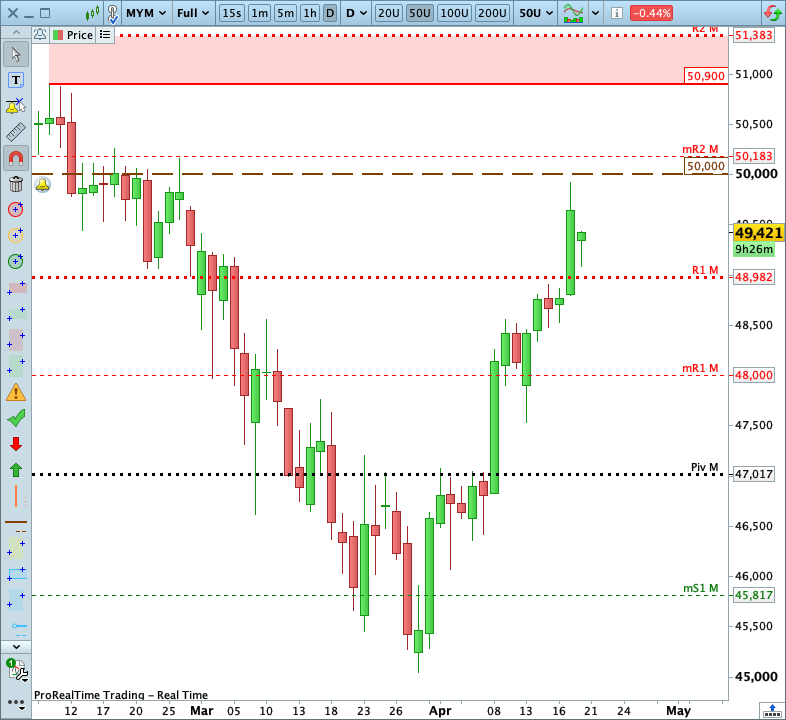
Trading carries risk. Only invest money you can afford to lose. Past performance doesn’t guarantee future results.
Until proven otherwise, buyers control the situation.
However, until new short sellers get trapped by a false bearish start, reaching the all-time high of 50,900 points in a straight line seems unlikely.
In this context, I’ll favor bullish trades again with a target of the symbolic 50,000-point threshold (where a correction could develop).
Happy trading!

Maxime holds two master’s degrees from the SKEMA Business School and FFBC. As founder and editor-in-chief of NewTrading.fr, he writes daily about financial trading.

The vise tightens

Dead cat bounce

Perfect timing