
Peace pipe


Actions speak louder than words. Washington and Tehran can hurl threats at each other all day long, but Mr. Market is placing a bet: despite the mutual promises of annihilation, both nations are economically bound to find their way back to peace sooner or later.

Even though burying the hatchet seems light-years away, the market is already positioning itself and stock indices are soaring (barely held back this morning by the weekend’s failed negotiations).
One question remains: will the promise of this coming commercial peace be enough to erase the consequences of the “energy shock” mentioned in Wednesday’s Fed Minutes?
Here too, the market sees the glass as half full.
Even with Brent crude back above $100 (following the US announcement of a naval blockade of the Strait of Hormuz), stock indices aren’t panicking.
And for good reason — barring any major surprises, the Fed won’t suddenly hike rates in 2026.
First, because US inflation isn’t running wild (March’s Core CPI released Friday held steady at an annual rate of +2.6%), and second, because the institution is quite comfortable living with inflation above its official target.
The Fed may put on a show of political independence, but it remains fundamentally accommodative when it comes to the economy…
With around $10 trillion in debt maturing over the next 12 months, Jerome Powell and his successor are probably willing to bend on their official 2% target, letting inflation erode the low-rate Covid-era debt.
Bottom line: as long as the military situation between the US and Iran doesn’t spiral completely out of control, and as long as closing the Strait of Hormuz doesn’t send core inflation through the roof, there’s reason for optimism.
Today’s trading plan
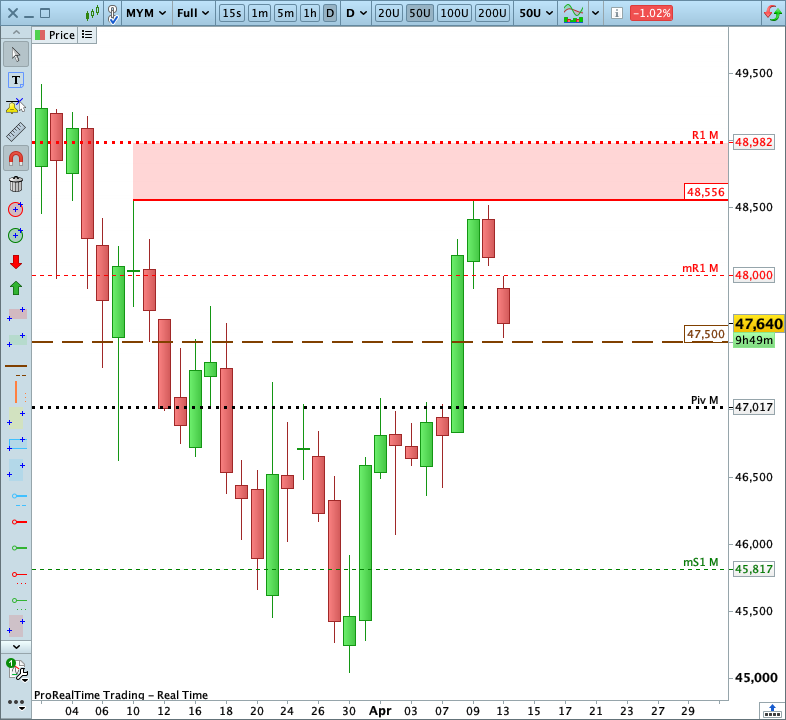
In my last trading plan, I mentioned how the high formed at the monthly pivot point seemed a bit too “obvious.” I’m sticking with that view this week, but now focusing on the 48,556-point resistance level that doesn’t seem to have trapped enough buyers.
From a behavioral perspective, the consensus appears relatively skeptical of the rally’s strength and pessimistic about its future, which invites me to take the contrarian view. In this context, I’ll favor long trades targeting the stop-losses of short sellers positioned above the 48,556-point resistance.
Happy trading!
NB: The trading plan will now be weekly so I can dedicate more time each day to developing the free NewTrading course.

Maxime holds two master’s degrees from the SKEMA Business School and FFBC. As founder and editor-in-chief of NewTrading.fr, he writes daily about financial trading.

The vise tightens

Dead cat bounce

Perfect timing